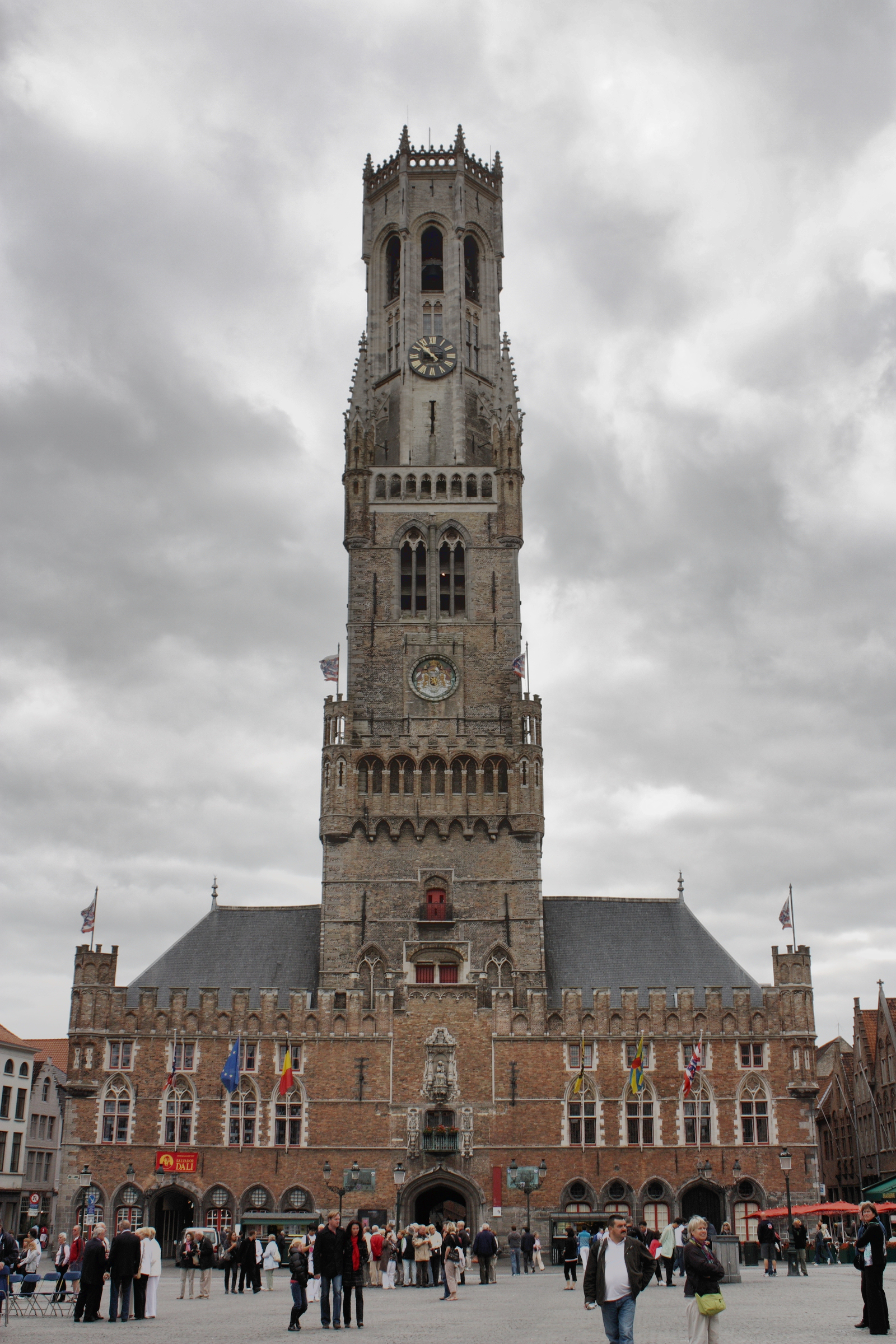
The Belfry of Bruges, or Belfort, is a medieval bell tower in the historical center of Bruges, Belgium. Standing 83 meters tall, the structure served as the city's primary watchtower and treasury, symbolizing the wealth and autonomy of the medieval Flemish merchant class. Its construction began in the 13th century and continued in phases, resulting in a unique architectural evolution from a simple wooden structure to the iconic stone tower seen today.
The tower houses a 47-bell carillon, which has signaled municipal regulations, time, and warnings to the city's inhabitants for over seven centuries. The upper octagonal section, added in the late 15th century, provides a panoramic view of the city and the surrounding region, while the lower levels historically protected the city's charters and municipal seals within a fortified treasury.
Key Facts
- Materials
- Brick, Sandstone
- Civilization
- Flemish
- Accessibility
- Not wheelchair accessible due to 366 narrow steps
- Date(s)
- 1240 - 1487
- Condition
- Well-preserved, open to the public
- Original Function
- Watchtower and municipal treasury
- Key Figures
- Philip the Bold
Origins and Early Construction
1240The original belfry was constructed in 1240, replacing an earlier wooden structure. It was designed to serve as a symbol of the city's growing economic power and to house the municipal archives.
Expansion and Fire
1280 - 1493A major fire in 1280 destroyed the wooden spire and the city archives. The tower was subsequently rebuilt, and the octagonal upper stage was added between 1483 and 1487, giving the belfry its distinctive silhouette.
Modern Preservation
20th century - presentThe belfry was designated a UNESCO World Heritage site in 1999 as part of the Belfries of Belgium and France. Ongoing maintenance ensures the structural integrity of the brickwork and the functionality of the historic carillon.
Cultural Significance
The Belfry of Bruges is a quintessential symbol of the medieval commune movement in the Low Countries. It represents the shift of power from feudal lords to the urban merchant class, serving as a physical manifestation of civic pride and administrative independence.
Today, it remains the most prominent landmark in Bruges, anchoring the city's identity as a preserved medieval urban center. Its carillon music remains a constant auditory feature of the city, maintaining a tradition that has persisted through centuries of political and social change.
Interpretive Notes
Scholarly debates and areas of uncertainty
There is ongoing academic discussion regarding the exact architectural influences of the octagonal upper stage, with some scholars arguing for strong French Gothic inspiration while others emphasize local Flemish structural adaptations.
Visiting Information
Entry Rules
Open daily. Tickets are required for entry and access to the tower climb. Due to the narrow staircase, visitors are advised to be in good physical condition.
Best Times to Visit
Early morning or late afternoon to avoid peak tourist crowds. The carillon concerts are best heard from the Grote Markt square.
Photography
Personal photography is permitted throughout the site. Commercial photography requires prior authorization from the city administration.
Preservation Notes
The structure is fragile; visitors must remain on designated paths. The 366-step climb is steep and narrow, and the site is not suitable for those with mobility issues.
Nearby POIs
10 shownSources & Further Reading
- [1]
- [2]Bruges: The History of a Medieval City — Andrew Brown. Cambridge University Press (2008)
Key Facts
- Materials
- Brick, Sandstone
- Civilization
- Flemish
- Accessibility
- Not wheelchair accessible due to 366 narrow steps
- Date(s)
- 1240 - 1487
- Condition
- Well-preserved, open to the public
- Original Function
- Watchtower and municipal treasury
- Key Figures
- Philip the Bold