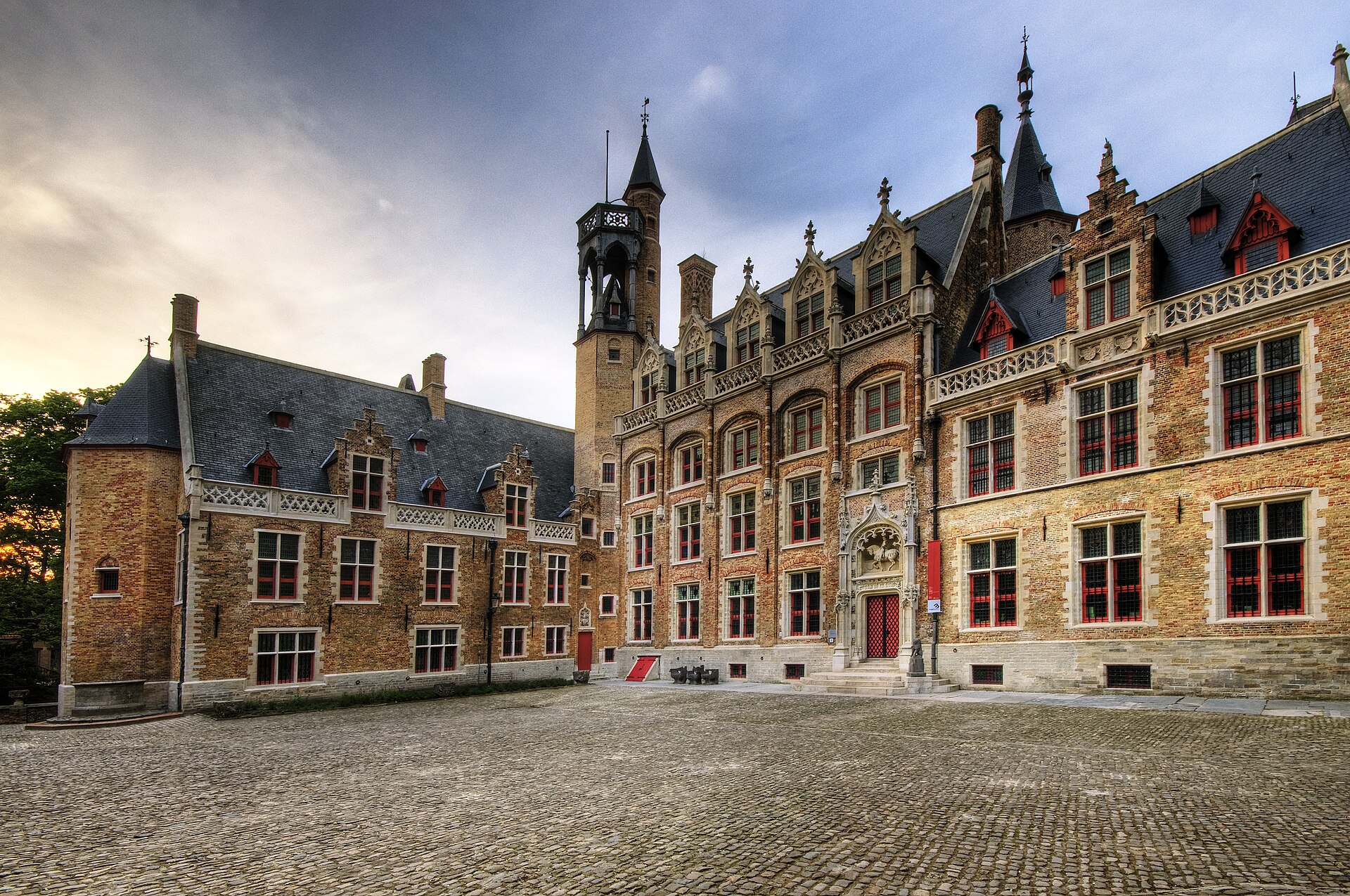
The Gruuthusemuseum is housed in the former urban palace of the Lords of Gruuthuse, a prominent noble family in medieval Bruges. The structure is a significant example of late medieval domestic architecture, characterized by its ornate brickwork and stepped gables. It served as the residence of Lodewijk van Gruuthuse, a wealthy merchant and diplomat who played a central role in the court of the Dukes of Burgundy.
Today, the museum displays a collection of over 600 artifacts spanning five centuries of Bruges' municipal history, including tapestries, sculptures, and decorative arts. A notable architectural feature is the 15th-century private oratory, which allows a direct visual connection to the choir of the adjacent Church of Our Lady, reflecting the close relationship between the noble household and the ecclesiastical institution.
Key Facts
- Materials
- Brick, Sandstone, Timber
- Civilization
- Burgundian Netherlands
- Accessibility
- Wheelchair accessible with elevator
- Date(s)
- 15th century
- Condition
- Restored and active museum
- Original Function
- Noble residence
- Key Figures
- Lodewijk van Gruuthuse, Charles the Bold
Origins and Rise
13th-14th centuryThe site originated as a warehouse for the 'gruut' tax, a monopoly on the sale of a mixture of herbs used in beer brewing, from which the family derived their name and wealth.
The Burgundian Golden Age
15th centuryUnder Lodewijk van Gruuthuse, the residence was expanded into a grand palace. It became a center of cultural patronage, hosting high-ranking guests including the future King Edward IV of England.
Decline and Transformation
16th-19th centuryFollowing the decline of Bruges as a commercial hub, the building changed hands multiple times, serving various purposes before being acquired by the city in the late 19th century for use as a museum.
Modern Restoration
2014-2019The museum underwent a major renovation to modernize its exhibition spaces and restore the historic facade, reopening in 2019 with a new narrative focus on the city's history.
Cultural Significance
The Gruuthusemuseum is a cornerstone of Bruges' cultural heritage, illustrating the intersection of mercantile wealth and aristocratic lifestyle during the Burgundian era. It serves as a vital repository for the city's history, bridging the gap between private noble life and the public history of the municipality.
The oratory remains a unique architectural testament to the religious devotion of the medieval elite, providing a rare surviving example of a private chapel integrated into a domestic space with a direct link to a parish church.
Interpretive Notes
Scholarly debates and areas of uncertainty
Debates exist regarding the extent of the 19th-century Neo-Gothic interventions, which significantly altered the building's appearance to fit the romanticized vision of medieval Bruges. Scholars continue to analyze how much of the current structure reflects original 15th-century design versus later historical reinterpretations.
Visiting Information
Entry Rules
Open daily except Mondays. Tickets can be purchased online or at the entrance. No specific dress code required.
Best Times to Visit
Weekday mornings to avoid weekend tourist crowds. The museum is particularly atmospheric during the winter months when the historic interiors are well-lit.
Photography
Personal photography is permitted without flash or tripods. Professional photography requires prior authorization from the museum administration.
Preservation Notes
Visitors are requested not to touch the artifacts or tapestries. The historic floors are uneven in some areas; please follow marked paths.
Nearby POIs
10 shownSources & Further Reading
- [1]Bruges: The History of a Medieval City — Andrew Brown and Jan Dumolyn. Cambridge University Press (2005)
- [2]The Gruuthuse Manuscript and its Context — Herman Brinkman. Leiden University Press (2015)
Key Facts
- Materials
- Brick, Sandstone, Timber
- Civilization
- Burgundian Netherlands
- Accessibility
- Wheelchair accessible with elevator
- Date(s)
- 15th century
- Condition
- Restored and active museum
- Original Function
- Noble residence
- Key Figures
- Lodewijk van Gruuthuse, Charles the Bold