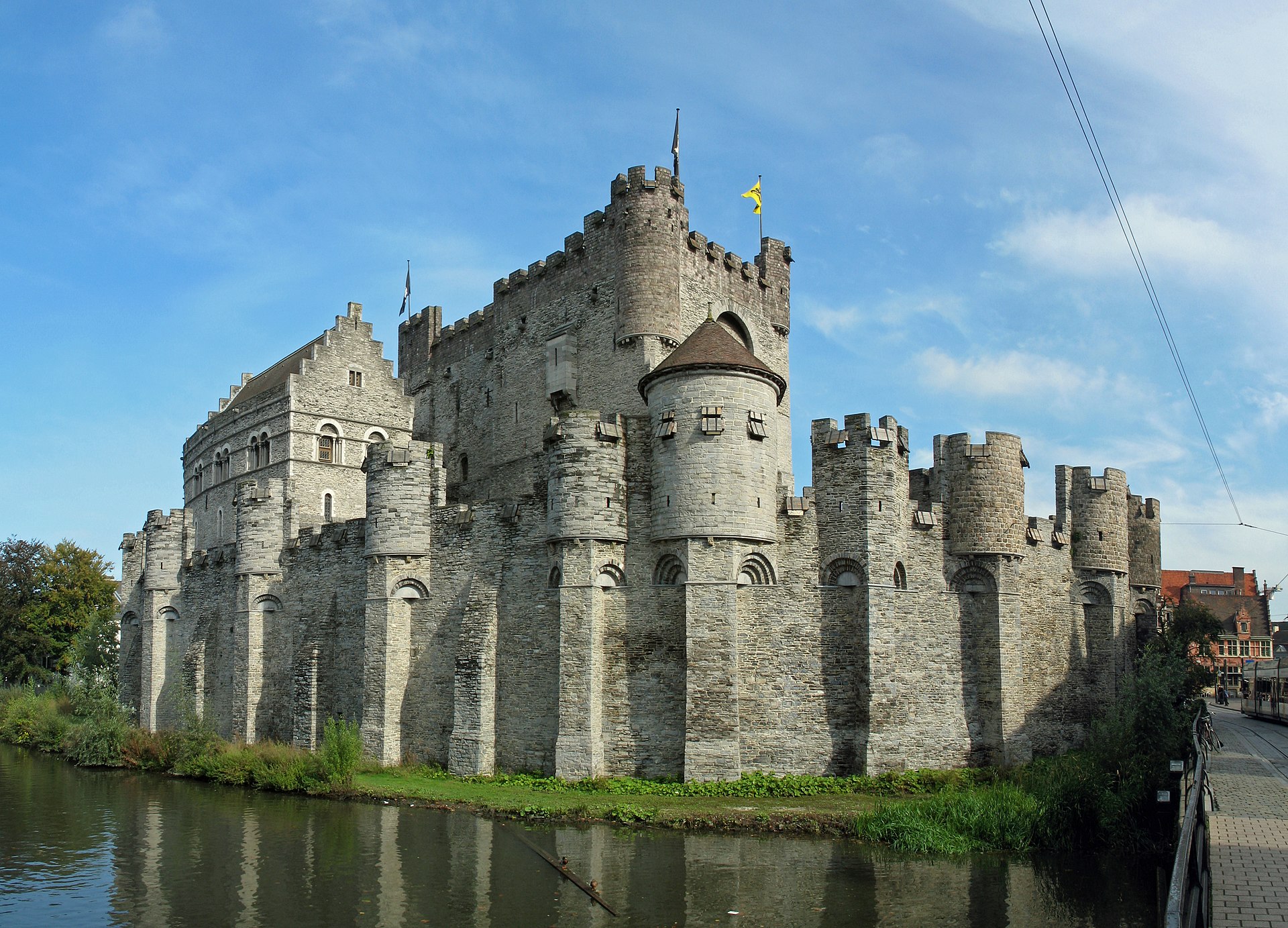
The Gravensteen, or 'Castle of the Counts,' is a medieval fortress located in the heart of Ghent, Belgium. Originally constructed in 1180 by Count Philip of Alsace, the castle served as the primary residence for the Counts of Flanders until the mid-14th century. Its strategic location at the confluence of the Leie and Scheldt rivers allowed the Counts to exert control over the city's burgeoning trade and political life.
Following its abandonment as a ducal residence in 1353, the castle underwent numerous transformations, serving as a courthouse, a prison, and eventually an industrial site housing a cotton mill. In the late 19th century, the structure was saved from demolition and underwent an extensive restoration to reflect its medieval appearance. Today, it functions as a museum, showcasing a collection of historical weaponry and judicial artifacts.
Key Facts
- Materials
- Tournai stone, Brick
- Civilization
- Flemish
- Accessibility
- Partially accessible; steep stairs and uneven floors in the keep
- Date(s)
- 1180
- Condition
- Restored museum
- Original Function
- Residence of the Counts of Flanders
- Key Figures
- Philip of Alsace, Louis II of Flanders
Foundations and Early History
1180Count Philip of Alsace commissioned the current stone castle to replace an earlier wooden structure. It was designed to project power and intimidate the citizens of Ghent, who were increasingly assertive in their political demands.
Administrative and Judicial Use
14th - 18th centuryAfter the Counts moved to the Prinsenhof, the Gravensteen became the seat of the Council of Flanders. It functioned as a courthouse and prison, gaining a reputation for the harsh treatment of political dissidents and criminals.
Industrial Transformation
19th centuryDuring the Industrial Revolution, the castle was sold to private owners and converted into a cotton mill. The site was heavily modified, with houses built against the curtain walls and the interior repurposed for manufacturing.
Restoration and Modern Era
1893 - presentThe city of Ghent purchased the castle in 1885 to prevent its destruction. A major restoration project led by architect Joseph de Waele returned the castle to a romanticized version of its medieval state, and it has since served as a public museum.
Cultural Significance
The Gravensteen is a symbol of the complex relationship between the medieval nobility and the urban merchant class of Ghent. Its history reflects the city's transition from a feudal stronghold to a center of industrial production.
In contemporary culture, the castle is a focal point for tourism in Flanders and is frequently used as a backdrop for historical events and festivals, reinforcing its status as the most recognizable landmark in Ghent.
Interpretive Notes
Scholarly debates and areas of uncertainty
The 19th-century restoration of the Gravensteen remains a subject of debate among architectural historians. Critics argue that the restoration was based on romanticized ideals rather than strict archaeological evidence, effectively creating a 'fictional' medieval structure that obscures the castle's actual historical evolution.
Visiting Information
Entry Rules
Open daily. Tickets can be purchased online or at the entrance. Audio guides are included with admission. No specific dress code, but comfortable footwear is recommended due to uneven stone floors.
Best Times to Visit
Weekday mornings to avoid weekend crowds. The castle is particularly atmospheric during the winter months when the city is less busy.
Photography
Personal photography is permitted throughout the site. Commercial photography requires prior authorization from the museum administration.
Preservation Notes
The structure is fragile; visitors are advised to stay within marked areas and avoid leaning on original masonry. Restoration work is ongoing to maintain the integrity of the curtain walls.
Nearby POIs
10 shownSources & Further Reading
- [1]The Gravensteen: A History of the Castle of the Counts — Ghent City Archives. Stad Gent Publications (2015)View
- [2]Medieval Castles of the Low Countries — Jean-Pierre Sosson. University of Leuven Press (2008)
Key Facts
- Materials
- Tournai stone, Brick
- Civilization
- Flemish
- Accessibility
- Partially accessible; steep stairs and uneven floors in the keep
- Date(s)
- 1180
- Condition
- Restored museum
- Original Function
- Residence of the Counts of Flanders
- Key Figures
- Philip of Alsace, Louis II of Flanders