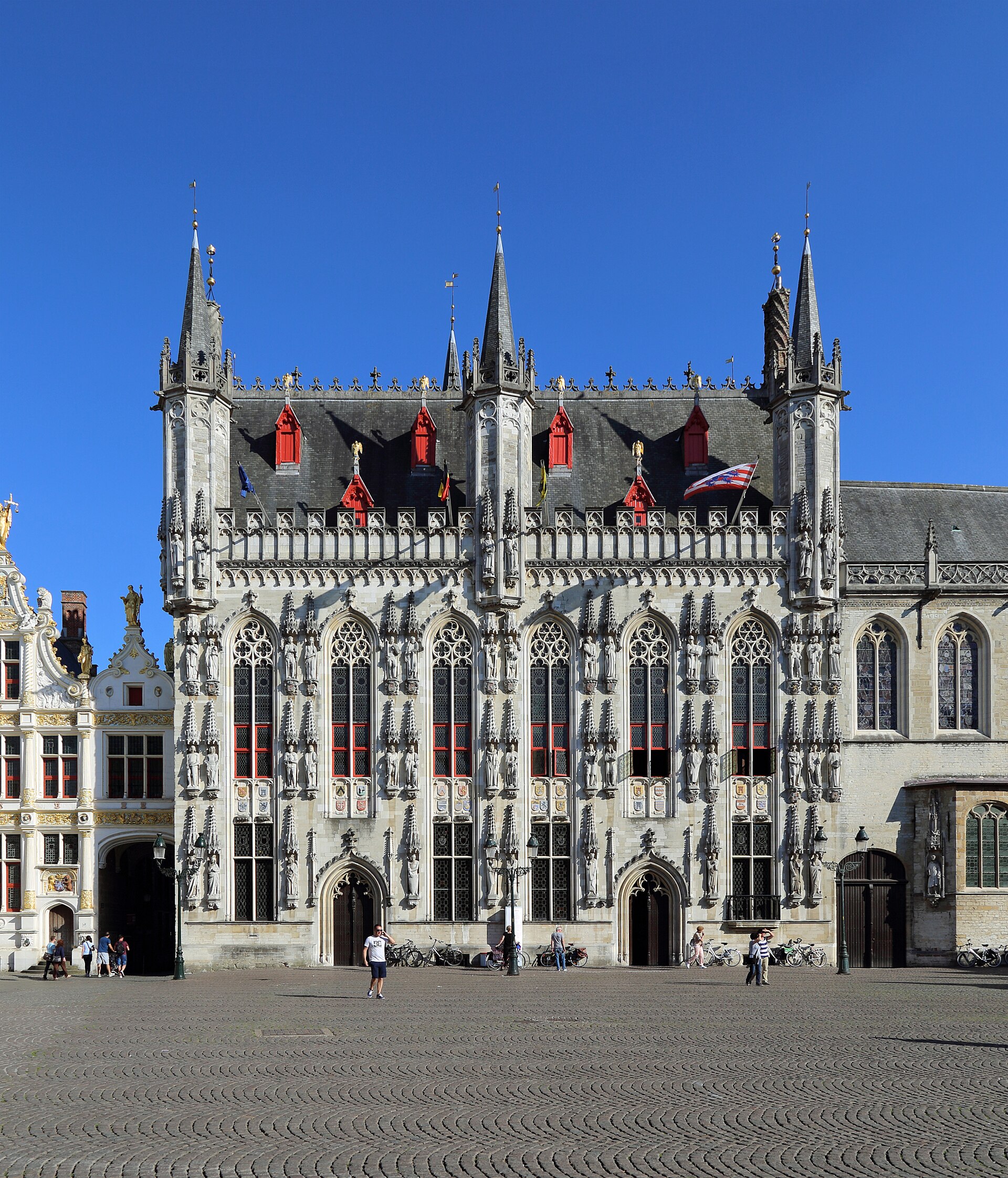
Bruges City Hall, or Stadhuis, is one of the oldest municipal buildings in the Low Countries, located on the Burg square in the heart of Bruges. Construction began in 1376 under the direction of architect Jan Roegiers and was completed in 1421. The building serves as a prime example of Late Gothic civic architecture, characterized by its ornate stone facade featuring statues of biblical figures and counts of Flanders.
Internally, the building is renowned for its Gothic Hall, which features a striking 19th-century polychrome vaulted wooden ceiling. The walls are adorned with extensive murals painted by Albrecht De Vriendt in the late 1800s, which illustrate key events in the history of Bruges and the evolution of its municipal administration.
Key Facts
- Materials
- Sandstone, Oak, Polychrome paint
- Civilization
- Flemish
- Accessibility
- Partially accessible; historic building with stairs
- Date(s)
- 1376-1421
- Condition
- Well-preserved, active municipal building
- Original Function
- Administrative center of Bruges
- Key Figures
- Jan Roegiers, Albrecht De Vriendt
Construction and Early Significance
1376-1421The city council of Bruges commissioned the building to replace the older count's hall. Its construction marked the growing political and economic power of the city during the late Middle Ages.
Gothic Revival and Interior Decoration
19th CenturyDuring the 19th century, the interior underwent significant restoration. The current vaulted wooden ceiling and the narrative murals were added during this period to reflect the Romantic interest in the city's medieval heritage.
Modern Preservation
20th Century - PresentAs part of the historic center of Bruges, the building is protected under UNESCO World Heritage status. It continues to function as a site for municipal ceremonies and as a public museum.
Cultural Significance
The City Hall is a symbol of the autonomy and wealth of medieval Bruges. Its architecture served as a model for other town halls in the region, including those in Brussels and Ghent, establishing a standard for civic pride in the Low Countries.
The building remains a focal point for local governance and tourism, representing the continuity of municipal administration in Bruges for over six centuries.
Interpretive Notes
Scholarly debates and areas of uncertainty
Debates exist regarding the extent of the 19th-century 'restoration' of the interior, with some architectural historians questioning whether the current decorative scheme accurately reflects the original medieval aesthetic or if it represents a stylized, idealized version of the past.
Visiting Information
Entry Rules
Open to the public daily. Tickets can be purchased at the entrance or online. Modest attire is recommended as it remains a functional government building.
Best Times to Visit
Weekday mornings to avoid weekend tourist crowds. The interior lighting is best during daylight hours to appreciate the detail of the wooden ceiling.
Photography
Personal photography is permitted without flash. Tripods are prohibited.
Preservation Notes
Do not touch the murals or the historic woodwork. Follow marked visitor paths to protect the original flooring.
Nearby POIs
10 shownSources & Further Reading
- [1]Bruges: The History of a Medieval City — Andrew Brown and Jan Dumolyn. Cambridge University Press (2015)View
- [2]The Gothic Hall of the Bruges Stadhuis — Ludo Vandamme. Bruges Municipal Archives (2010)
Key Facts
- Materials
- Sandstone, Oak, Polychrome paint
- Civilization
- Flemish
- Accessibility
- Partially accessible; historic building with stairs
- Date(s)
- 1376-1421
- Condition
- Well-preserved, active municipal building
- Original Function
- Administrative center of Bruges
- Key Figures
- Jan Roegiers, Albrecht De Vriendt