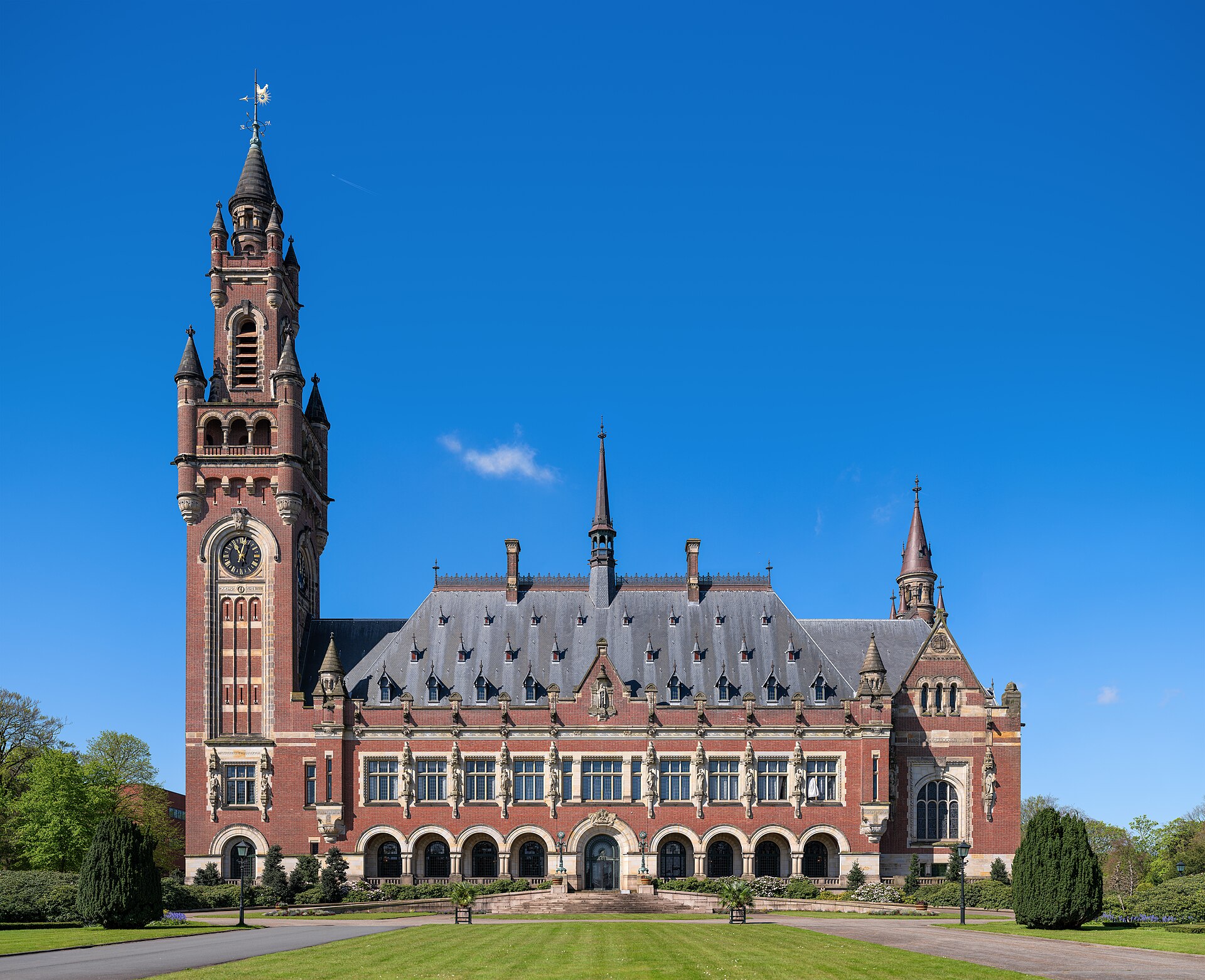
The Peace Palace (Vredespaleis) in The Hague serves as the seat of the International Court of Justice, the Permanent Court of Arbitration, and the Peace Palace Library. Completed in 1913, the building was commissioned to house the Permanent Court of Arbitration, an institution created by the Hague Peace Conferences of 1899 and 1907 to settle international disputes through mediation and arbitration.
Designed by French architect Louis M. Cordonnier in a Neo-Renaissance style, the structure was funded largely by American philanthropist Andrew Carnegie. The interior is noted for its extensive collection of diplomatic gifts donated by various nations, which were intended to symbolize global cooperation and the shared aspiration for international peace through law.
Key Facts
- Materials
- Brick, Granite, Sandstone, Marble
- Civilization
- Modern Netherlands
- Accessibility
- Limited; guided tours available by appointment
- Date(s)
- 1907-1913
- Condition
- Active, well-preserved
- Original Function
- Seat of the Permanent Court of Arbitration
- Key Figures
- Andrew Carnegie, Louis M. Cordonnier, Tsar Nicholas II
Origins and Funding
1899-1907Following the first Hague Peace Conference in 1899, the need for a permanent home for international arbitration became clear. Andrew Carnegie donated 1.5 million dollars in 1903 to fund the construction of a dedicated building and a library for international law.
Design and Construction
1907-1913Architect Louis M. Cordonnier won the international design competition. Construction began in 1907, utilizing a blend of Neo-Renaissance and Neo-Gothic elements. The building was officially inaugurated on August 28, 1913.
International Judicial Hub
1922-PresentThe palace became the home of the Permanent Court of International Justice in 1922, which was succeeded by the International Court of Justice (the principal judicial organ of the United Nations) in 1946.
Cultural Significance
The Peace Palace is a global symbol of international law and the peaceful resolution of conflicts. It represents the early 20th-century ideal of 'Peace through Law,' a movement that sought to replace military confrontation with diplomatic and judicial processes. The building itself acts as a collaborative monument, with materials and decorative elements contributed by nations worldwide, reflecting a collective commitment to international stability.
Interpretive Notes
Scholarly debates and areas of uncertainty
Debates often center on the efficacy of the institutions housed within the palace versus the symbolic nature of the building itself. Scholars of international relations frequently discuss whether the 'Hague System' of arbitration has successfully evolved to meet the challenges of modern geopolitical conflicts.
Visiting Information
Entry Rules
The building is not open for general walk-in visits. Access is restricted to guided tours, which must be booked in advance via the official website. Security screening is mandatory for all visitors.
Best Times to Visit
Guided tours are available on specific weekends and during the summer months. Check the official visitor calendar for availability.
Photography
Photography is permitted in public areas during guided tours, but is strictly prohibited inside the courtrooms and restricted areas.
Preservation Notes
The building is a protected national monument. Visitors must follow all instructions from security staff and remain with their designated tour group at all times.
Nearby POIs
11 shownSources & Further Reading
- [1]
- [2]The Hague Peace Conferences of 1899 and 1907 — James Brown Scott. Johns Hopkins Press (1909)
Key Facts
- Materials
- Brick, Granite, Sandstone, Marble
- Civilization
- Modern Netherlands
- Accessibility
- Limited; guided tours available by appointment
- Date(s)
- 1907-1913
- Condition
- Active, well-preserved
- Original Function
- Seat of the Permanent Court of Arbitration
- Key Figures
- Andrew Carnegie, Louis M. Cordonnier, Tsar Nicholas II