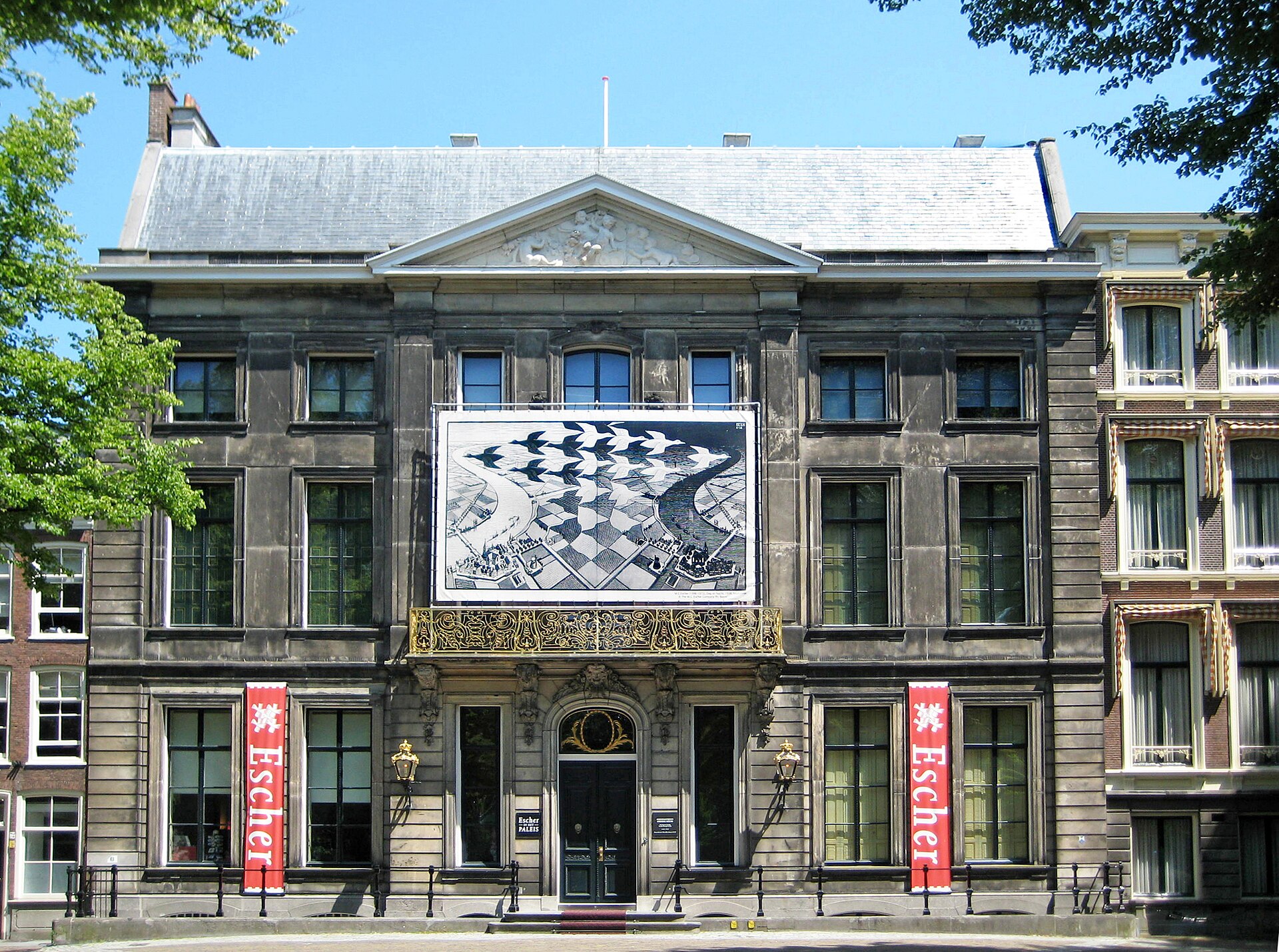
Escher in Het Paleis is a permanent exhibition dedicated to the works of the Dutch graphic artist M.C. Escher. Located in the Lange Voorhout Palace, the museum occupies a building that served as the winter residence of Queen Emma of the Netherlands from 1901 until 1934. The exhibition space preserves the royal atmosphere of the palace while showcasing a comprehensive collection of Escher's woodcuts, lithographs, and drawings, including his famous explorations of infinity, impossible geometry, and optical illusions.
The museum highlights the intersection of art and mathematics, featuring iconic works such as 'Day and Night' and the 'Metamorphosis' series. The palace interior itself remains a significant attraction, featuring original chandeliers designed by Rotterdam artist Hans van Bentem, which integrate elements of Escher's visual language into the historic architecture.
Key Facts
- Materials
- Brick, Stucco, Wood, Glass
- Civilization
- Dutch
- Accessibility
- Wheelchair accessible with elevator access to all floors
- Date(s)
- 1764
- Condition
- Restored and active museum
- Original Function
- Private residence (Palace)
- Key Figures
- M.C. Escher, Queen Emma of the Netherlands
Palace Origins
1764The building was originally constructed as a private residence for Pieter van Reede van Oudtshoorn. It underwent several ownership changes before being acquired by the Dutch Royal Family in the late 19th century.
Royal Residence
1901-1934The palace served as the winter residence for Queen Emma, the widow of King William III. During this period, the building functioned as a center for royal life in The Hague, retaining much of its 18th-century architectural character.
Transformation into Museum
2002Following extensive renovations, the building was repurposed to house the M.C. Escher collection. The museum was designed to balance the preservation of the royal interior with the display of modern graphic art.
Cultural Significance
The museum serves as a primary cultural institution in The Hague, bridging the gap between historical royal heritage and 20th-century modern art. It is central to the public understanding of M.C. Escher, whose work has had a profound influence on both the art world and the fields of mathematics and crystallography.
Interpretive Notes
Scholarly debates and areas of uncertainty
Discussions often center on the juxtaposition of Escher's avant-garde, mathematically rigorous work within a traditional, ornate royal palace setting. Some critics argue the setting distracts from the art, while others maintain that the palace provides a unique context that highlights the contrast between classical architecture and Escher's surrealist perspectives.
Visiting Information
Entry Rules
Open Tuesday through Sunday. Tickets can be purchased online or at the museum entrance. No specific dress code is required.
Best Times to Visit
Weekday mornings are generally quieter. The museum is popular with school groups, so visiting outside of peak holiday seasons can provide a more contemplative experience.
Photography
Personal photography is permitted for non-commercial use. Flash and tripods are prohibited to protect the artworks.
Preservation Notes
The palace is a protected historic monument. Visitors are requested to refrain from touching the walls or the displays. Large bags must be stored in provided lockers.
Nearby POIs
11 shownSources & Further Reading
- [1]M.C. Escher: His Life and Complete Graphic Work — J.L. Locher. Harry N. Abrams (1982)
- [2]The Magic of M.C. Escher — Bruno Ernst. Taschen (2007)
Key Facts
- Materials
- Brick, Stucco, Wood, Glass
- Civilization
- Dutch
- Accessibility
- Wheelchair accessible with elevator access to all floors
- Date(s)
- 1764
- Condition
- Restored and active museum
- Original Function
- Private residence (Palace)
- Key Figures
- M.C. Escher, Queen Emma of the Netherlands