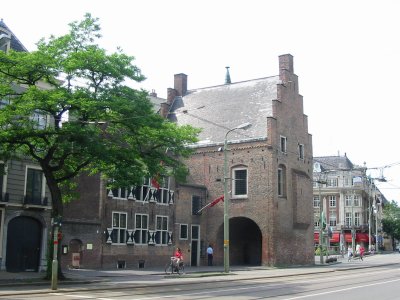
The Gevangenpoort, or 'Prisoner's Gate,' is a medieval gatehouse located in The Hague that served as the primary prison for the County of Holland from the 15th century until 1828. Originally constructed as a defensive gate in the 13th century, it was later repurposed into a detention facility where high-profile political prisoners were held and interrogated.
Today, the site operates as a museum dedicated to the history of crime and punishment in the Netherlands. The interior retains much of its original layout, including dark cells, interrogation rooms, and the 'Ridderzaal' area, housing a collection of historical judicial artifacts and instruments of torture that illustrate the evolution of the Dutch legal system.
Key Facts
- Materials
- Brick, Stone
- Civilization
- Dutch
- Accessibility
- Limited due to historic narrow staircases
- Date(s)
- 13th century
- Condition
- Well-preserved museum
- Original Function
- Defensive gatehouse
- Key Figures
- Johan de Witt, Cornelis de Witt
Origins as a Gatehouse
13th centuryThe structure began as a fortified gatehouse providing access to the Binnenhof, the political center of the Counts of Holland. Its strategic location made it a vital defensive point for the city's administrative core.
Conversion to Prison
15th centuryBy the 1400s, the gatehouse was converted into a prison. It became the central detention facility for the Court of Holland, housing individuals accused of serious crimes, including political dissenters and those awaiting trial or execution.
The De Witt Incident
1672The prison is famously associated with the lynching of Johan and Cornelis de Witt. The brothers were held in the Gevangenpoort before being dragged out by an angry mob and murdered, a pivotal event in the 'Year of Disaster' (Rampjaar).
Museum Transformation
1882 - presentAfter ceasing operations as a prison in 1828, the building was slated for demolition but was saved due to its historical significance. It opened as a museum in 1882 and has since undergone several restorations to preserve its medieval character.
Cultural Significance
The Gevangenpoort serves as a somber reminder of the harsh judicial practices of the Dutch Republic. It is deeply embedded in the national consciousness due to its association with the De Witt brothers, symbolizing the volatility of Dutch politics in the 17th century. The site provides critical insight into the transition from medieval retributive justice to modern legal frameworks.
Interpretive Notes
Scholarly debates and areas of uncertainty
There is ongoing academic discussion regarding the authenticity of certain torture instruments displayed in the museum, with some historians arguing that several items were acquired or reconstructed in the 19th century to satisfy the public's fascination with the 'macabre' rather than representing actual tools used within this specific prison.
Visiting Information
Entry Rules
Access is by guided tour only. Tickets must be booked in advance via the official website. The museum is closed on Mondays.
Best Times to Visit
Weekday mornings are generally quieter. The site is best visited in conjunction with a tour of the adjacent Binnenhof to understand the political context of the prison.
Photography
Non-commercial photography is permitted without flash. Tripods are prohibited due to narrow corridors.
Preservation Notes
The building is a protected national monument. Visitors must follow marked paths and avoid touching the historic walls and artifacts to prevent further degradation of the masonry.
Nearby POIs
11 shownSources & Further Reading
- [1]The Gevangenpoort: A History of the Prison — J.G.C. Venner. Museum Gevangenpoort Publications (2015)View
- [2]Crime and Punishment in the Dutch Republic — S. Faber. Amsterdam University Press (2008)
Key Facts
- Materials
- Brick, Stone
- Civilization
- Dutch
- Accessibility
- Limited due to historic narrow staircases
- Date(s)
- 13th century
- Condition
- Well-preserved museum
- Original Function
- Defensive gatehouse
- Key Figures
- Johan de Witt, Cornelis de Witt