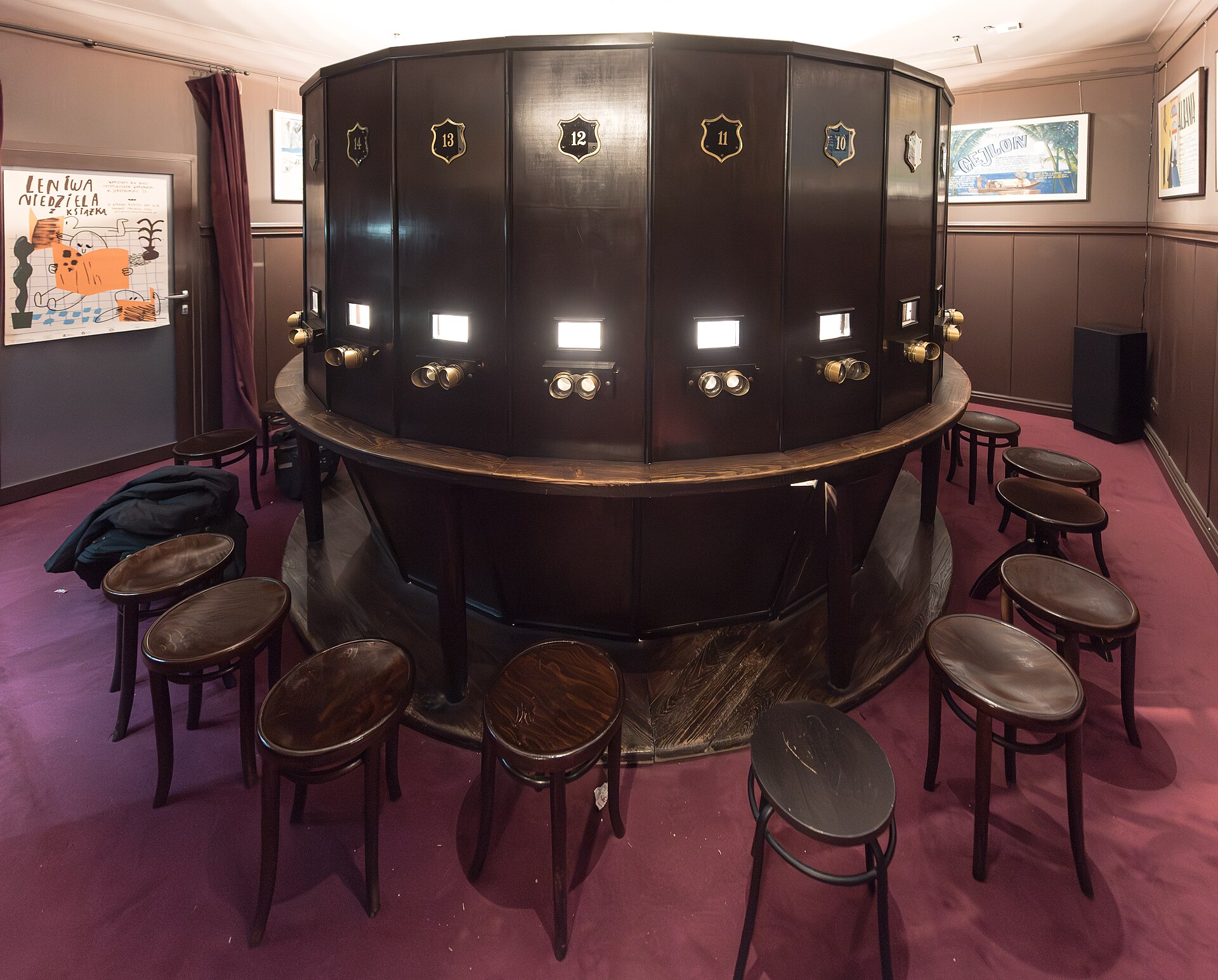
The Fotoplastikon Warszawski is a unique stereoscopic theater located in a historic tenement house in Warsaw. Established in 1905, it is one of the few remaining devices of its kind in the world that remains in its original location and continues to function using its authentic rotating mechanism. The device features twenty-four viewing stations that allow visitors to experience three-dimensional images through stereoscopic slides.
The collection housed at the Fotoplastikon serves as a significant visual archive, documenting urban life in Warsaw, global expeditions, and historical events from the early 20th century. It survived the destruction of World War II, largely due to its location in a building that escaped the widespread demolition of the city center, and remains a rare example of pre-cinema entertainment technology.
Key Facts
- Materials
- Wood, Metal, Glass
- Civilization
- Polish
- Accessibility
- Ground floor access
- Date(s)
- 1905
- Condition
- Operational and preserved
- Original Function
- Stereoscopic entertainment theater
- Key Figures
- August Fuhrmann
Establishment
1905The Fotoplastikon was opened by the German entrepreneur August Fuhrmann, who established a network of these theaters across Europe. The Warsaw location was situated in the courtyard of a tenement house at Aleje Jerozolimskie 51.
Survival Through Conflict
1939-1945During the occupation of Warsaw and the subsequent Uprising, the building housing the Fotoplastikon miraculously survived the systematic destruction of the city. It served as a clandestine meeting point for members of the Polish resistance.
Modern Preservation
2008-PresentIn 2008, the facility was acquired by the Warsaw Rising Museum. It underwent a comprehensive restoration to ensure the mechanical components remained functional while preserving the original aesthetic of the viewing room.
Cultural Significance
The Fotoplastikon is a vital piece of Warsaw's cultural heritage, representing the transition from 19th-century optical curiosities to modern cinema. It is deeply embedded in the collective memory of Warsaw residents as a survivor of the city's wartime trauma and a testament to the endurance of pre-war urban culture.
Interpretive Notes
Scholarly debates and areas of uncertainty
There is ongoing discussion regarding the digitization of the stereoscopic slides versus the preservation of the physical glass plates, balancing the need for archival access with the risk of damaging the fragile original media.
Visiting Information
Entry Rules
Open Tuesday through Sunday. Tickets can be purchased on-site or via the official website. Group visits should be arranged in advance.
Best Times to Visit
Weekday afternoons are generally quieter, allowing for a more focused experience with the stereoscopic collections.
Photography
Personal photography is permitted, but the use of flash is strictly prohibited to protect the historical slides.
Preservation Notes
The device is a delicate mechanical antique. Visitors are requested to handle the viewing stations gently and follow all instructions provided by the museum staff.
Nearby POIs
11 shown- Palace of Culture and Science0.4 km
- Neon Museum0.4 km
- National Museum in Warsaw1.2 km
- Church of the Holy Cross1.3 km
- Fryderyk Chopin Museum1.3 km
- Tomb of the Unknown Soldier1.4 km
- Warsaw Rising Museum1.9 km
- St. Anne's Church2 km
- Copernicus Science Centre2 km
- Sigismund's Column2.1 km
- Royal Castle in Warsaw2.2 km
Sources & Further Reading
- [1]Fotoplastikon Warszawski: A History of Stereoscopy in Poland — Marek Stępień. Warsaw Historical Review (2012)
- [2]The Fuhrmann Stereoscopic Theaters of Europe — Hans-Dieter Müller. Journal of Optical History (2015)
Key Facts
- Materials
- Wood, Metal, Glass
- Civilization
- Polish
- Accessibility
- Ground floor access
- Date(s)
- 1905
- Condition
- Operational and preserved
- Original Function
- Stereoscopic entertainment theater
- Key Figures
- August Fuhrmann
Nearby POIs
11 shown- Palace of Culture and Science0.4 km
- Neon Museum0.4 km
- National Museum in Warsaw1.2 km
- Church of the Holy Cross1.3 km
- Fryderyk Chopin Museum1.3 km
- Tomb of the Unknown Soldier1.4 km
- Warsaw Rising Museum1.9 km
- St. Anne's Church2 km
- Copernicus Science Centre2 km
- Sigismund's Column2.1 km
- Royal Castle in Warsaw2.2 km