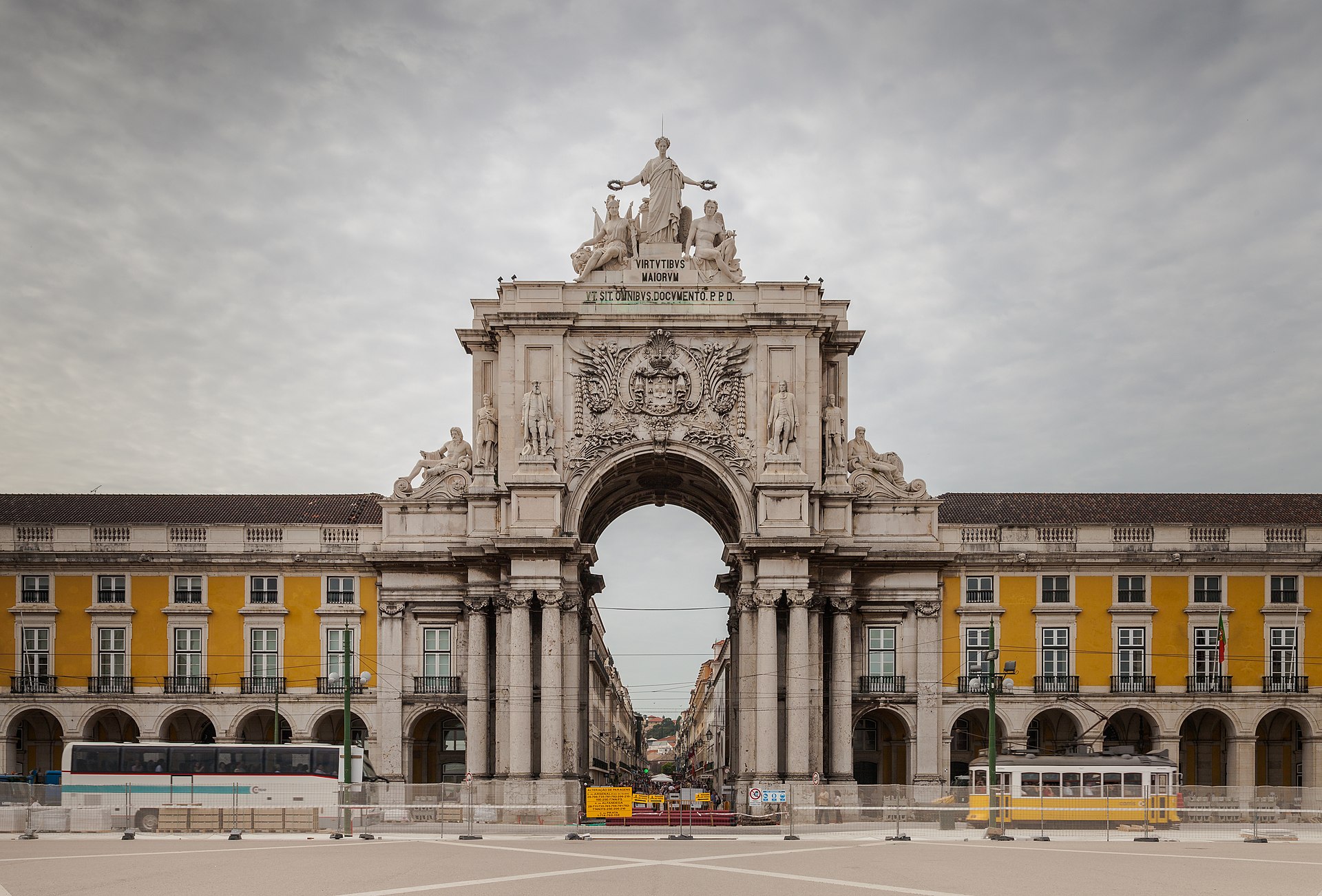
The Arco da Rua Augusta is a monumental triumphal arch located at the northern end of the Praça do Comércio in Lisbon. Commissioned following the devastating 1755 earthquake, the structure serves as a symbol of the city's resilience and its subsequent reconstruction under the direction of the Marquis of Pombal. The arch connects the grand riverside square to the bustling Rua Augusta, acting as a ceremonial gateway to the Baixa district.
The structure features an intricate sculptural program designed by Célestin Anatole Calmels and Victor Bastos. The top of the arch is crowned by an allegorical group representing Glory rewarding Valor and Genius, while the lower columns feature statues of historical figures such as Vasco da Gama, the Marquis of Pombal, and Nuno Álvares Pereira. The arch remains a defining landmark of Lisbon's urban planning and Enlightenment-era architecture.
Key Facts
- Materials
- Limestone, Marble
- Civilization
- Portuguese
- Accessibility
- Elevator access available to the upper terrace
- Date(s)
- 1755 - 1875
- Condition
- Well-preserved, open to the public with an observation deck
- Original Function
- Commemorative monument and ceremonial gateway
- Key Figures
- Marquis of Pombal, Célestin Anatole Calmels, Victor Bastos
Post-Earthquake Planning
1755Following the 1755 earthquake and tsunami, the Marquis of Pombal initiated a massive urban renewal project. The arch was conceived as the centerpiece of the new Praça do Comércio, intended to demonstrate the strength and modernity of the Portuguese state.
Initial Construction
1775The first version of the arch was begun in 1775, but construction stalled due to political shifts and the death of King Joseph I. The project remained incomplete for nearly a century, leaving only the base structure standing.
Completion
1873 - 1875Construction resumed in 1873 under the supervision of architect Veríssimo José da Costa. The arch was finally completed in 1875, incorporating the original design elements alongside new sculptural additions that celebrated Portuguese history.
Cultural Significance
The arch represents the 'Pombaline' era of Lisbon, characterized by rationalist urban planning and the transition from absolute monarchy to a more centralized administrative state. It serves as a physical manifestation of the city's recovery from the 1755 disaster, framing the transition from the Tagus River into the heart of the city's commercial center.
Today, it is a primary tourist destination that offers panoramic views of the Baixa and the river. It remains a point of national pride, symbolizing the endurance of the Portuguese people and the architectural legacy of the Enlightenment in Southern Europe.
Interpretive Notes
Scholarly debates and areas of uncertainty
There is ongoing discussion regarding the symbolic intent of the various statues on the arch. Some historians argue that the inclusion of specific figures like the Marquis of Pombal was a deliberate attempt by 19th-century liberals to rewrite the narrative of the 18th-century reconstruction to align with contemporary political ideologies.
Visiting Information
Entry Rules
The arch is open daily. Access to the observation deck requires a ticket, which can be purchased at the entrance. No specific dress code is enforced.
Best Times to Visit
Late afternoon provides the best lighting for photography of the Praça do Comércio from the top of the arch. Weekday mornings are generally less crowded.
Photography
Personal photography is permitted. Commercial photography requires prior authorization from the Lisbon City Council.
Preservation Notes
The structure is subject to regular maintenance due to its exposure to coastal winds and urban pollution. Visitors are requested to respect the integrity of the stone carvings and follow signage on the observation deck.
Nearby POIs
11 shown- Se de Lisboa0.4 km
- Sao Jorge Castle0.7 km
- Igreja de Sao Roque0.8 km
- Mosteiro de Sao Vicente de Fora1.1 km
- Church of Santa Engracia1.3 km
- Estrela Basilica2.1 km
- Museu Nacional de Arte Antiga2.2 km
- Museu Nacional do Azulejo2.7 km
- Calouste Gulbenkian Museum3.6 km
- Santuario de Cristo Rei4.5 km
- Palace of Ajuda5.3 km
Sources & Further Reading
- [1]The Pombaline Reconstruction of Lisbon — Kenneth Maxwell. Cambridge University Press (1995)
- [2]Lisbon: A History of the City — Jorge Gaspar. Lisbon Municipal Archives (2010)
Key Facts
- Materials
- Limestone, Marble
- Civilization
- Portuguese
- Accessibility
- Elevator access available to the upper terrace
- Date(s)
- 1755 - 1875
- Condition
- Well-preserved, open to the public with an observation deck
- Original Function
- Commemorative monument and ceremonial gateway
- Key Figures
- Marquis of Pombal, Célestin Anatole Calmels, Victor Bastos
Nearby POIs
11 shown- Se de Lisboa0.4 km
- Sao Jorge Castle0.7 km
- Igreja de Sao Roque0.8 km
- Mosteiro de Sao Vicente de Fora1.1 km
- Church of Santa Engracia1.3 km
- Estrela Basilica2.1 km
- Museu Nacional de Arte Antiga2.2 km
- Museu Nacional do Azulejo2.7 km
- Calouste Gulbenkian Museum3.6 km
- Santuario de Cristo Rei4.5 km
- Palace of Ajuda5.3 km