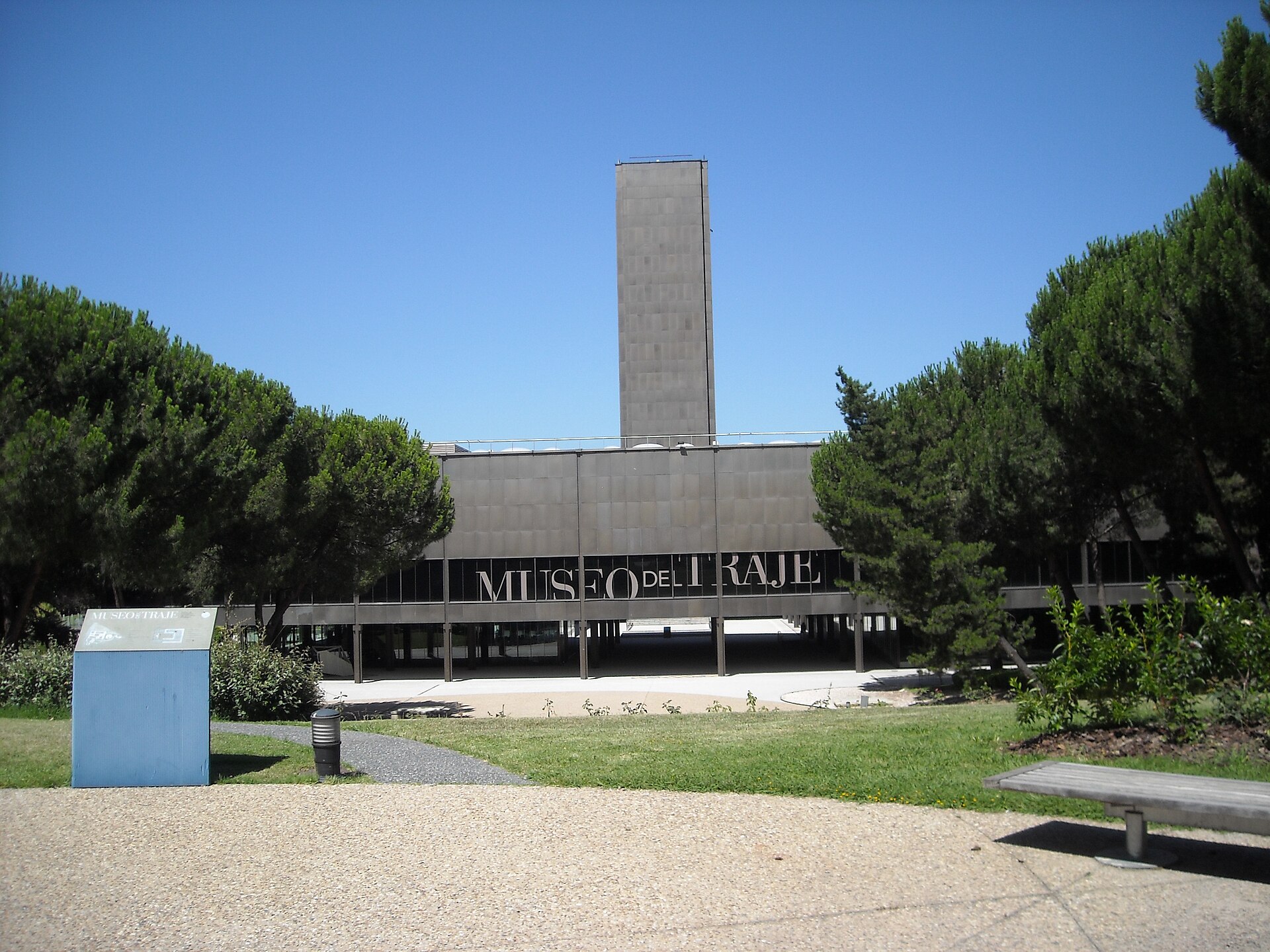
The Museo del Traje (Costume Museum) in Madrid is a national museum dedicated to the preservation and study of the historical evolution of clothing and fashion in Spain. Established in its current form in 2004, the institution serves as both a public exhibition space and a research center for ethnology and textile heritage.
The museum's collection comprises over 160,000 pieces and documents, ranging from medieval garments to contemporary haute couture. It provides a comprehensive overview of Spanish social history through the lens of dress, highlighting the intersection of craftsmanship, industrial development, and cultural identity.
Key Facts
- Materials
- Reinforced concrete, Glass, Steel
- Civilization
- Spanish
- Accessibility
- Fully wheelchair accessible
- Date(s)
- 1971-1973
- Condition
- Active, fully operational
- Original Function
- Museum of Spanish Contemporary Art
- Key Figures
- Jaime López de Asiain, Ángel Díaz Domínguez
Origins of the Collection
1925The museum's roots trace back to the 1925 Ibero-American Exhibition in Seville, where a significant collection of regional costumes was assembled. This collection later formed the basis of the Museo del Pueblo Español.
Architectural Development
1971-1973The current building was designed by architects Jaime López de Asiain and Ángel Díaz Domínguez. Originally constructed to house the Museum of Spanish Contemporary Art, the structure is a notable example of Spanish Brutalist architecture.
Establishment of the Costume Museum
2004The Museo del Traje was officially inaugurated in 2004, consolidating various collections related to fashion and ethnography into a single specialized institution under the Spanish Ministry of Culture.
Cultural Significance
The museum is the primary repository for Spanish textile heritage, playing a critical role in documenting the social and economic history of the country. It serves as a vital resource for fashion historians, designers, and researchers, while also fostering public appreciation for the technical skill and artistic expression inherent in historical dress.
Interpretive Notes
Scholarly debates and areas of uncertainty
Discussions within the institution often focus on the balance between preserving fragile organic materials and the demands of public display. Additionally, there is ongoing academic debate regarding the classification of fashion as a fine art versus an ethnographic artifact, which influences how the collection is curated and interpreted.
Visiting Information
Entry Rules
Open Tuesday through Sunday. Tickets can be purchased online or at the box office. Free entry is available during specific hours on weekends and certain public holidays.
Best Times to Visit
Weekday mornings are generally quieter, allowing for a more focused viewing of the permanent collection.
Photography
Non-commercial photography is permitted without flash or tripods. Commercial photography requires prior authorization from the museum administration.
Preservation Notes
The museum maintains strict climate control to protect delicate textiles. Visitors are requested to refrain from touching exhibits and to maintain a respectful distance from display cases.
Nearby POIs
11 shown- Temple of Debod2 km
- Cerralbo Museum2.2 km
- Monument to Miguel de Cervantes2.3 km
- Royal Palace of Madrid2.9 km
- Catedral de la Almudena3 km
- Museo del Romanticismo3 km
- Sorolla Museum3.1 km
- Museo Nacional de Ciencias Naturales3.3 km
- Real Basilica de San Francisco el Grande3.5 km
- Lazaro Galdiano Museum3.7 km
- Museo Arqueologico Nacional3.9 km
Sources & Further Reading
- [1]Museo del Traje: Historia y Colecciones — Ministerio de Cultura y Deporte. Gobierno de España (2020)View
- [2]Arquitectura y Museografía en España — Javier Arnaldo. Editorial Complutense (2015)
Key Facts
- Materials
- Reinforced concrete, Glass, Steel
- Civilization
- Spanish
- Accessibility
- Fully wheelchair accessible
- Date(s)
- 1971-1973
- Condition
- Active, fully operational
- Original Function
- Museum of Spanish Contemporary Art
- Key Figures
- Jaime López de Asiain, Ángel Díaz Domínguez
Nearby POIs
11 shown- Temple of Debod2 km
- Cerralbo Museum2.2 km
- Monument to Miguel de Cervantes2.3 km
- Royal Palace of Madrid2.9 km
- Catedral de la Almudena3 km
- Museo del Romanticismo3 km
- Sorolla Museum3.1 km
- Museo Nacional de Ciencias Naturales3.3 km
- Real Basilica de San Francisco el Grande3.5 km
- Lazaro Galdiano Museum3.7 km
- Museo Arqueologico Nacional3.9 km