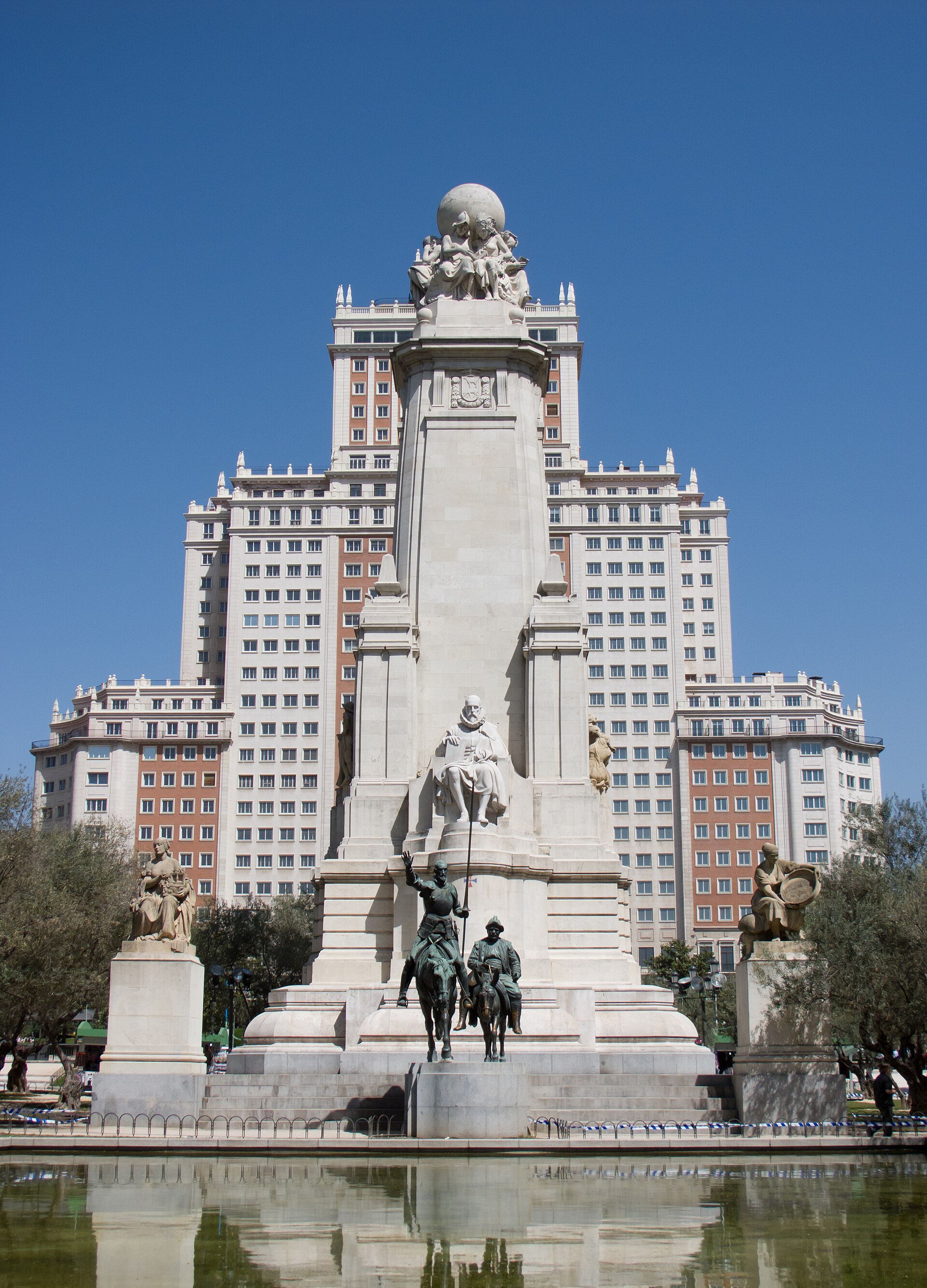
The Monument to Miguel de Cervantes is a prominent sculptural ensemble located in the Plaza de España in Madrid, Spain. Dedicated to the author of Don Quixote, the monument was commissioned to commemorate the tercentenary of the publication of the second part of the novel. It serves as a central landmark in the city, anchoring the western end of the Gran Vía.
The structure features a central stone stele topped by a globe, with a bronze statue of Cervantes seated at the base. Flanking the monument are iconic bronze sculptures of the novel's protagonists, Don Quixote and Sancho Panza, mounted on their respective horse and donkey. The ensemble is completed by a fountain and allegorical figures representing Spanish literature and the five continents.
Key Facts
- Materials
- Stone, Bronze
- Civilization
- Spanish
- Accessibility
- Fully accessible in public plaza
- Date(s)
- 1925-1930
- Condition
- Well-preserved, public landmark
- Original Function
- Commemorative monument
- Key Figures
- Miguel de Cervantes, Rafael Martínez Zapatero, Pedro Muguruza, Lorenzo Coullaut Valera
Conception and Commission
1915The project was initiated to celebrate the 300th anniversary of the publication of the second part of Don Quixote. A national competition was held to select the design, which was won by architects Rafael Martínez Zapatero and Pedro Muguruza, and sculptor Lorenzo Coullaut Valera.
Construction Phase
1925-1930Construction began in 1925. The monument was inaugurated in 1930, though the surrounding plaza continued to undergo development throughout the mid-20th century to integrate the monument into the urban landscape of Madrid.
Modern Restoration
21st CenturyThe monument underwent significant cleaning and structural maintenance in recent years as part of the broader renovation of the Plaza de España, ensuring the preservation of the bronze and stone elements against urban pollution.
Cultural Significance
The monument is a primary symbol of Spanish national identity and literary heritage. It honors Miguel de Cervantes not only as a writer but as a figure who defined the Spanish language and cultural consciousness. The inclusion of Quixote and Sancho Panza reflects the enduring global impact of his work on literature and art.
For the residents of Madrid, the Plaza de España and the Cervantes monument serve as a vital public space. It remains one of the most photographed sites in the city, acting as a cultural touchstone for tourists and locals alike.
Interpretive Notes
Scholarly debates and areas of uncertainty
There is occasional academic discussion regarding the aesthetic transition of the monument from its initial 1920s design to its final completion, specifically concerning the balance between the classical architectural base and the more expressive, modernist-influenced bronze sculptures.
Visiting Information
Entry Rules
The monument is located in a public plaza and is accessible 24 hours a day. No entry fees or tickets are required.
Best Times to Visit
Early morning or late evening to avoid the high volume of tourists and to enjoy the lighting of the monument at night.
Photography
None. Public space photography is permitted.
Preservation Notes
The monument is a protected cultural asset. Visitors are requested not to climb on the sculptures or the fountain base to prevent wear on the bronze surfaces.
Nearby POIs
11 shown- Cerralbo Museum0.2 km
- Temple of Debod0.4 km
- Royal Palace of Madrid0.7 km
- Catedral de la Almudena0.8 km
- Museo del Romanticismo1.2 km
- Real Basilica de San Francisco el Grande1.4 km
- Thyssen-Bornemisza Museum1.7 km
- Cybele Palace1.8 km
- Naval Museum of Madrid1.8 km
- Museo Arqueologico Nacional2 km
- Museo del Prado2 km
Sources & Further Reading
- [1]Monumento a Miguel de Cervantes en la Plaza de España — Ayuntamiento de Madrid. Memoria de Madrid (2020)View
- [2]Lorenzo Coullaut Valera y el monumento a Cervantes — María del Carmen Rodríguez. Revista de Arte (2015)
Key Facts
- Materials
- Stone, Bronze
- Civilization
- Spanish
- Accessibility
- Fully accessible in public plaza
- Date(s)
- 1925-1930
- Condition
- Well-preserved, public landmark
- Original Function
- Commemorative monument
- Key Figures
- Miguel de Cervantes, Rafael Martínez Zapatero, Pedro Muguruza, Lorenzo Coullaut Valera
Nearby POIs
11 shown- Cerralbo Museum0.2 km
- Temple of Debod0.4 km
- Royal Palace of Madrid0.7 km
- Catedral de la Almudena0.8 km
- Museo del Romanticismo1.2 km
- Real Basilica de San Francisco el Grande1.4 km
- Thyssen-Bornemisza Museum1.7 km
- Cybele Palace1.8 km
- Naval Museum of Madrid1.8 km
- Museo Arqueologico Nacional2 km
- Museo del Prado2 km