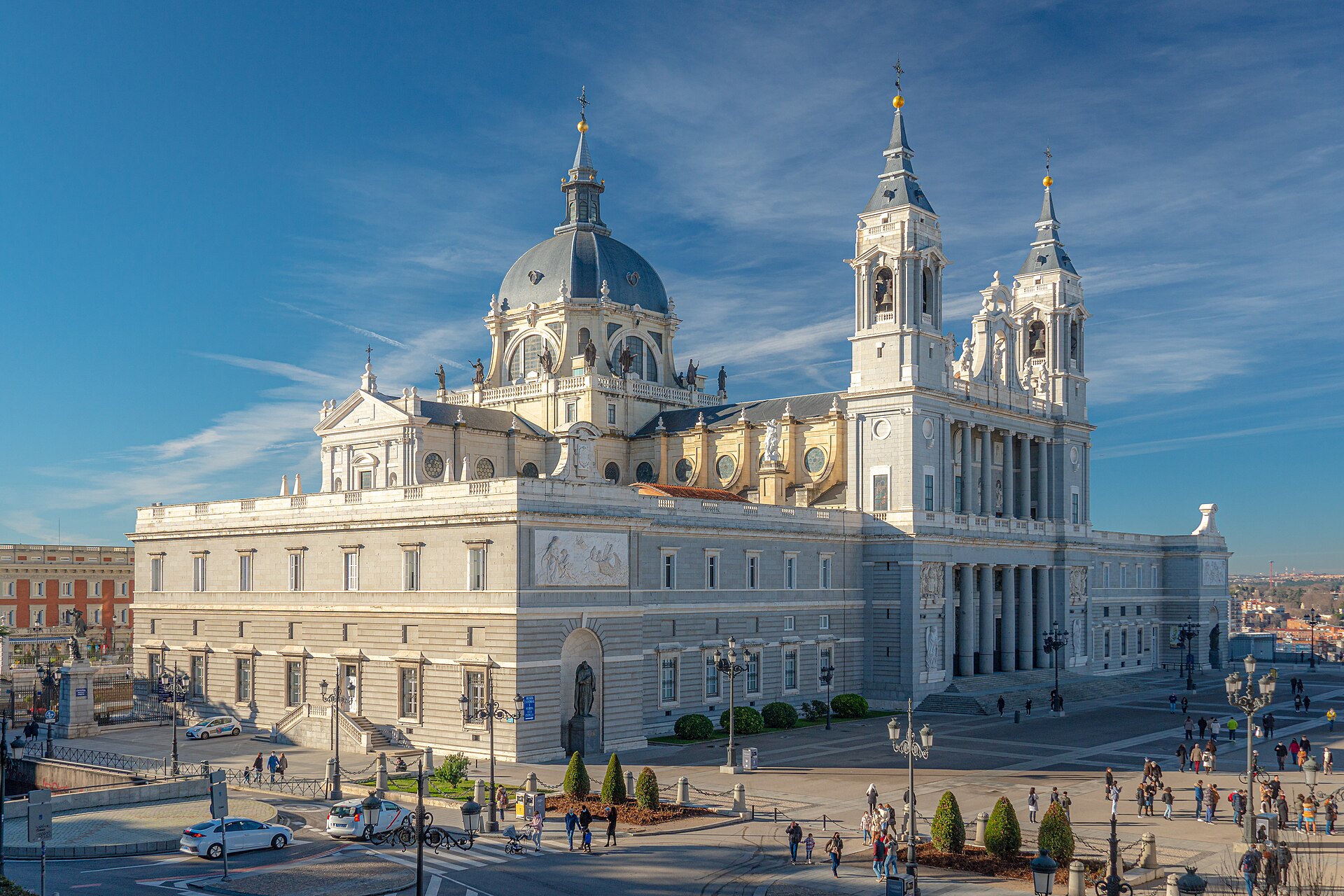
The Catedral de Santa María la Real de la Almudena serves as the seat of the Roman Catholic Archdiocese of Madrid. Although plans for a cathedral in Madrid date back to the 16th century, construction did not begin until 1883 under the direction of architect Francisco de Cubas. The project faced significant delays due to the Spanish Civil War and shifting architectural preferences, resulting in a unique blend of styles including a Neo-Gothic interior and a Neoclassical exterior designed to harmonize with the adjacent Royal Palace.
The cathedral was finally completed and consecrated by Pope John Paul II in 1993, making it the first cathedral in Spain to be consecrated by a pope. It houses the image of the Virgin of Almudena, the patron saint of Madrid, and serves as a major site for both religious worship and state ceremonies, including the 2004 wedding of King Felipe VI and Queen Letizia.
Key Facts
- Materials
- Granite, Stone, Marble
- Civilization
- Spanish
- Accessibility
- Wheelchair accessible
- Date(s)
- 1883 - 1993
- Condition
- Active religious site
- Original Function
- Cathedral
- Key Figures
- Francisco de Cubas, Pope John Paul II, King Alfonso XII
Conception and Early Construction
1879-1883King Alfonso XII approved the construction of a cathedral in Madrid to replace the city's lack of a dedicated episcopal seat. Francisco de Cubas designed the original Neo-Gothic structure, and the first stone was laid in 1883.
Interruption and Redesign
1936-1950Construction was halted during the Spanish Civil War. In 1944, a new architectural competition was held to ensure the exterior facade matched the Neoclassical style of the nearby Royal Palace, leading to the appointment of Fernando Chueca Goitia.
Completion and Consecration
1993After a century of intermittent work, the cathedral was finished. It was consecrated by Pope John Paul II on June 15, 1993, officially establishing it as the primary cathedral of the Archdiocese of Madrid.
Cultural Significance
The Almudena Cathedral is a symbol of Madrid's status as a capital city and religious center. Its location directly facing the Royal Palace emphasizes the historical link between the Spanish monarchy and the Catholic Church. It remains the primary venue for royal weddings and significant national religious observances.
Interpretive Notes
Scholarly debates and areas of uncertainty
Architectural critics have long debated the stylistic inconsistency of the building, specifically the juxtaposition of the Neo-Gothic interior with the Neoclassical exterior. Some argue this creates a disjointed aesthetic, while others view it as a successful compromise between the original 19th-century vision and the 20th-century requirement to match the Royal Palace.
Visiting Information
Entry Rules
Open daily for visitors and worshipers. Entry is free, though a small donation is requested for the museum and dome access. Modest dress is required.
Best Times to Visit
Weekday mornings to avoid the heavy weekend tourist traffic and scheduled liturgical services.
Photography
Photography is permitted in most areas, but flash and tripods are prohibited. Photography is strictly forbidden during religious services.
Preservation Notes
The structure is well-maintained, but visitors are asked to respect the sanctity of the space and remain within designated tourist areas during services.
Nearby POIs
11 shown- Royal Palace of Madrid0.1 km
- Real Basilica de San Francisco el Grande0.6 km
- Monument to Miguel de Cervantes0.8 km
- Cerralbo Museum0.9 km
- Temple of Debod1 km
- Thyssen-Bornemisza Museum1.7 km
- Museo del Romanticismo1.8 km
- Naval Museum of Madrid1.9 km
- Museo Nacional Centro de Arte Reina Sofia1.9 km
- Museo del Prado1.9 km
- Cybele Palace1.9 km
Sources & Further Reading
- [1]La Catedral de Santa María la Real de la Almudena — Archidiócesis de Madrid. Archidiócesis de Madrid Official Portal (2023)View
- [2]Madrid: The Architecture of the Capital — Fernando Chueca Goitia. Editorial Dossat (1985)
Key Facts
- Materials
- Granite, Stone, Marble
- Civilization
- Spanish
- Accessibility
- Wheelchair accessible
- Date(s)
- 1883 - 1993
- Condition
- Active religious site
- Original Function
- Cathedral
- Key Figures
- Francisco de Cubas, Pope John Paul II, King Alfonso XII
Nearby POIs
11 shown- Royal Palace of Madrid0.1 km
- Real Basilica de San Francisco el Grande0.6 km
- Monument to Miguel de Cervantes0.8 km
- Cerralbo Museum0.9 km
- Temple of Debod1 km
- Thyssen-Bornemisza Museum1.7 km
- Museo del Romanticismo1.8 km
- Naval Museum of Madrid1.9 km
- Museo Nacional Centro de Arte Reina Sofia1.9 km
- Museo del Prado1.9 km
- Cybele Palace1.9 km