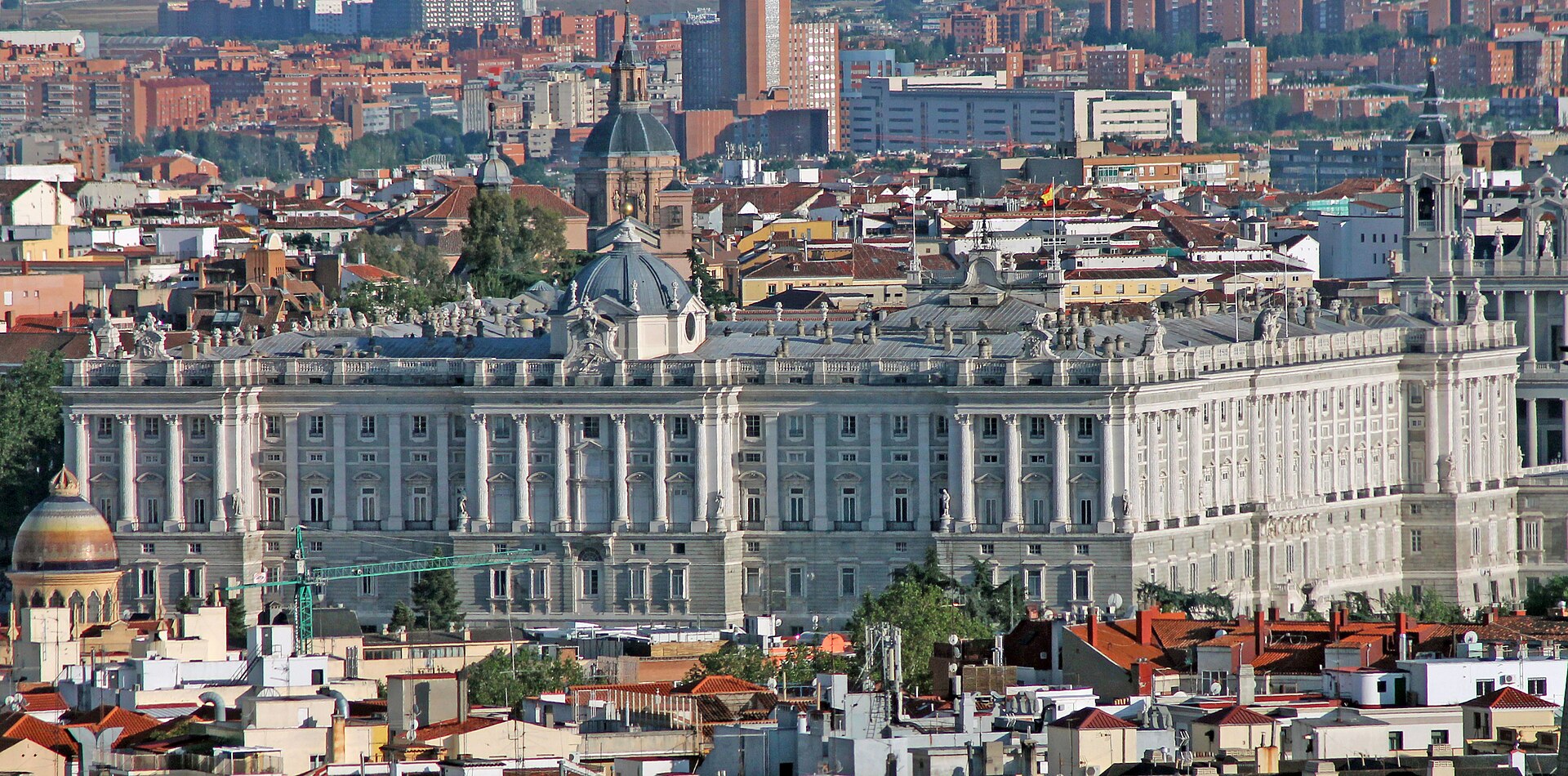
The Royal Palace of Madrid, or Palacio Real de Madrid, serves as the official residence of the Spanish royal family, though it is primarily used for state ceremonies and official functions. Located on the site of the 9th-century Alcázar of Madrid, the current structure was commissioned by King Philip V following a devastating fire in 1734.
Designed by architects Filippo Juvarra and Giovanni Battista Sacchetti, the palace is the largest royal residence in Western Europe by floor area. Its architecture reflects a transition from Italian Baroque to the more restrained Neoclassical style, featuring an expansive square plan with a central courtyard and a monumental facade constructed from granite and Colmenar stone.
Key Facts
- Materials
- Granite, Colmenar stone, Marble, Stucco
- Civilization
- Spanish Monarchy
- Accessibility
- Wheelchair accessible with elevators to main floors
- Date(s)
- 1738-1755
- Condition
- Well-preserved, used for state ceremonies
- Original Function
- Royal Residence
- Key Figures
- Philip V, Charles III, Filippo Juvarra, Giovanni Battista Sacchetti
The Alcázar Origins
9th-17th centuryThe site was originally a fortress built by the Emirate of Córdoba. It later served as the primary residence for the Castilian monarchs until the medieval Alcázar was destroyed by fire on Christmas Eve, 1734.
Construction of the New Palace
1738-1755King Philip V ordered the construction of a new palace on the same site. Filippo Juvarra initially proposed a massive design, but after his death, his pupil Giovanni Battista Sacchetti scaled the project down to the current dimensions.
Royal Residence and Expansion
18th-19th centuryCharles III was the first monarch to reside in the palace in 1764. Throughout the 18th and 19th centuries, the interior was continuously decorated with frescoes by masters such as Tiepolo, Mengs, and Bayeu.
Modern Era
20th century-presentFollowing the transition to democracy in Spain, the palace ceased to be the primary home of the royal family. It remains the property of the Spanish state and is managed by the Patrimonio Nacional for public visitation and state events.
Cultural Significance
The palace is a symbol of the Spanish monarchy's historical power and the influence of the Bourbon dynasty in Spain. It houses an extensive collection of historical artifacts, including the Royal Armoury and the Stradivarius collection, which are of immense cultural value to the nation.
Beyond its artistic contents, the palace remains the stage for the most significant diplomatic events in Spain, including the reception of foreign heads of state and the signing of international treaties, maintaining its role as the heart of Spanish state protocol.
Interpretive Notes
Scholarly debates and areas of uncertainty
There is ongoing academic discussion regarding the extent of the influence of Bernini's unbuilt designs for the Louvre on the palace's original architectural plans. Additionally, scholars debate the preservation balance between maintaining the palace as a living museum versus its continued utility as a functional state building.
Visiting Information
Entry Rules
Open daily. Tickets can be purchased online or at the box office. Security screening is mandatory for all visitors. Large bags and backpacks are not permitted inside.
Best Times to Visit
Weekday mornings (10:00-11:30) to avoid the largest tourist groups. The palace is particularly significant during the Changing of the Guard ceremony held on Wednesdays.
Photography
Photography is permitted in most areas without flash or tripods. Photography is strictly prohibited in the Royal Armoury and specific temporary exhibition rooms.
Preservation Notes
The palace is a protected heritage site. Visitors must refrain from touching walls, tapestries, or furniture. Restoration work is ongoing in various wings; some rooms may be temporarily closed to the public.
Nearby POIs
11 shown- Catedral de la Almudena0.1 km
- Real Basilica de San Francisco el Grande0.7 km
- Monument to Miguel de Cervantes0.7 km
- Cerralbo Museum0.8 km
- Temple of Debod0.9 km
- Thyssen-Bornemisza Museum1.6 km
- Museo del Romanticismo1.6 km
- Naval Museum of Madrid1.8 km
- Cybele Palace1.8 km
- Museo del Prado1.9 km
- Museo Nacional Centro de Arte Reina Sofia1.9 km
Sources & Further Reading
- [1]
- [2]Architecture and Power in the Eighteenth Century — J.J. Martín González. Editorial Cátedra (1991)
Key Facts
- Materials
- Granite, Colmenar stone, Marble, Stucco
- Civilization
- Spanish Monarchy
- Accessibility
- Wheelchair accessible with elevators to main floors
- Date(s)
- 1738-1755
- Condition
- Well-preserved, used for state ceremonies
- Original Function
- Royal Residence
- Key Figures
- Philip V, Charles III, Filippo Juvarra, Giovanni Battista Sacchetti
Nearby POIs
11 shown- Catedral de la Almudena0.1 km
- Real Basilica de San Francisco el Grande0.7 km
- Monument to Miguel de Cervantes0.7 km
- Cerralbo Museum0.8 km
- Temple of Debod0.9 km
- Thyssen-Bornemisza Museum1.6 km
- Museo del Romanticismo1.6 km
- Naval Museum of Madrid1.8 km
- Cybele Palace1.8 km
- Museo del Prado1.9 km
- Museo Nacional Centro de Arte Reina Sofia1.9 km