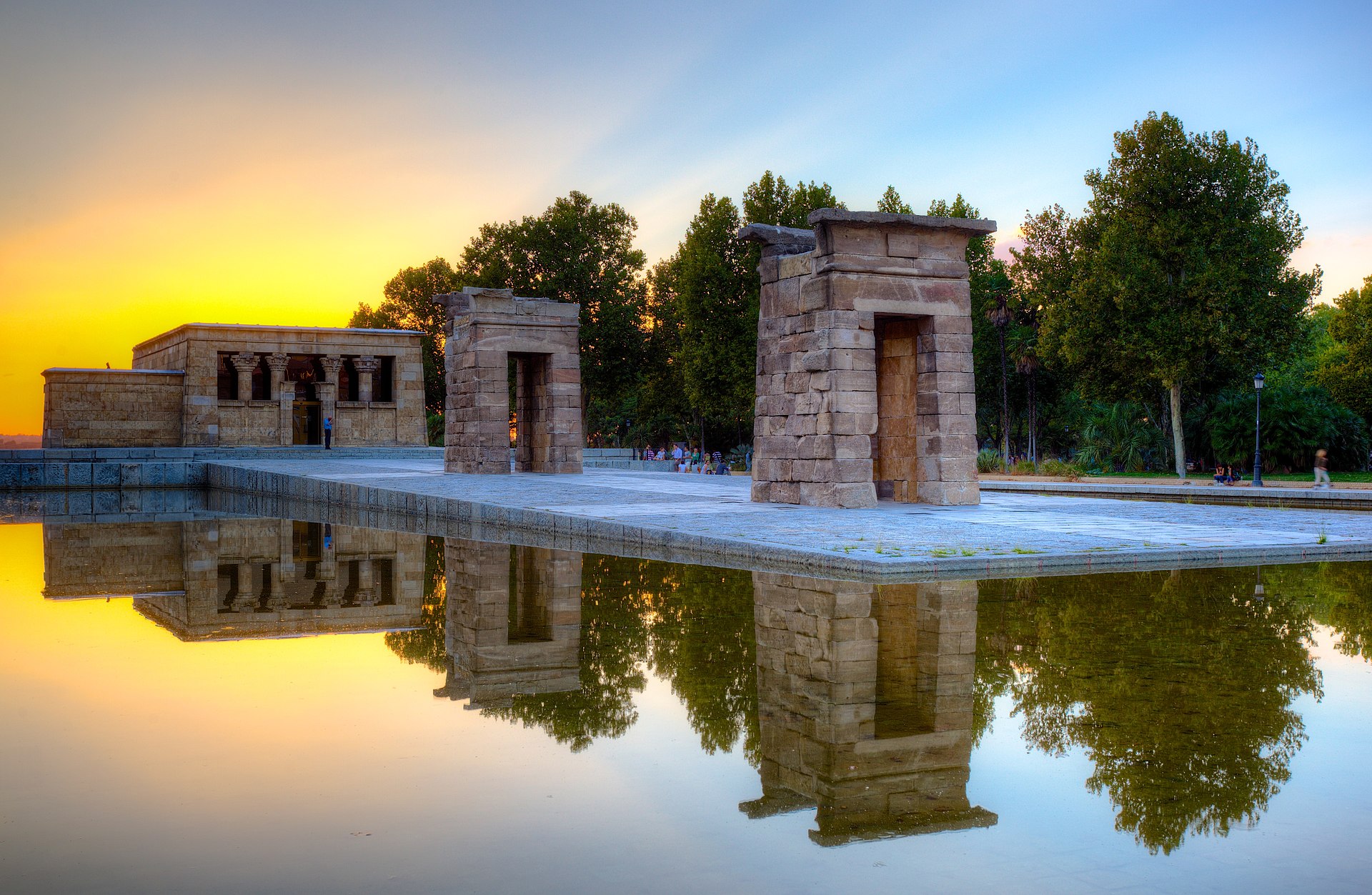
The Temple of Debod is an ancient Egyptian temple that was dismantled and rebuilt in Madrid, Spain. Originally constructed in the 2nd century BCE in the village of Debod, near the first cataract of the Nile in Nubia, it was dedicated to the gods Amun and Isis. The structure was gifted to Spain by the Egyptian government in 1968 as a gesture of gratitude for Spanish assistance in saving the Abu Simbel temples from the rising waters caused by the Aswan High Dam.
The temple was transported stone by stone and reassembled in the Parque del Oeste, near the Plaza de España. It remains one of the few examples of ancient Egyptian architecture located outside of Egypt and is the only one of its kind in Spain. The site is oriented from east to west, following the original alignment of its foundation in Nubia, and is surrounded by a reflecting pool that evokes its original riverside setting.
Key Facts
- Materials
- Sandstone
- Civilization
- Ancient Egyptian
- Accessibility
- Ground level access, limited interior space
- Date(s)
- 2nd century BCE
- Condition
- Reconstructed and preserved as a museum
- Original Function
- Temple dedicated to Amun and Isis
- Key Figures
- Adikhalamani, Ptolemy VI Philometor, Augustus
Origins in Nubia
2nd century BCEThe temple was commissioned by the Meroitic king Adikhalamani, who dedicated a chapel to the gods Amun and Isis. Subsequent rulers of the Ptolemaic dynasty and later Roman emperors expanded the structure, adding further chambers and decorative elements.
Relocation and Rescue
1960-1968Following the construction of the Aswan High Dam, the temple was threatened by flooding. In recognition of the Spanish archaeological team's efforts to rescue the Abu Simbel temples, the Egyptian government donated the Temple of Debod to Spain.
Reconstruction in Madrid
1970-1972The temple was dismantled, shipped to Spain, and reassembled in Madrid's Parque del Oeste. The reconstruction process was meticulous, aiming to preserve the original orientation and structural integrity of the stone blocks.
Modern Status
1972-PresentThe temple opened to the public in 1972. It serves as a museum and a significant cultural landmark in Madrid, attracting visitors interested in ancient history and architectural preservation.
Cultural Significance
The Temple of Debod serves as a symbol of international cooperation in the field of cultural heritage preservation. Its presence in Madrid highlights the global effort to protect monuments threatened by modern infrastructure projects, specifically the Aswan High Dam.
For the local population, the temple has become an iconic feature of the Madrid skyline, particularly at sunset. It represents a unique intersection of Egyptian history and Spanish urban landscape, fostering public interest in Egyptology and ancient civilizations.
Interpretive Notes
Scholarly debates and areas of uncertainty
There is ongoing discussion regarding the long-term impact of Madrid's climate on the sandstone structure. Unlike the arid environment of Nubia, Madrid experiences significant humidity and temperature fluctuations, which some experts argue may accelerate the weathering of the original stone surfaces.
Visiting Information
Entry Rules
Entry is free, but capacity is strictly limited to ensure the preservation of the interior. Visitors are admitted in small groups for short durations. The temple is closed on Mondays and certain public holidays.
Best Times to Visit
Sunset is the most popular time to visit due to the lighting on the temple and the reflecting pool. Weekday mornings generally offer shorter wait times for entry.
Photography
Personal photography is permitted. Flash photography is prohibited inside the temple to protect the interior carvings.
Preservation Notes
Do not touch the stone surfaces, as oils from skin can damage the ancient sandstone. Stay within the designated visitor paths and follow the instructions of the site staff.
Nearby POIs
11 shown- Cerralbo Museum0.3 km
- Monument to Miguel de Cervantes0.4 km
- Royal Palace of Madrid0.9 km
- Catedral de la Almudena1 km
- Real Basilica de San Francisco el Grande1.5 km
- Museo del Romanticismo1.6 km
- Museo del Traje2 km
- Thyssen-Bornemisza Museum2.1 km
- Cybele Palace2.2 km
- Naval Museum of Madrid2.3 km
- Museo Arqueologico Nacional2.4 km
Sources & Further Reading
- [1]The Temple of Debod: A Nubian Temple in Madrid — Martin Almagro-Basch. Ministerio de Educación y Ciencia (1971)
- [2]The Rescue of the Nubian Monuments — Torgny Säve-Söderbergh. UNESCO (1987)
Key Facts
- Materials
- Sandstone
- Civilization
- Ancient Egyptian
- Accessibility
- Ground level access, limited interior space
- Date(s)
- 2nd century BCE
- Condition
- Reconstructed and preserved as a museum
- Original Function
- Temple dedicated to Amun and Isis
- Key Figures
- Adikhalamani, Ptolemy VI Philometor, Augustus
Nearby POIs
11 shown- Cerralbo Museum0.3 km
- Monument to Miguel de Cervantes0.4 km
- Royal Palace of Madrid0.9 km
- Catedral de la Almudena1 km
- Real Basilica de San Francisco el Grande1.5 km
- Museo del Romanticismo1.6 km
- Museo del Traje2 km
- Thyssen-Bornemisza Museum2.1 km
- Cybele Palace2.2 km
- Naval Museum of Madrid2.3 km
- Museo Arqueologico Nacional2.4 km