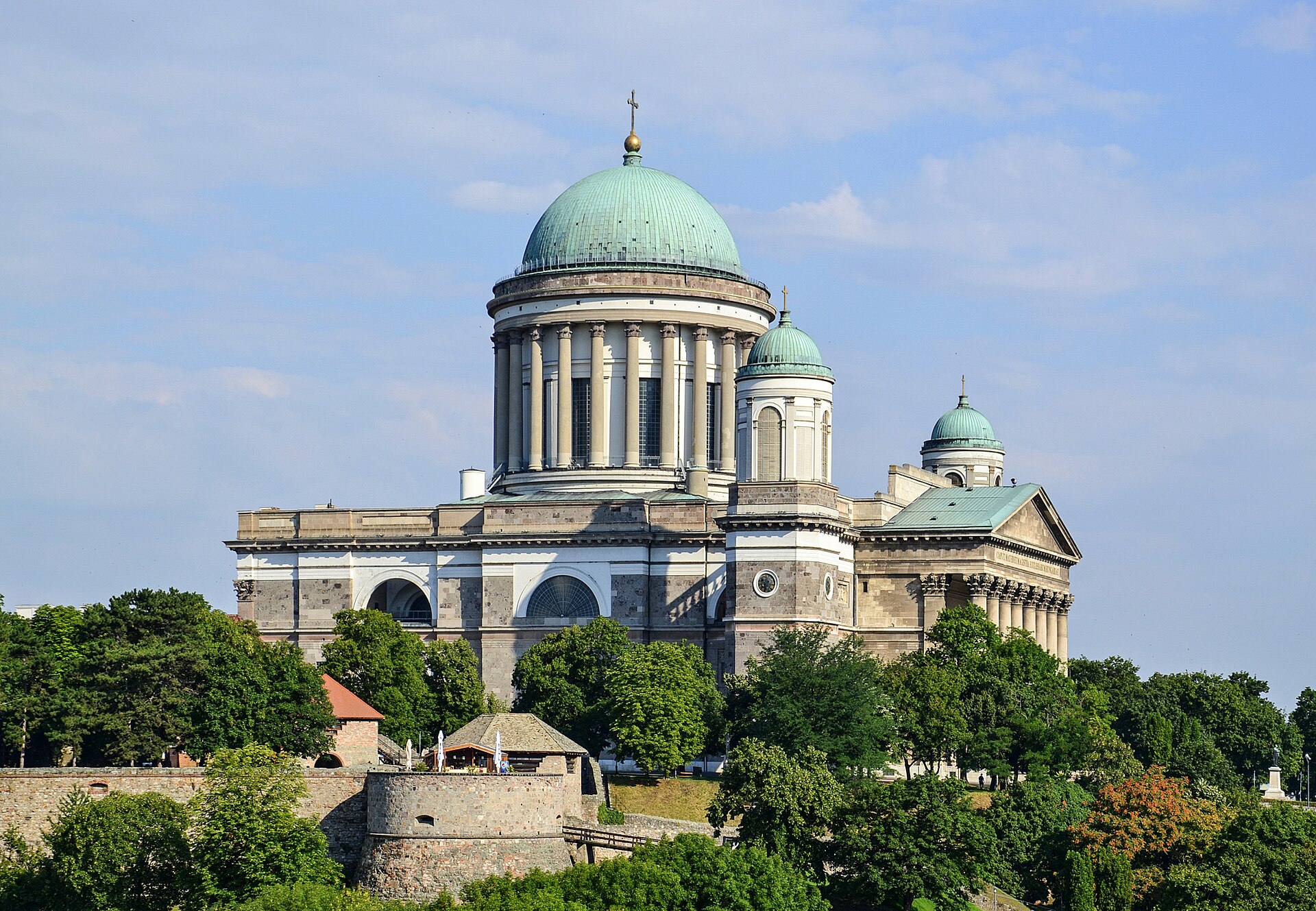
The Esztergom Basilica, formally the Primatial Basilica of the Blessed Virgin Mary Assumed into Heaven and St. Adalbert, is the largest church in Hungary and the seat of the Catholic Church in the country. Situated on Castle Hill overlooking the Danube River, the current structure was built between 1822 and 1869 on the site of several previous cathedrals, including one dating back to the 11th century.
Designed in a monumental Neoclassical style, the basilica features a massive dome, a grand portico with Corinthian columns, and an interior that houses the world's largest painting on a single canvas. It serves as the mother church of the Archdiocese of Esztergom-Budapest and remains a significant pilgrimage site and a symbol of Hungarian religious history.
Key Facts
- Materials
- Stone, Brick, Marble
- Civilization
- Hungarian
- Accessibility
- Accessible via ramp at the side entrance; elevator available for dome access
- Date(s)
- 1822-1869
- Condition
- Well-preserved, active religious site
- Original Function
- Cathedral and Primatial seat
- Key Figures
- József Hild, János Packh, Primate Sándor Rudnay
Early Foundations
11th centuryThe first cathedral on this site was established by King Stephen I of Hungary around 1010, dedicated to Saint Adalbert. It served as the center of the Hungarian Church until it was destroyed by fire in 1180 and subsequently rebuilt.
Ottoman Occupation
16th-17th centuryDuring the Ottoman wars, the medieval cathedral was severely damaged and eventually fell into ruin. The site remained largely neglected until the liberation of Esztergom in 1683.
Construction of the Current Basilica
1822-1869Primate Sándor Rudnay commissioned the construction of the new basilica to restore the prestige of the archdiocese. Architects Pál Kühnel, János Packh, and József Hild oversaw the project, which was completed in 1869, though the interior decoration continued for several years thereafter.
Modern Era
20th century-presentThe basilica survived the conflicts of the 20th century with relatively minor damage. It remains a central site for Hungarian national and religious life, undergoing periodic restoration to preserve its structural integrity and interior artworks.
Cultural Significance
The Esztergom Basilica is a cornerstone of Hungarian national identity, representing the historical continuity of the Catholic Church in the region. Its location on the Danube, marking the border between Hungary and Slovakia, emphasizes its role as a bridge between cultures and a sentinel of Hungarian history.
Interpretive Notes
Scholarly debates and areas of uncertainty
There is ongoing discussion regarding the architectural transition from the original designs by Pál Kühnel to the modifications implemented by József Hild, specifically concerning the structural stability of the massive dome and the integration of the Bakócz Chapel, a 16th-century Renaissance structure moved stone-by-stone into the new basilica.
Visiting Information
Entry Rules
Open daily. Entry to the main church is free, though there are fees for the crypt, the treasury, and the dome lookout. Modest dress is required as it is an active place of worship.
Best Times to Visit
Early morning or late afternoon to avoid peak tourist crowds and to experience the light within the dome. Weekdays are generally quieter than weekends.
Photography
Personal photography is permitted without flash. Tripods and professional equipment require prior authorization from the parish office.
Preservation Notes
Visitors are requested to remain quiet and respectful. Do not touch the marble surfaces or historical artifacts. Restoration work may occasionally limit access to specific chapels.
Nearby POIs
11 shownSources & Further Reading
- [1]The Basilica of Esztergom — József Csergheő. Esztergom-Budapest Archdiocese Press (2015)
- [2]Neoclassical Architecture in Hungary — Anna Zádor. Akadémiai Kiadó (1985)
Key Facts
- Materials
- Stone, Brick, Marble
- Civilization
- Hungarian
- Accessibility
- Accessible via ramp at the side entrance; elevator available for dome access
- Date(s)
- 1822-1869
- Condition
- Well-preserved, active religious site
- Original Function
- Cathedral and Primatial seat
- Key Figures
- József Hild, János Packh, Primate Sándor Rudnay