Krakow: Royal Heritage and Golden Ages of Poland’s Ancient Heart
Step into Poland’s historic royal capital, where medieval market squares, royal legends, and vibrant Jewish heritage endure across centuries.
 Daniel Romanov
Krakow: Royal Heritage and Golden Ages of Poland's Ancient Heart
Krakow stands as the cultural and historical crown jewel of Poland. Spared from widespread destruction during World War II, its historic center retains an extraordinary concentration of medieval, Renaissance, and Baroque architecture. For over five centuries, Krakow served as the royal capital of Poland, where monarchs were crowned, scholars gathered, and trade routes intersected at the heart of Europe.
Set along the banks of the Vistula River, Krakow offers a living journey through Polish history. From the legend of the Wawel Dragon to the vibrant streets of Kazimierz, the city preserves the spirit and identity of a nation across generations.
The Royal Citadel of Wawel
Rising dramatically above the Vistula River, Wawel Hill forms the symbolic center of Polish statehood and national pride.
At its crest lies Wawel Castle (Zamek Królewski na Wawelu), an impressive fortress and royal palace featuring a magnificent Renaissance arcaded courtyard. For centuries, Polish kings ruled from these halls, governing a vast commonwealth that stretched across Central and Eastern Europe.
Adjacent to the palace stands Wawel Cathedral (Katedra Wawelska), the spiritual sanctuary of the nation. Here, Polish monarchs were crowned and laid to rest in elaborate tombs alongside national heroes and poets. The cathedral's Sigismund Chapel, capped with a golden dome, is considered one of the finest Renaissance architectural masterpieces north of the Alps.
Europe's Largest Medieval Market Square
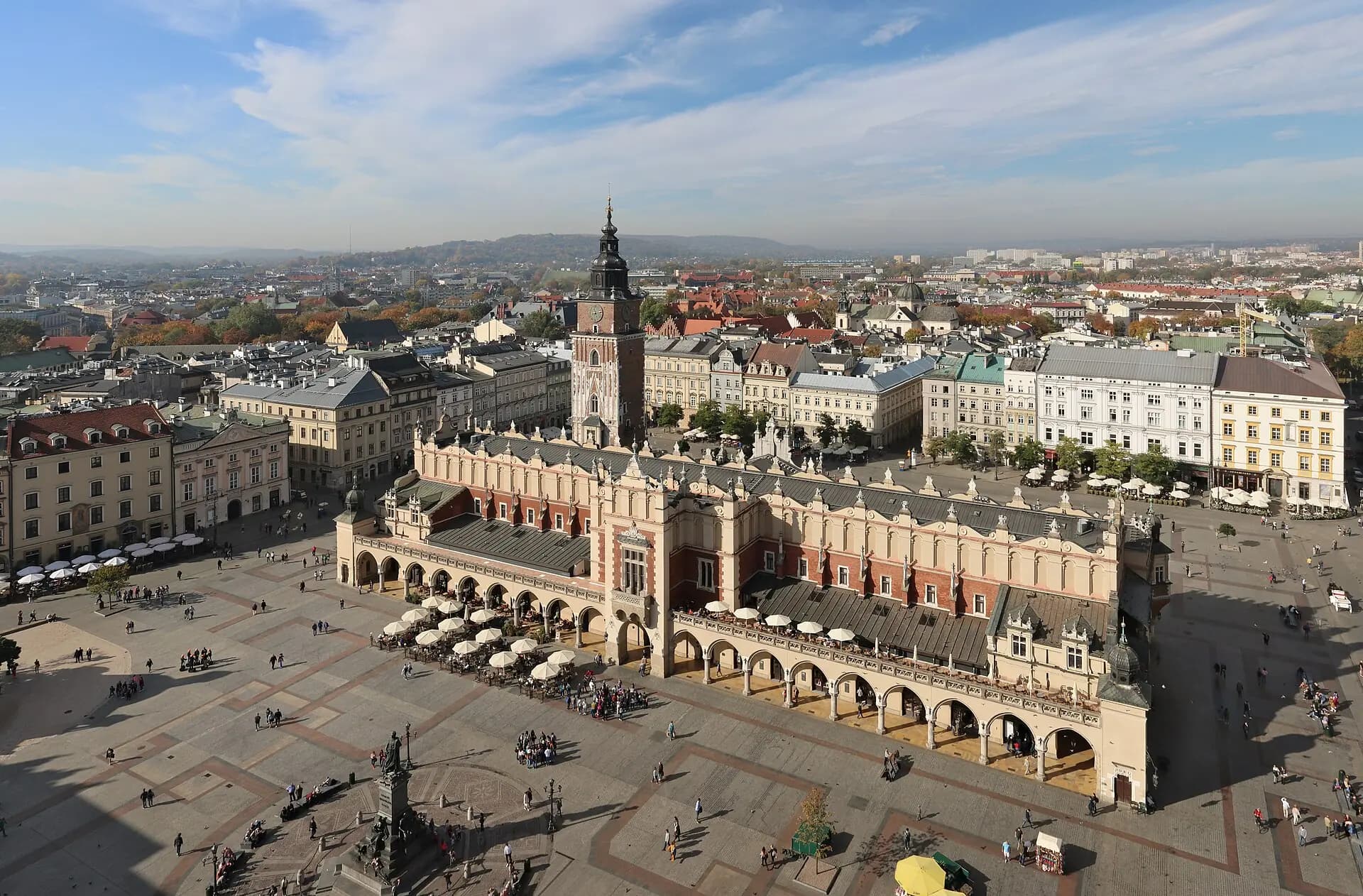
At the center of Krakow's Old Town lies the Rynek Główny, one of Europe's largest and grandest medieval market squares.
Dominating the center of the square is the Sukiennice (Cloth Hall), a Renaissance merchant hall where international traders once exchanged Polish lead, salt, and textiles for exotic spices and silk. Today, its lower arcade continues to house bustling stalls selling local crafts and amber jewelry.
Beneath the cobblestones of the market, Rynek Underground transports visitors back to medieval Krakow, revealing high-tech multimedia exhibits alongside preserved medieval market stalls and cobblestone pathways.
Rising above the corner of the square is the twin-towered St. Mary's Basilica (Church of the Assumption of the Blessed Virgin Mary). Famous for its exquisite wooden altarpiece carved by Veit Stoss, the basilica is also known for the hourly Hejnał mariacki, a trumpet call played from the higher tower that abruptly breaks off in memory of a trumpeter struck by an arrow during a thirteenth-century siege.
Defensive Fortifications and Cultural Treasures
During the Middle Ages, Krakow was encircled by formidable defensive brick walls, moats, and fortified towers.
While most of the walls were removed in the nineteenth century to form the leafy Planty Park, key northern fortifications were preserved. Saint Florian's Gate served as the main ceremonial entrance for royal processions heading toward Wawel. Just beyond the gate stands the Barbakan, a formidable fifteenth-century Gothic defensive outpost with seven turrets, representing one of the few surviving structures of its kind in Europe.
Nearby in the Old Town, the Czartoryski Museum houses one of Poland's oldest and most prestigious art collections, including Leonardo da Vinci's famed masterpiece, Lady with an Ermine.
Kazimierz and Twentieth-Century Memory
South of the Old Town lies Kazimierz, founded in the fourteenth century by King Casimir III as an independent city. For centuries, Kazimierz thrived as a major center of Jewish religious, intellectual, and cultural life.
The historic neighborhood features preserved synagogues, including the Krakow Old Synagogue, which now serves as a museum documenting Jewish heritage in Krakow.
During World War II, the city suffered under Nazi occupation. Across the Vistula River in the Podgórze district, Oskar Schindler's Enamel Factory now houses a poignant museum detailing the wartime experience of Krakow's citizens and Schindler's heroic efforts to rescue over one thousand Jewish workers.
Tastes of Lesser Poland
Krakow's culinary offerings reflect traditional Polish comfort food alongside historic regional specialties.
A ubiquitous street snack is the obwarzanek krakowski, a braided ring-shaped bread boiled and baked, sprinkled with poppy seeds, sesame, or salt. Other iconic staples include pierogi (dumplings stuffed with potato and cheese, meat, or seasonal berries), barszcz czerwony (beet soup served with tiny mushroom dumplings), and bigos (a hearty hunter's stew of sauerkraut, meat, and wild mushrooms).
The vibrant cafés of Kazimierz and Old Town cellar restaurants offer welcoming spaces to enjoy local meads, vodkas, and regional pastries like mazurek.
The Timeless Spirit of Krakow
Krakow is a city that bridges past grandeur with enduring vitality. Its royal monuments, medieval square, historic sanctuaries, and rich cultural tapestry continue to inspire travelers from around the world. In Krakow, history is not merely commemorated in stone; it thrives in every cobblestone street, trumpet call, and lively courtyard.