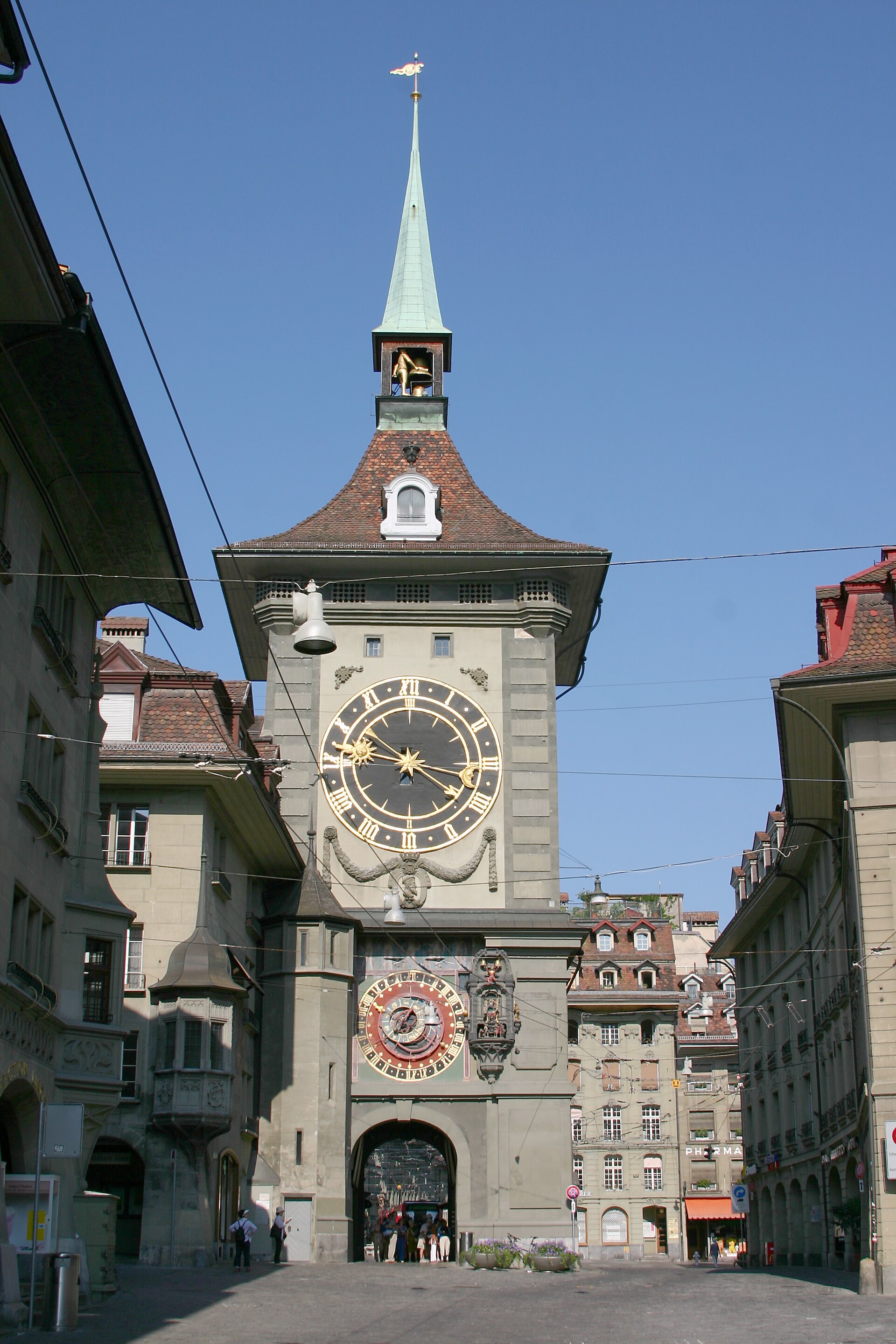
The Zytglogge is a landmark medieval tower in Bern, Switzerland, originally constructed in the early 13th century as a guard tower for the city's western fortifications. Over the centuries, it has served various functions, including a prison, a guard post, and a civic clock tower, anchoring the urban layout of the Old City of Bern.
The structure is best known for its complex astronomical clock, installed in the 15th century. The clock features a mechanical puppet show that activates before each hour, a feature that has made it a central point of interest for centuries. The tower's current appearance reflects significant renovations from the 1770s, which integrated late Baroque elements into the medieval stone core.
Key Facts
- Materials
- Limestone, Sandstone, Oak, Brass
- Civilization
- Swiss
- Accessibility
- Limited; steep, narrow stairs inside the tower
- Date(s)
- 1218-1220
- Condition
- Well-preserved, fully functional
- Original Function
- Guard tower and city gate
- Key Figures
- Kaspar Brunner
Origins as a Gate Tower
1218-1220The Zytglogge was built as the western gate tower of Bern's first city wall. It stood as a defensive structure protecting the entrance to the city until the city expanded and the wall was moved westward.
Installation of the Clock
1405Following a major city fire, the tower was repurposed. The first clock mechanism was installed in 1405, and the astronomical clock face was added shortly thereafter, establishing the tower as the city's primary timekeeper.
Baroque Renovation
1770-1771The tower underwent a major renovation to align with the aesthetic tastes of the 18th century. The exterior was plastered and painted, and the current Rococo-style facade was added, giving the tower its present appearance.
Modern Preservation
20th century - presentThe tower remains a functioning timepiece. Extensive restoration work in the 1980s ensured the mechanical clockwork and the puppet figures remain operational, maintaining the tower's status as a UNESCO World Heritage site.
Cultural Significance
The Zytglogge serves as the symbolic heart of Bern. Historically, it provided the standard time for the city, and its location was used as the reference point for all official measurements and distances in the region. It remains a primary icon of Swiss medieval urban planning and horological history.
Beyond its technical function, the tower is deeply embedded in local folklore and daily life. The hourly puppet performance continues to draw crowds, maintaining a tradition that has persisted for over 500 years, bridging the gap between medieval civic life and modern tourism.
Interpretive Notes
Scholarly debates and areas of uncertainty
There is ongoing academic discussion regarding the exact configuration of the original 13th-century gate structure, as the multiple layers of renovation have obscured the primary masonry. Additionally, the precise evolution of the astronomical clock's gear train remains a subject of study for horologists interested in pre-industrial mechanical engineering.
Visiting Information
Entry Rules
Access to the interior is restricted to guided tours only. Tours must be booked in advance via the official Bern tourism portal. The interior involves climbing steep, narrow medieval staircases.
Best Times to Visit
Mid-morning or mid-afternoon to avoid the peak crowds that gather for the hourly puppet show. The tower is best viewed from the Kramgasse street level.
Photography
Photography is permitted from the street. Flash photography is prohibited inside the tower during guided tours to protect the delicate clock mechanisms.
Preservation Notes
The clock mechanism is highly sensitive; visitors must follow the guide's instructions and avoid touching any of the internal machinery or walls. The tower is an active historical site and may occasionally close for maintenance.
Nearby POIs
11 shownSources & Further Reading
- [1]
- [2]Die Zytglogge in Bern — Paul Hofer. Gesellschaft für Schweizerische Kunstgeschichte (1969)
Key Facts
- Materials
- Limestone, Sandstone, Oak, Brass
- Civilization
- Swiss
- Accessibility
- Limited; steep, narrow stairs inside the tower
- Date(s)
- 1218-1220
- Condition
- Well-preserved, fully functional
- Original Function
- Guard tower and city gate
- Key Figures
- Kaspar Brunner