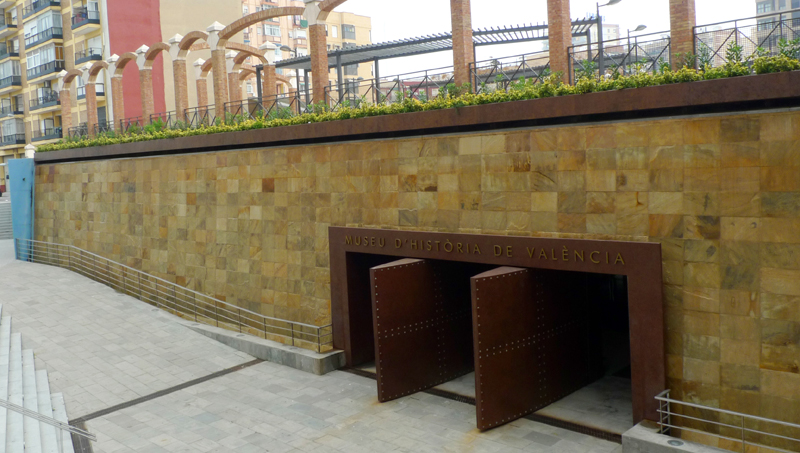
The Valencia History Museum (Museu d'Història de València) is located within the former water cisterns of the city, a subterranean architectural space originally designed by Ildefonso Cerdá in the 19th century. The museum provides a comprehensive chronological overview of Valencia's development, from its Roman foundation as Valentia Edetanorum to the present day.
The exhibition space utilizes a blend of traditional artifacts and interactive multimedia displays to illustrate the city's evolution through various cultural layers, including Visigothic, Islamic, and Christian periods. By repurposing the historic cistern structure, the museum integrates the physical history of the city's infrastructure with its curated historical narrative.
Key Facts
- Materials
- Brick, Stone, Concrete
- Civilization
- Spanish
- Accessibility
- Fully accessible with elevator access to the subterranean level
- Date(s)
- 2003
- Condition
- Active museum
- Original Function
- Water cistern
- Key Figures
- Ildefonso Cerdá
The Cistern Origins
1850-1899The site was originally constructed as a massive underground water reservoir to supply the growing city of Valencia, featuring a series of brick arches and vaulted ceilings that remain the defining architectural feature of the museum space.
Museum Establishment
2003The municipal government converted the decommissioned cistern into a history museum, aiming to centralize the city's historical archives and artifacts while preserving the industrial heritage of the water storage facility.
Modern Curatorial Focus
2004-PresentThe museum has expanded its collection to include digital reconstructions of the city's medieval walls and interactive exhibits detailing the impact of the 20th-century urban expansion on the historic center.
Cultural Significance
The museum serves as the primary repository for Valencia's civic identity, bridging the gap between the city's Roman origins and its modern status as a Mediterranean hub. It plays a critical role in local education, providing a space where residents and visitors can engage with the layers of cultural influence that define the Valencian community.
Interpretive Notes
Scholarly debates and areas of uncertainty
There is ongoing discussion regarding the balance between the preservation of the original industrial architecture of the cistern and the requirements for modern museum climate control and lighting, which necessitates constant monitoring of the brick structures.
Visiting Information
Entry Rules
Open Tuesday to Sunday. Admission is free on Sundays and public holidays. Visitors are requested to refrain from touching artifacts and to follow marked paths through the subterranean galleries.
Best Times to Visit
Weekday mornings are generally quieter, allowing for a more focused experience of the multimedia installations.
Photography
Personal photography is permitted without flash. Tripods and professional equipment require prior authorization from the museum administration.
Preservation Notes
The subterranean environment is climate-controlled to protect the brickwork and artifacts. Visitors should be aware of the low-light conditions in certain sections of the exhibition.
Nearby POIs
11 shown- Torres de Quart2.1 km
- Valencian Museum of Ethnology2.2 km
- Prehistory Museum of Valencia2.3 km
- Institut Valencia d'Art Modern2.4 km
- Lonja de la Seda2.6 km
- La Casa de la Ciencia2.8 km
- Torres de Serranos2.9 km
- Catedral de Valencia2.9 km
- Gonzalez Marti National Museum of Ceramics and Decorative Arts2.9 km
- Museu de Belles Arts de Valencia3.3 km
- City of Arts and Sciences5.2 km
Sources & Further Reading
- [1]Museu d'Història de València: Guía del visitante — Ayuntamiento de Valencia. Valencia Municipal Press (2015)View
- [2]Industrial Heritage in Spain: The Cisterns of Valencia — Garcia, M.. Journal of Urban History (2008)
Key Facts
- Materials
- Brick, Stone, Concrete
- Civilization
- Spanish
- Accessibility
- Fully accessible with elevator access to the subterranean level
- Date(s)
- 2003
- Condition
- Active museum
- Original Function
- Water cistern
- Key Figures
- Ildefonso Cerdá
Nearby POIs
11 shown- Torres de Quart2.1 km
- Valencian Museum of Ethnology2.2 km
- Prehistory Museum of Valencia2.3 km
- Institut Valencia d'Art Modern2.4 km
- Lonja de la Seda2.6 km
- La Casa de la Ciencia2.8 km
- Torres de Serranos2.9 km
- Catedral de Valencia2.9 km
- Gonzalez Marti National Museum of Ceramics and Decorative Arts2.9 km
- Museu de Belles Arts de Valencia3.3 km
- City of Arts and Sciences5.2 km