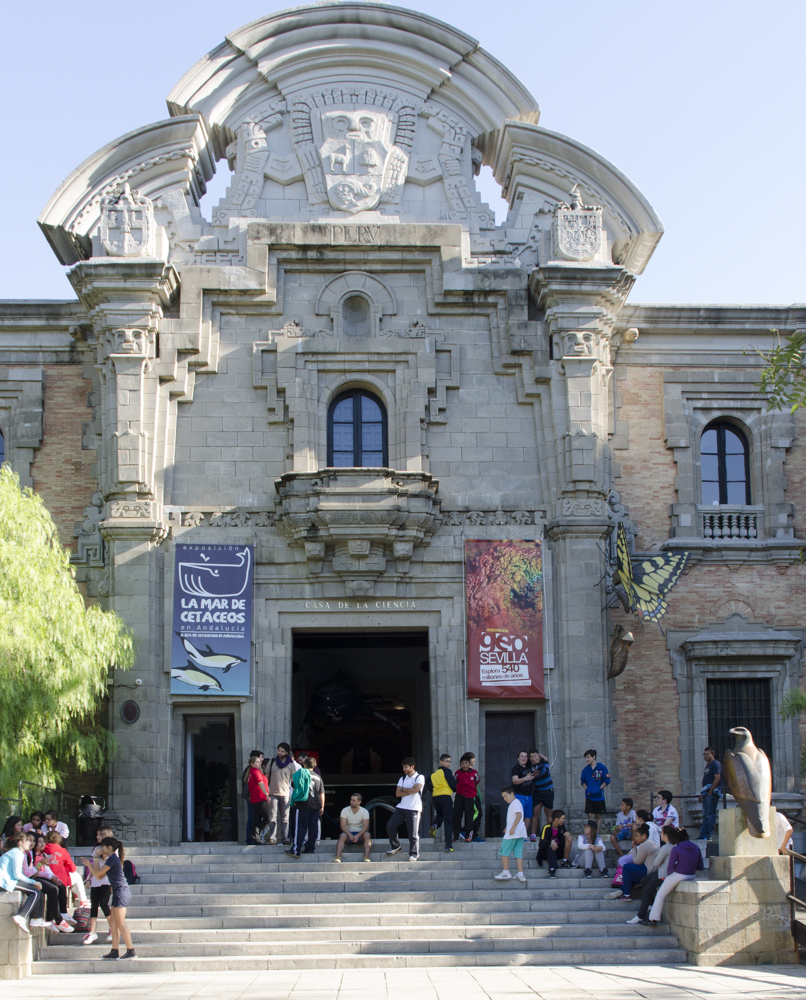
La Casa de la Ciencia is a science museum located in the historic Maria Luisa Park in Seville, Spain. It is housed within the former Peruvian Pavilion, a building originally constructed for the 1929 Ibero-American Exposition. The museum serves as a center for scientific dissemination, managed by the Spanish National Research Council (CSIC) in collaboration with the regional government.
The facility features a variety of permanent and temporary exhibitions focused on astronomy, biodiversity, and geology. It includes a planetarium and dedicated spaces for educational workshops, aiming to bridge the gap between scientific research and the general public through interactive displays and curated collections.
Key Facts
- Materials
- Brick, Ceramic tiles, Stone
- Civilization
- Spanish
- Accessibility
- Wheelchair accessible
- Date(s)
- 1929
- Condition
- Restored and active museum
- Original Function
- Exhibition Pavilion
- Key Figures
- Manuel Piqueras Cotolí
The Ibero-American Exposition
1929The building was designed by architect Manuel Piqueras Cotolí to serve as the Peruvian Pavilion for the 1929 Ibero-American Exposition. It is noted for its Neo-Peruvian architectural style, which incorporates indigenous Andean motifs and colonial influences.
Post-Exposition Use
1930-2000Following the conclusion of the exposition, the building served various administrative and institutional purposes. Its location within the Maria Luisa Park ensured its preservation as a significant landmark of the city's architectural heritage.
Transformation into a Science Museum
2008-PresentIn 2008, the building was repurposed as La Casa de la Ciencia. The initiative was led by the CSIC to create a permanent space for scientific outreach in Andalusia, leading to extensive renovations to accommodate modern exhibition galleries and a planetarium.
Cultural Significance
La Casa de la Ciencia represents the intersection of Seville's historical architectural legacy and its modern commitment to scientific education. By occupying a building from the 1929 Exposition, it preserves the memory of the city's international outreach while providing a contemporary venue for public engagement with STEM fields.
Visiting Information
Entry Rules
Open Tuesday to Sunday. Tickets can be purchased at the entrance. Concessions are available for students, seniors, and groups.
Best Times to Visit
Weekday mornings are generally quieter. The museum is a popular destination for school groups, so visiting during mid-afternoon can provide a more relaxed experience.
Photography
Personal photography is permitted in most areas. Flash and tripods are prohibited in the planetarium and certain temporary exhibition galleries.
Preservation Notes
The building is a protected historical structure. Visitors are requested to respect the architectural features and follow signage regarding the handling of interactive displays.
Nearby POIs
11 shown- Catedral de Valencia0.1 km
- Torres de Serranos0.3 km
- Lonja de la Seda0.3 km
- Gonzalez Marti National Museum of Ceramics and Decorative Arts0.4 km
- Museu de Belles Arts de Valencia0.5 km
- Prehistory Museum of Valencia0.7 km
- Institut Valencia d'Art Modern0.7 km
- Valencian Museum of Ethnology0.7 km
- Torres de Quart0.7 km
- Valencia History Museum2.8 km
- City of Arts and Sciences3.1 km
Sources & Further Reading
- [1]La Casa de la Ciencia: Historia y Arquitectura — Consejo Superior de Investigaciones Científicas. CSIC Official Portal (2020)View
- [2]Arquitectura de la Exposición Iberoamericana de 1929 — Ayuntamiento de Sevilla. Sevilla Patrimonio (2015)
Key Facts
- Materials
- Brick, Ceramic tiles, Stone
- Civilization
- Spanish
- Accessibility
- Wheelchair accessible
- Date(s)
- 1929
- Condition
- Restored and active museum
- Original Function
- Exhibition Pavilion
- Key Figures
- Manuel Piqueras Cotolí
Nearby POIs
11 shown- Catedral de Valencia0.1 km
- Torres de Serranos0.3 km
- Lonja de la Seda0.3 km
- Gonzalez Marti National Museum of Ceramics and Decorative Arts0.4 km
- Museu de Belles Arts de Valencia0.5 km
- Prehistory Museum of Valencia0.7 km
- Institut Valencia d'Art Modern0.7 km
- Valencian Museum of Ethnology0.7 km
- Torres de Quart0.7 km
- Valencia History Museum2.8 km
- City of Arts and Sciences3.1 km