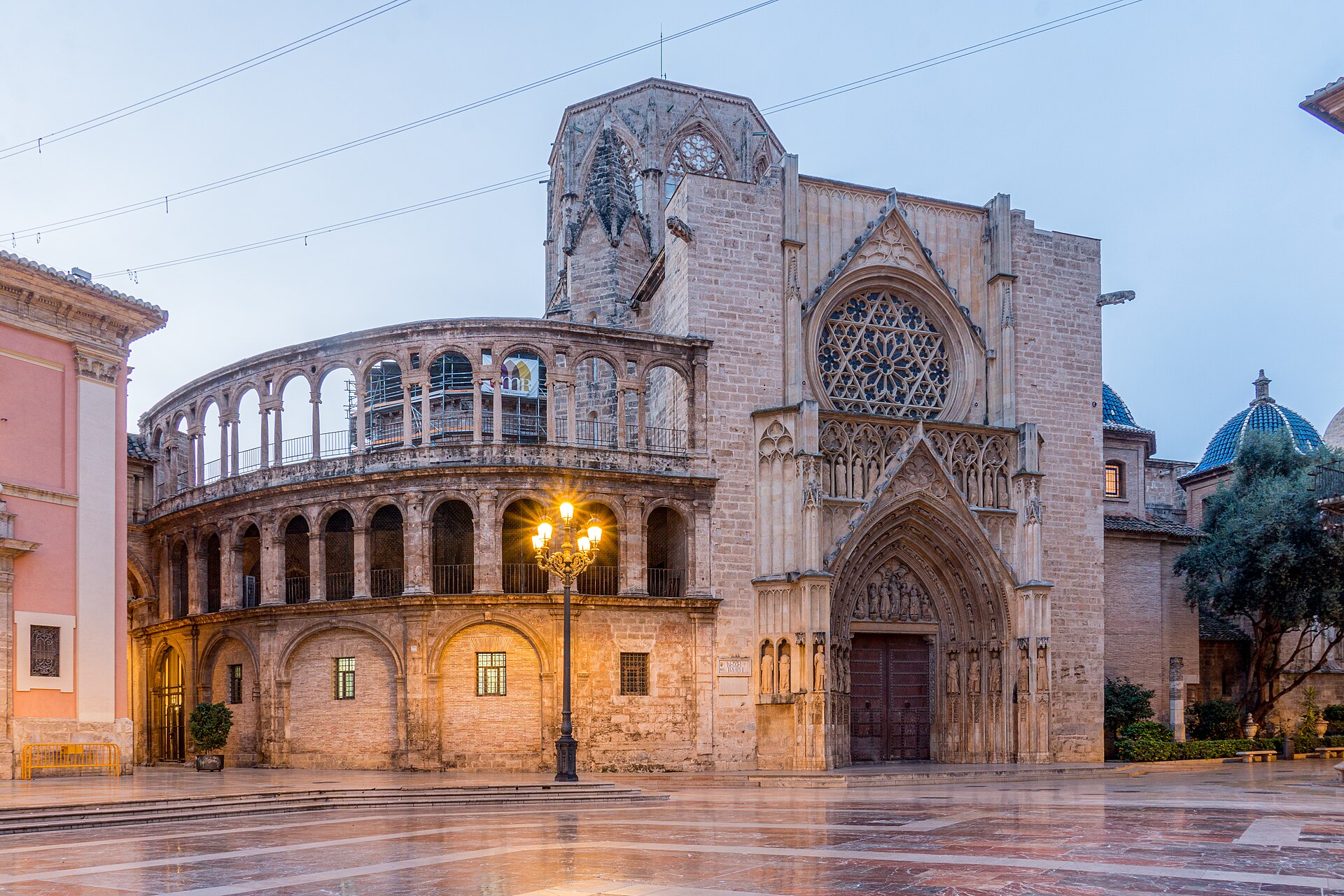
The Cathedral of Valencia, dedicated to Saint Mary, was consecrated in 1238 by the first bishop of Valencia following the Reconquista. Built on the site of a former Visigothic cathedral that had been converted into a mosque, the structure reflects a complex architectural evolution spanning several centuries. Its primary construction began in the 13th century, incorporating Romanesque, Gothic, and later Renaissance and Baroque elements.
The cathedral is internationally recognized for housing the Holy Chalice, a 1st-century vessel venerated by tradition as the Holy Grail. The site also features the Miguelete, a prominent 14th-century bell tower that serves as a landmark of the city skyline, and a collection of Renaissance frescoes discovered behind the altar in the early 21st century.
Key Facts
- Materials
- Stone, Marble, Brick
- Civilization
- Kingdom of Valencia
- Accessibility
- Ground floor accessible; tower access via narrow stairs
- Date(s)
- 1262 - 18th century
- Condition
- Active religious site and museum
- Original Function
- Cathedral
- Key Figures
- James I of Aragon, Pope Callixtus III, Pope Alexander VI
Origins and Reconquest
1238Following the conquest of the city by James I of Aragon, the former Aljama mosque was consecrated as a cathedral. The site had previously served as a Visigothic cathedral before the Islamic period.
Gothic Construction
1262 - 14th centuryConstruction of the current Gothic structure began in 1262. The ambulatory and the Puerta del Palau were completed during this phase, establishing the cathedral's foundational layout.
The Miguelete Tower
1381 - 1429The iconic bell tower, known as El Miguelete, was constructed as a detached structure before being connected to the main cathedral body in the 15th century.
Renaissance and Baroque Additions
15th - 18th centuryThe cathedral underwent significant interior modifications, including the addition of Renaissance frescoes in the main altar and the construction of the Baroque-style Puerta de los Hierros.
Cultural Significance
The Cathedral of Valencia serves as the spiritual heart of the city and a repository of Valencian history. Its role as the custodian of the Holy Chalice makes it a major site for religious pilgrimage and historical study. The cathedral's architectural diversity mirrors the shifting cultural influences of the region, from the post-Reconquista period to the height of the Spanish Renaissance.
Interpretive Notes
Scholarly debates and areas of uncertainty
The provenance of the Holy Chalice remains a subject of historical and archaeological inquiry. While the Catholic Church recognizes it as a relic of significant antiquity, scholars debate its specific origins and the historical accuracy of the traditions linking it to the Last Supper.
Visiting Information
Entry Rules
Open daily for visitors and worshipers. Tickets are required for the museum and the Miguelete tower. Modest dress is requested, and visitors are asked to remain quiet during liturgical services.
Best Times to Visit
Early morning or late afternoon to avoid peak tourist crowds and to experience the cathedral during quieter hours.
Photography
Photography is permitted in most areas without flash. Tripods and professional equipment require prior authorization.
Preservation Notes
The cathedral is an active site of ongoing conservation, particularly regarding the Renaissance frescoes and the structural integrity of the Miguelete tower. Visitors should respect all cordoned-off areas.
Nearby POIs
11 shown- La Casa de la Ciencia0.1 km
- Gonzalez Marti National Museum of Ceramics and Decorative Arts0.3 km
- Lonja de la Seda0.3 km
- Torres de Serranos0.4 km
- Museu de Belles Arts de Valencia0.5 km
- Prehistory Museum of Valencia0.7 km
- Torres de Quart0.8 km
- Valencian Museum of Ethnology0.8 km
- Institut Valencia d'Art Modern0.8 km
- Valencia History Museum2.9 km
- City of Arts and Sciences3 km
Sources & Further Reading
- [1]The Holy Chalice of Valencia — Janice Bennett. Insight Press (2005)
- [2]Valencia Cathedral: Architecture and History — Arturo Zaragoza Catalán. Generalitat Valenciana (2010)
Key Facts
- Materials
- Stone, Marble, Brick
- Civilization
- Kingdom of Valencia
- Accessibility
- Ground floor accessible; tower access via narrow stairs
- Date(s)
- 1262 - 18th century
- Condition
- Active religious site and museum
- Original Function
- Cathedral
- Key Figures
- James I of Aragon, Pope Callixtus III, Pope Alexander VI
Nearby POIs
11 shown- La Casa de la Ciencia0.1 km
- Gonzalez Marti National Museum of Ceramics and Decorative Arts0.3 km
- Lonja de la Seda0.3 km
- Torres de Serranos0.4 km
- Museu de Belles Arts de Valencia0.5 km
- Prehistory Museum of Valencia0.7 km
- Torres de Quart0.8 km
- Valencian Museum of Ethnology0.8 km
- Institut Valencia d'Art Modern0.8 km
- Valencia History Museum2.9 km
- City of Arts and Sciences3 km