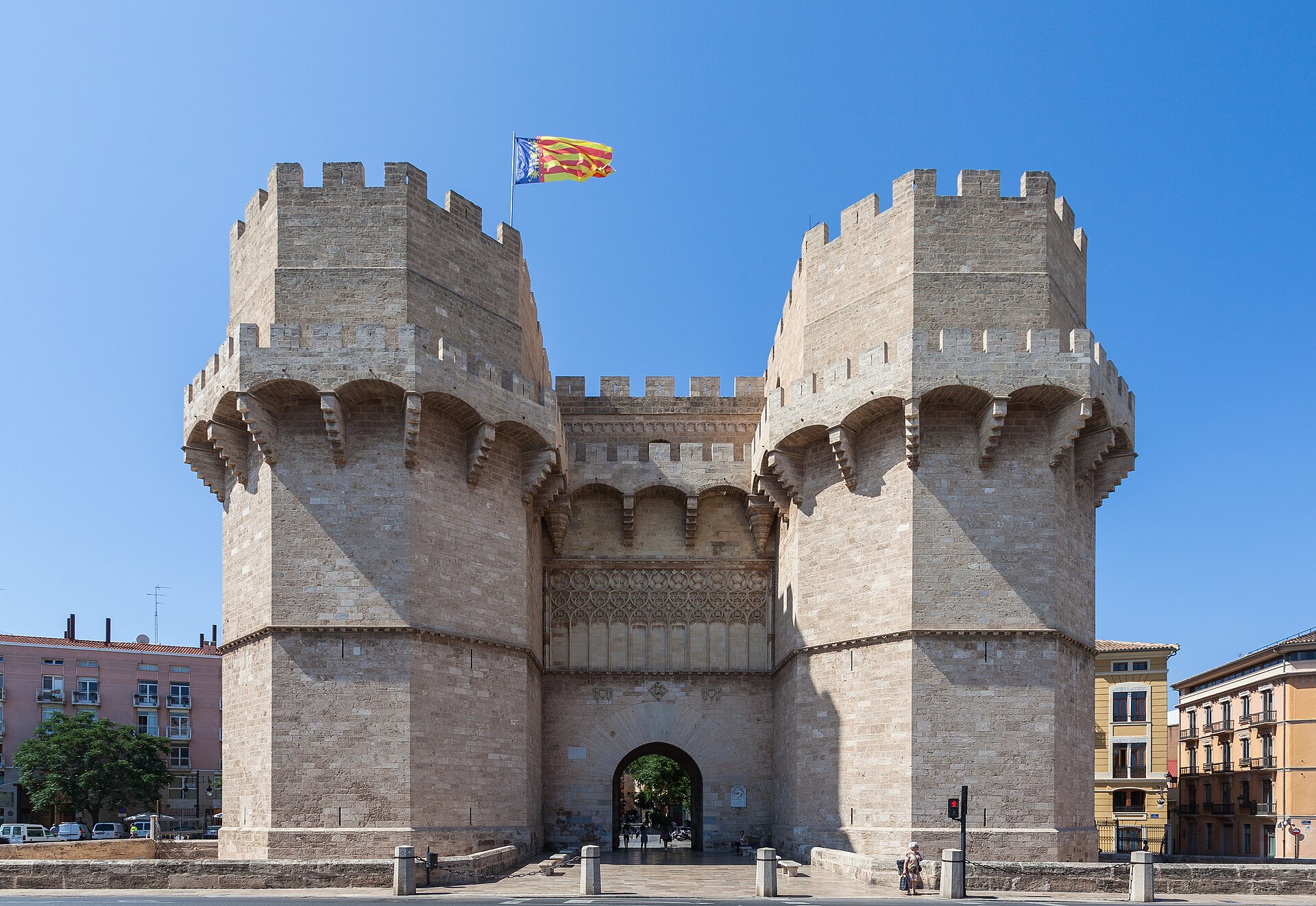
The Torres de Serranos is one of the twelve gates that formed part of the ancient Christian city wall of Valencia, Spain. Constructed between 1392 and 1398 by architects Pere Balaguer and Pere Comte, the structure served as the primary northern entrance to the city and a defensive bastion. Its design reflects the Valencian Gothic style, characterized by two massive polygonal towers flanking a central gate.
Following its military utility, the site functioned as a prison for the nobility from the late 16th century until 1887. During the Spanish Civil War, the towers were used to store and protect art treasures evacuated from the Museo del Prado in Madrid. Today, the monument serves as a public landmark and venue for civic ceremonies, most notably the 'Cridà' which marks the beginning of the Fallas festival.
Key Facts
- Materials
- Limestone, Brick
- Civilization
- Crown of Aragon
- Accessibility
- Stairs required for tower access
- Date(s)
- 1392-1398
- Condition
- Well-preserved, restored
- Original Function
- City gate and defensive fortification
- Key Figures
- Pere Balaguer
Construction and Design
14th CenturyCommissioned by the city council to replace older fortifications, the gate was designed by Pere Balaguer. It was built to demonstrate the wealth and power of Valencia, featuring elaborate stone carvings and defensive battlements.
Prison Era
1586-1887After the city walls lost their defensive necessity, the towers were repurposed as a prison specifically for noblemen and high-ranking individuals, a function they served for three centuries.
Civil War Preservation
1936-1939During the Spanish Civil War, the towers were reinforced to serve as a secure vault for the Spanish national art collection, protecting masterpieces from the Prado Museum from aerial bombardment.
Modern Restoration
20th Century - PresentThe site underwent significant cleaning and structural restoration in the 1990s to remove centuries of urban pollution and stabilize the masonry, allowing for safe public access to the battlements.
Cultural Significance
The Torres de Serranos are a symbol of Valencian identity and architectural heritage. Beyond their historical role as a gateway, they are deeply integrated into the city's modern cultural life. The annual 'Cridà' ceremony, where the Fallera Mayor invites the world to the Fallas festival, takes place at the foot of the towers, cementing their status as the ceremonial heart of the city.
Interpretive Notes
Scholarly debates and areas of uncertainty
There is ongoing academic discussion regarding the extent of the original defensive capabilities versus the symbolic, aesthetic intent of the gate's design. Some historians argue the elaborate facade was intended more as a triumphal arch to impress visitors than as a purely functional military structure.
Visiting Information
Entry Rules
Open to the public with a small entrance fee. Visitors can climb the towers for panoramic views of the city and the Turia Gardens. No specific dress code is required.
Best Times to Visit
Early morning or late afternoon to avoid peak heat and to capture the best light for photography from the top of the towers.
Photography
Personal photography is permitted throughout the site. Commercial photography requires prior authorization from the Valencia City Council.
Preservation Notes
The structure is fragile; visitors are advised to stay within marked paths on the battlements and refrain from leaning on the historic stone parapets.
Nearby POIs
11 shown- La Casa de la Ciencia0.3 km
- Catedral de Valencia0.4 km
- Museu de Belles Arts de Valencia0.4 km
- Institut Valencia d'Art Modern0.6 km
- Lonja de la Seda0.6 km
- Prehistory Museum of Valencia0.6 km
- Valencian Museum of Ethnology0.6 km
- Gonzalez Marti National Museum of Ceramics and Decorative Arts0.7 km
- Torres de Quart0.8 km
- Valencia History Museum2.9 km
- City of Arts and Sciences3.4 km
Sources & Further Reading
- [1]Valencia: The City of Arts and Sciences — Josep Vicent Boira. Universitat de València (2015)
- [2]The Gothic Architecture of Valencia — Arturo Zaragoza Catalán. Generalitat Valenciana (2000)
Key Facts
- Materials
- Limestone, Brick
- Civilization
- Crown of Aragon
- Accessibility
- Stairs required for tower access
- Date(s)
- 1392-1398
- Condition
- Well-preserved, restored
- Original Function
- City gate and defensive fortification
- Key Figures
- Pere Balaguer
Nearby POIs
11 shown- La Casa de la Ciencia0.3 km
- Catedral de Valencia0.4 km
- Museu de Belles Arts de Valencia0.4 km
- Institut Valencia d'Art Modern0.6 km
- Lonja de la Seda0.6 km
- Prehistory Museum of Valencia0.6 km
- Valencian Museum of Ethnology0.6 km
- Gonzalez Marti National Museum of Ceramics and Decorative Arts0.7 km
- Torres de Quart0.8 km
- Valencia History Museum2.9 km
- City of Arts and Sciences3.4 km