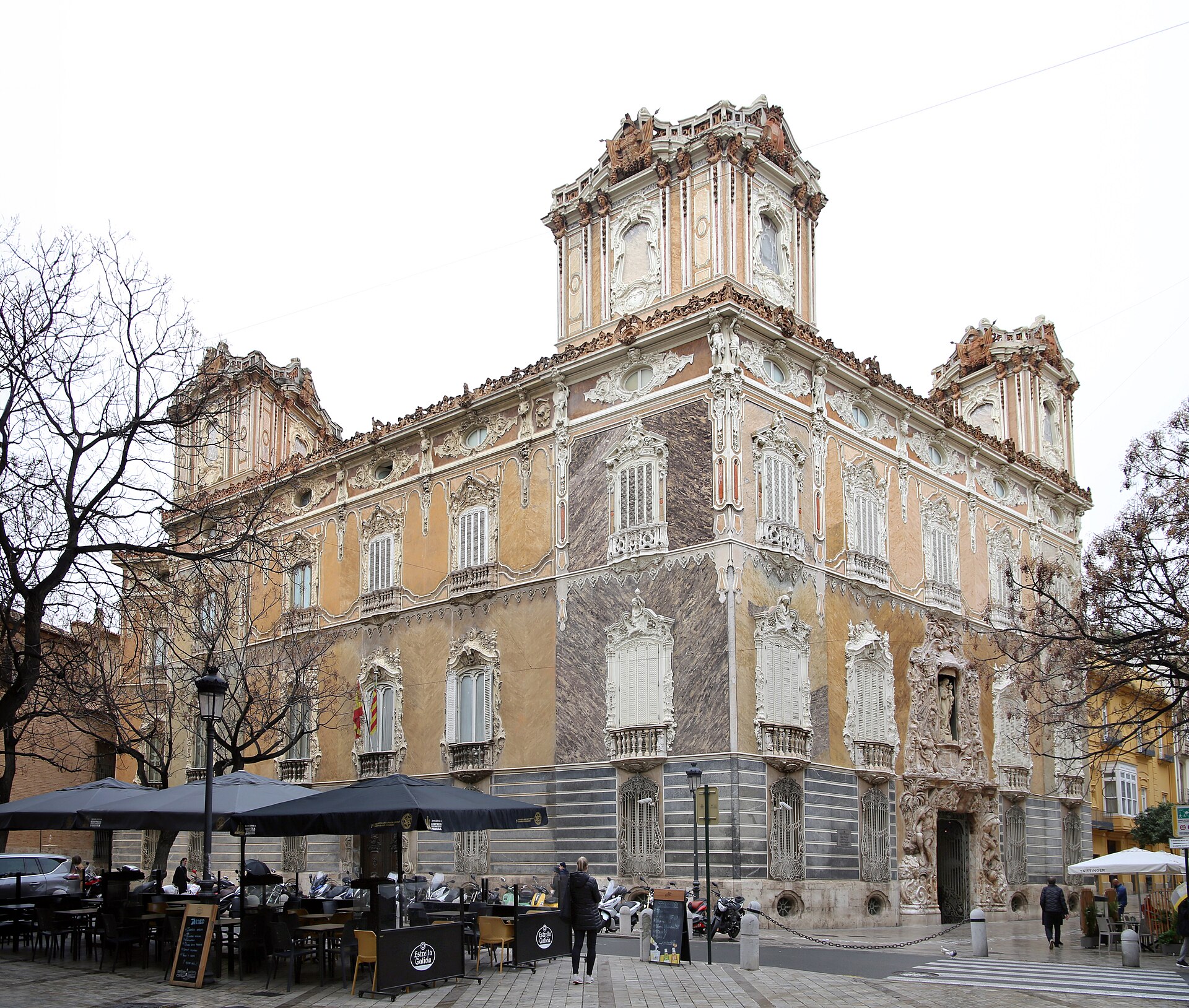
The González Martí National Museum of Ceramics and Decorative Arts is housed in the Palace of the Marqués de Dos Aguas in Valencia, Spain. The building itself is a masterpiece of Rococo architecture, featuring a famous alabaster entrance designed by Ignacio Vergara and sculpted by Luis Domingo, which represents the rivers Turia and Júcar.
The museum's collection originated from the private holdings of Manuel González Martí and his wife, Amelia Cuñat. It encompasses a vast array of ceramics spanning from prehistoric times to the contemporary era, with a particular focus on the rich tradition of Valencian pottery, including Manises and Paterna ware. Beyond ceramics, the museum displays textiles, traditional costumes, furniture, and paintings, offering a comprehensive view of Spanish decorative arts.
Key Facts
- Materials
- Alabaster, Ceramic, Wood, Textiles
- Civilization
- Spanish
- Accessibility
- Wheelchair accessible
- Date(s)
- 1740 (Palace renovation)
- Condition
- Well-preserved museum
- Original Function
- Residential Palace
- Key Figures
- Manuel González Martí, Ignacio Vergara
The Palace Origins
15th-18th CenturyThe building was originally a Gothic palace belonging to the Rabassa de Perellós family. In 1740, the third Marqués de Dos Aguas commissioned a radical renovation, transforming the facade into the elaborate Rococo style that defines the structure today.
Foundation of the Museum
1947-1954Manuel González Martí donated his extensive private collection of ceramics to the Spanish state in 1947. The museum was officially established in 1954, with the Palace of the Marqués de Dos Aguas acquired by the government to serve as its permanent home.
Modern Expansion
1990s-PresentThe museum underwent a major renovation in the 1990s to modernize its facilities and improve the display of its growing collection. Today, it remains a primary institution for the study and preservation of Spanish decorative arts.
Cultural Significance
The museum serves as the primary repository for Valencian ceramic history, a craft that has defined the region's economy and artistic identity for centuries. The Palace of the Marqués de Dos Aguas is considered a landmark of Spanish Baroque and Rococo architecture, symbolizing the wealth and influence of the Valencian nobility during the 18th century.
Interpretive Notes
Scholarly debates and areas of uncertainty
Debates often center on the attribution of specific ceramic pieces from the Manises workshops, as historical records for early production are sometimes fragmented. Additionally, there is ongoing discussion regarding the balance between preserving the palace's original residential interior and adapting the space for modern museum display requirements.
Visiting Information
Entry Rules
Open Tuesday to Sunday. Tickets can be purchased at the entrance. Reduced rates apply for students and seniors. Free entry is available on Sundays and specific public holidays.
Best Times to Visit
Weekday mornings are generally quieter. The museum is a popular destination during the Fallas festival in March, though it can be significantly more crowded during this period.
Photography
Personal photography is permitted without flash or tripods. Professional or commercial photography requires prior authorization from the museum administration.
Preservation Notes
Visitors are requested not to touch the exhibits or the palace walls. Large bags must be left in the provided lockers. Flash photography is strictly prohibited to protect light-sensitive textiles and pigments.
Nearby POIs
11 shown- Catedral de Valencia0.3 km
- Lonja de la Seda0.4 km
- La Casa de la Ciencia0.4 km
- Torres de Serranos0.7 km
- Museu de Belles Arts de Valencia0.7 km
- Torres de Quart0.9 km
- Prehistory Museum of Valencia0.9 km
- Valencian Museum of Ethnology0.9 km
- Institut Valencia d'Art Modern1 km
- City of Arts and Sciences2.8 km
- Valencia History Museum2.9 km
Key Facts
- Materials
- Alabaster, Ceramic, Wood, Textiles
- Civilization
- Spanish
- Accessibility
- Wheelchair accessible
- Date(s)
- 1740 (Palace renovation)
- Condition
- Well-preserved museum
- Original Function
- Residential Palace
- Key Figures
- Manuel González Martí, Ignacio Vergara
Nearby POIs
11 shown- Catedral de Valencia0.3 km
- Lonja de la Seda0.4 km
- La Casa de la Ciencia0.4 km
- Torres de Serranos0.7 km
- Museu de Belles Arts de Valencia0.7 km
- Torres de Quart0.9 km
- Prehistory Museum of Valencia0.9 km
- Valencian Museum of Ethnology0.9 km
- Institut Valencia d'Art Modern1 km
- City of Arts and Sciences2.8 km
- Valencia History Museum2.9 km