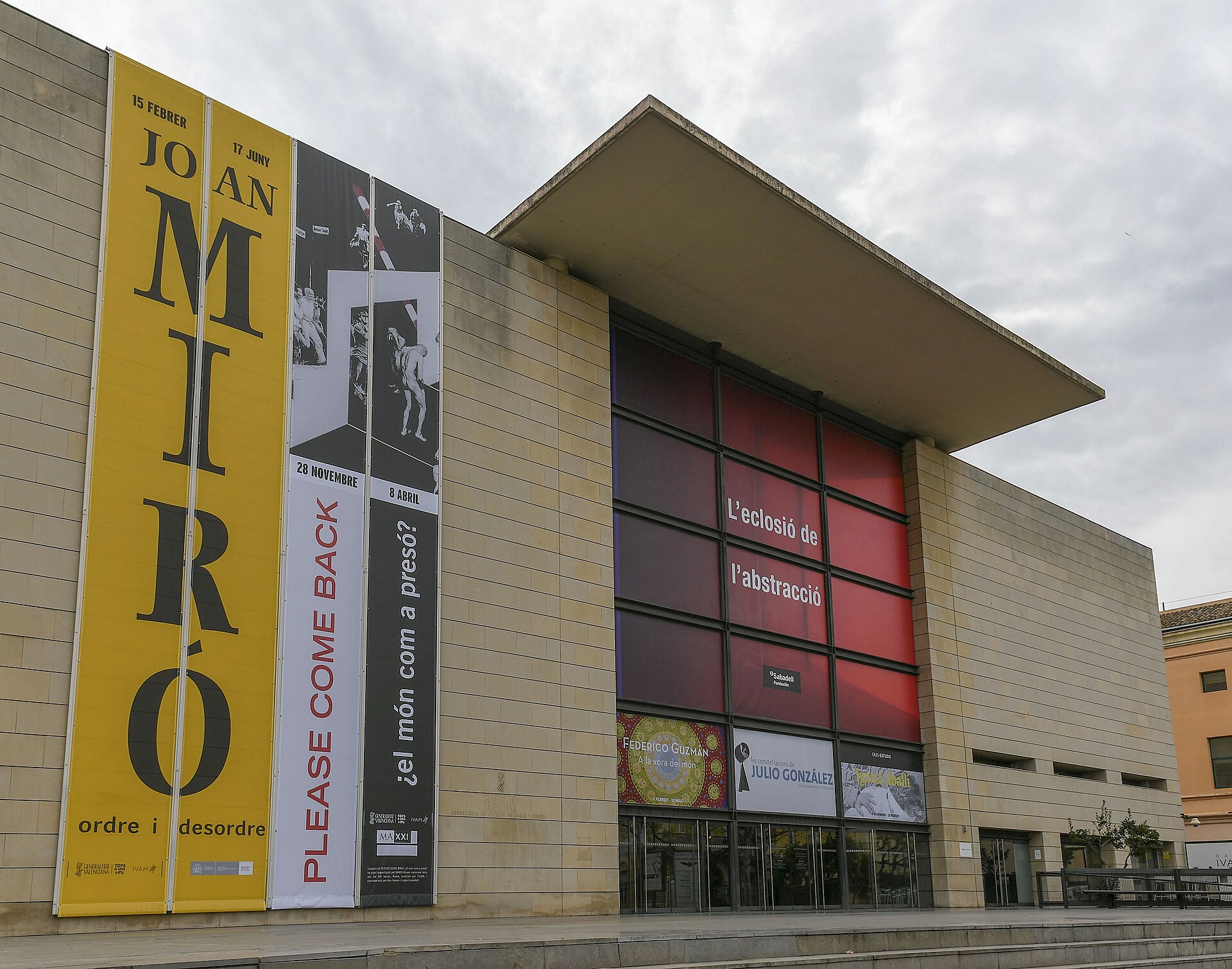
The Institut Valencià d'Art Modern (IVAM) was established in 1986 as the first center in Spain dedicated exclusively to modern and contemporary art. Located in the El Carmen neighborhood of Valencia, the museum serves as a primary institution for the study and dissemination of 20th-century avant-garde movements, with a particular focus on the work of sculptor Julio González and the painter Ignacio Pinazo.
The museum complex comprises two main venues: the Centre Julio González, which houses the permanent collection and administrative offices, and the Sala de la Muralla, which displays archaeological remains of the medieval city walls. Through its extensive collection and rotating exhibitions, the IVAM explores the evolution of modern art, photography, and design within both a Spanish and international context.
Key Facts
- Materials
- Concrete, Glass, Steel
- Civilization
- Spanish
- Accessibility
- Fully wheelchair accessible
- Date(s)
- 1989
- Condition
- Active, well-maintained
- Original Function
- Modern Art Museum
- Key Figures
- Julio González, Ignacio Pinazo
Foundation and Opening
1986-1989The IVAM was founded in 1986 by the Generalitat Valenciana. The Centre Julio González, designed by architects Emilio Giménez and Carlos Salvadores, opened its doors in 1989 to house the museum's growing collection.
Expansion and Integration
1990sDuring the 1990s, the museum expanded its facilities to include the Sala de la Muralla, integrating the archaeological ruins of the 14th-century medieval city walls into the museum's exhibition space.
Contemporary Evolution
2000-PresentThe institution has continued to evolve, focusing on digital archives, educational outreach, and international collaborations. It remains a central pillar of Valencia's cultural landscape and a key reference point for contemporary art research in Europe.
Cultural Significance
The IVAM is a cornerstone of cultural life in Valencia, representing the city's transition into a major hub for contemporary art in the post-Franco era. It plays a vital role in preserving the legacy of Spanish avant-garde artists while fostering dialogue between local creators and the global art community.
Interpretive Notes
Scholarly debates and areas of uncertainty
Discussions often center on the balance between maintaining the museum's historical focus on the 20th-century avant-garde versus the need to dedicate more space to emerging contemporary practices and digital media.
Visiting Information
Entry Rules
Open Tuesday to Sunday. Tickets can be purchased online or at the box office. Reduced rates are available for students, seniors, and groups.
Best Times to Visit
Weekday mornings are generally quieter. The museum is often busier during the opening of new temporary exhibitions.
Photography
Non-commercial photography is permitted in most galleries without flash or tripods. Specific temporary exhibitions may prohibit photography.
Preservation Notes
Maintain a respectful distance from artworks. Large bags and backpacks must be stored in the provided lockers.
Nearby POIs
11 shown- Prehistory Museum of Valencia0.2 km
- Valencian Museum of Ethnology0.2 km
- Torres de Quart0.4 km
- Torres de Serranos0.6 km
- La Casa de la Ciencia0.7 km
- Lonja de la Seda0.7 km
- Catedral de Valencia0.8 km
- Gonzalez Marti National Museum of Ceramics and Decorative Arts1 km
- Museu de Belles Arts de Valencia1 km
- Valencia History Museum2.4 km
- City of Arts and Sciences3.8 km
Sources & Further Reading
- [1]
- [2]The Architecture of the IVAM — Emilio Giménez. Valencia Architectural Review (1990)
Key Facts
- Materials
- Concrete, Glass, Steel
- Civilization
- Spanish
- Accessibility
- Fully wheelchair accessible
- Date(s)
- 1989
- Condition
- Active, well-maintained
- Original Function
- Modern Art Museum
- Key Figures
- Julio González, Ignacio Pinazo
Nearby POIs
11 shown- Prehistory Museum of Valencia0.2 km
- Valencian Museum of Ethnology0.2 km
- Torres de Quart0.4 km
- Torres de Serranos0.6 km
- La Casa de la Ciencia0.7 km
- Lonja de la Seda0.7 km
- Catedral de Valencia0.8 km
- Gonzalez Marti National Museum of Ceramics and Decorative Arts1 km
- Museu de Belles Arts de Valencia1 km
- Valencia History Museum2.4 km
- City of Arts and Sciences3.8 km