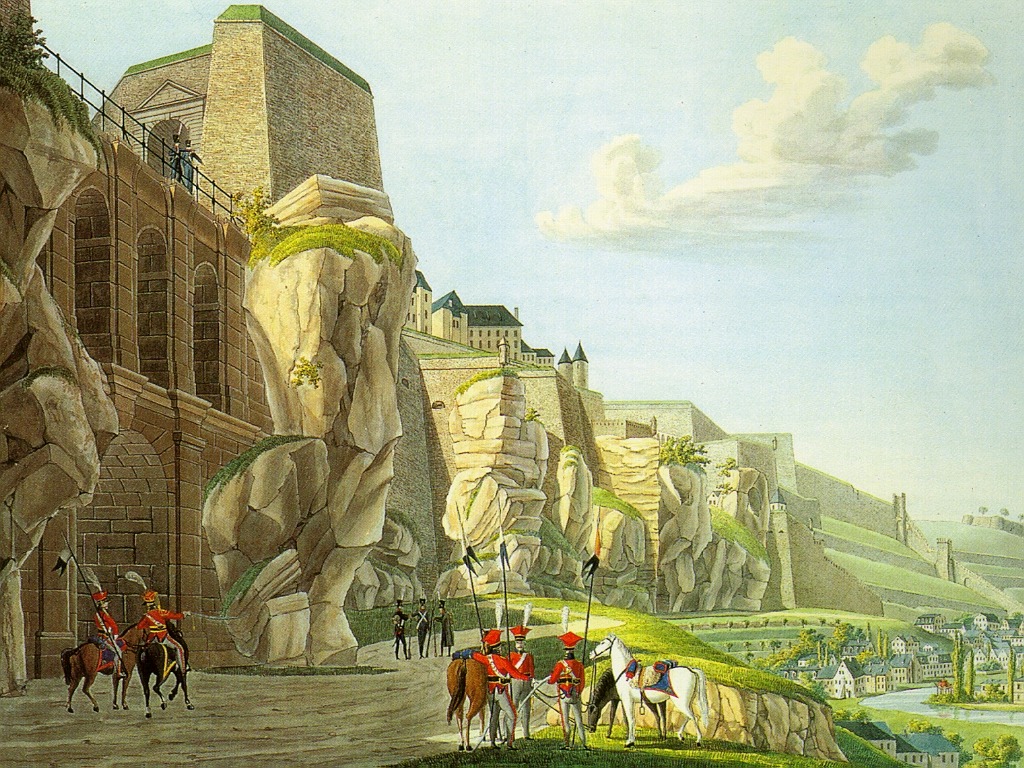
The Bock is a rocky promontory that served as the strategic foundation for the city of Luxembourg. In 963 CE, Count Siegfried built his castle, 'Lucilinburhuc,' on this site, marking the origin of the city and the nation. The location's natural defensive advantages led to its continuous expansion into one of the most formidable fortresses in Europe, often referred to as the 'Gibraltar of the North.'
Today, the site is best known for the Casemates du Bock, an extensive network of underground tunnels and galleries carved into the rock. These fortifications were developed over centuries by successive ruling powers, including the Burgundians, Spaniards, French, and Austrians, to house soldiers, horses, and military equipment, ultimately serving as a testament to the evolution of European military engineering.
Key Facts
- Materials
- Sandstone, Limestone
- Civilization
- Luxembourgish / Holy Roman Empire
- Accessibility
- Partial; steep terrain and uneven surfaces in tunnels
- Date(s)
- 963 CE
- Condition
- Ruined castle foundations with well-preserved underground casemates
- Original Function
- Castle and defensive fortification
- Key Figures
- Count Siegfried, Vauban, Philip the Good
Founding of the Castle
963 CECount Siegfried of the Ardennes acquired the rocky outcrop from the Abbey of St. Maximin in Trier. He constructed a small castle here, which became the seat of the County of Luxembourg and the nucleus of the future city.
Expansion and Siege Warfare
14th-17th centuryAs the strategic importance of the site grew, the fortress was expanded by various European powers. The Burgundian and Spanish occupations saw the addition of sophisticated bastions and the initial development of the underground defensive galleries.
The Vauban Era
1684-1795Following the French conquest, the military engineer Vauban significantly redesigned the fortifications. The casemates were expanded to reach a total length of 23 kilometers, capable of sheltering thousands of troops and their supplies.
Demilitarization and Preservation
1867-PresentUnder the Treaty of London in 1867, the fortress was dismantled. While the surface structures were largely demolished, the underground casemates were preserved. The site was declared a UNESCO World Heritage site in 1994.
Cultural Significance
The Bock is the symbolic birthplace of Luxembourg. It represents the historical struggle for sovereignty in the heart of Europe, having been occupied by almost every major European power over the centuries. It remains a central element of the national identity and a primary site for understanding the history of European fortification architecture.
Interpretive Notes
Scholarly debates and areas of uncertainty
There is ongoing discussion regarding the extent of the original 10th-century castle foundations versus later medieval additions, as much of the site was heavily modified during the 17th and 18th-century military upgrades.
Visiting Information
Entry Rules
The Casemates are open to the public seasonally (typically March to October). Tickets are required for entry into the underground tunnels. No specific dress code, but sturdy footwear is recommended due to damp and uneven floors.
Best Times to Visit
Spring and autumn offer the best balance of weather and crowd levels. Early morning visits are recommended to avoid peak tourist traffic in the narrow tunnels.
Photography
Personal photography is permitted throughout the site. Flash is recommended for the darker sections of the casemates.
Preservation Notes
The site is fragile; visitors must stay within marked paths. The underground environment is naturally humid and cool, regardless of outside temperature.
Nearby POIs
10 shown- National Museum of Archaeology, History, and Art0.2 km
- Grand Ducal Palace0.2 km
- Luxembourg City History Museum0.2 km
- Notre-Dame Cathedral of Luxembourg0.4 km
- Gelle Fra0.5 km
- MUDAM0.7 km
- Beaufort Castle27 km
- Luxembourg National Museum of Military History28.9 km
- Bourscheid Castle33 km
- Chateau de Vianden36.3 km
Sources & Further Reading
- [1]The Fortress of Luxembourg: A History — Jean-Marie Kreins. Luxembourg City Museum Press (2010)
- [2]Vauban and the Fortifications of Europe — Christopher Duffy. Routledge (1985)
Key Facts
- Materials
- Sandstone, Limestone
- Civilization
- Luxembourgish / Holy Roman Empire
- Accessibility
- Partial; steep terrain and uneven surfaces in tunnels
- Date(s)
- 963 CE
- Condition
- Ruined castle foundations with well-preserved underground casemates
- Original Function
- Castle and defensive fortification
- Key Figures
- Count Siegfried, Vauban, Philip the Good
Nearby POIs
10 shown- National Museum of Archaeology, History, and Art0.2 km
- Grand Ducal Palace0.2 km
- Luxembourg City History Museum0.2 km
- Notre-Dame Cathedral of Luxembourg0.4 km
- Gelle Fra0.5 km
- MUDAM0.7 km
- Beaufort Castle27 km
- Luxembourg National Museum of Military History28.9 km
- Bourscheid Castle33 km
- Chateau de Vianden36.3 km