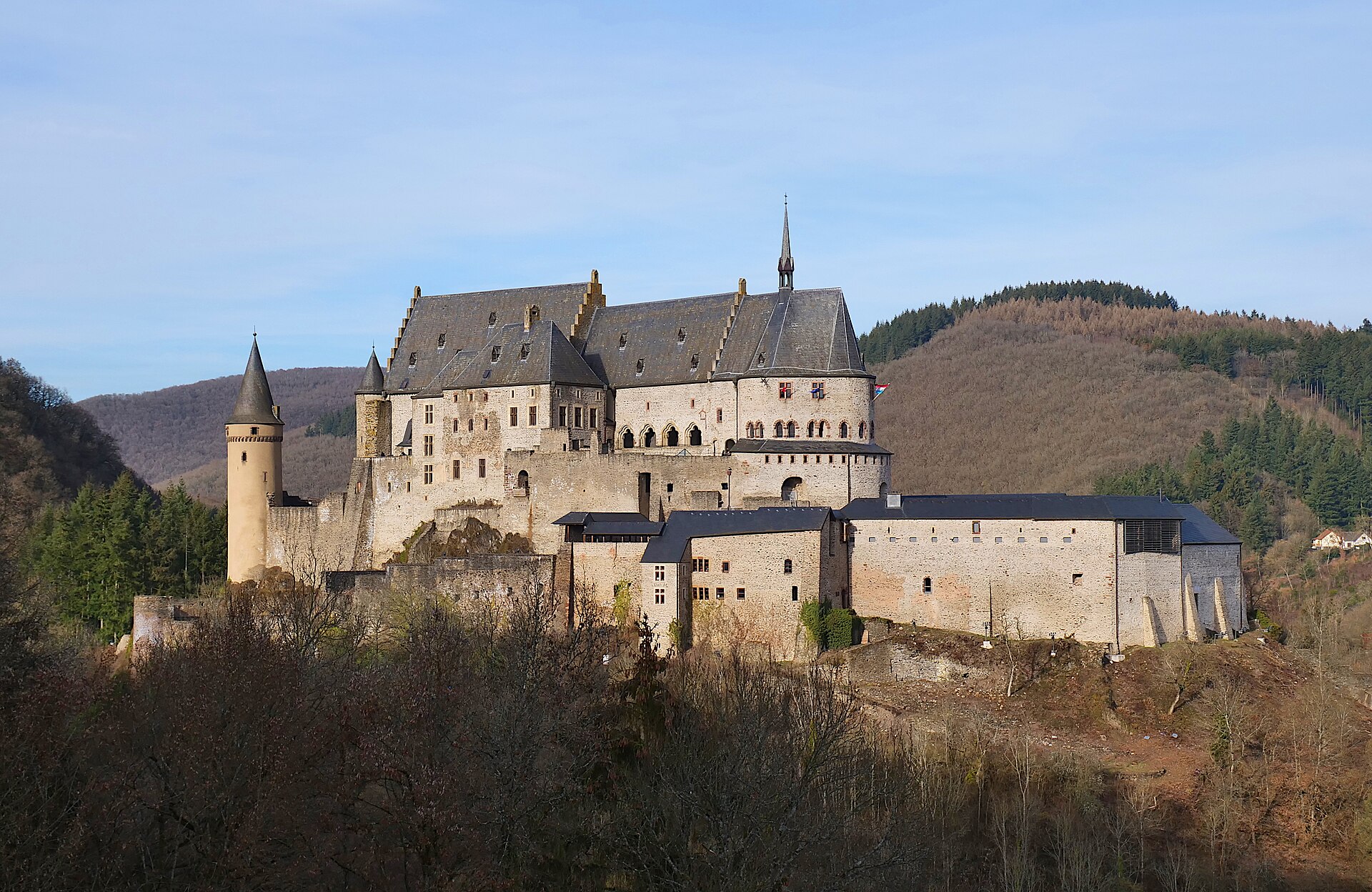
Chateau de Vianden is one of the largest and most significant feudal residences of the Romanesque and Gothic periods in Europe. Situated on a rocky promontory overlooking the Our River, the castle was constructed between the 11th and 14th centuries on the foundations of a Roman castellum and a Carolingian refuge.
The structure served as the seat of the powerful Counts of Vianden until the early 15th century. After centuries of neglect and partial destruction, the castle underwent an extensive restoration process beginning in 1977, which returned the site to its former architectural grandeur and established it as a primary cultural landmark in Luxembourg.
Key Facts
- Materials
- Sandstone, Slate, Timber
- Civilization
- Luxembourgish / Holy Roman Empire
- Accessibility
- Partially accessible; steep terrain and stairs limit access to some upper levels
- Date(s)
- 11th - 14th century
- Condition
- Fully restored and open as a museum
- Original Function
- Fortified residence and administrative center
- Key Figures
- Counts of Vianden, Henry I of Vianden, Grand Duke Jean of Luxembourg
Origins and Early Development
11th centuryThe castle was built on the site of a former Roman fort. The earliest Romanesque sections, including the chapel and the small palace, date back to the 11th century, establishing the site as the seat of the influential Counts of Vianden.
Gothic Expansion
13th - 14th centuryDuring the 13th century, the castle underwent significant expansion in the Gothic style. The Great Palace and the Banqueting Hall were added, reflecting the growing political influence and wealth of the counts within the Holy Roman Empire.
Decline and Ruin
15th - 19th centuryFollowing the marriage of the last countess to the House of Nassau, the castle lost its status as a primary residence. It fell into disrepair, and in 1820, King William I of the Netherlands sold the structure, leading to further looting and structural decay.
Restoration and Modern Era
1977 - presentThe Luxembourg state acquired the castle in 1977 and initiated a comprehensive restoration project. The work focused on reconstructing the roof and interior spaces based on historical records, transforming the ruins into a museum and cultural venue.
Cultural Significance
Chateau de Vianden is a symbol of Luxembourg's medieval heritage and the historical autonomy of the Vianden region. It serves as a vital link to the architectural history of the Ardennes, demonstrating the transition from defensive Romanesque fortifications to the refined residential Gothic style.
Today, the castle hosts the annual Vianden Medieval Festival, which draws international visitors and reinforces the site's role in maintaining regional cultural identity and historical education.
Interpretive Notes
Scholarly debates and areas of uncertainty
Debate exists regarding the exact extent of the original Roman castellum foundations, as subsequent medieval construction significantly altered the site. Additionally, some architectural historians have questioned the historical accuracy of certain 20th-century restoration choices, particularly regarding the interior decorative elements.
Visiting Information
Entry Rules
Open daily. Tickets can be purchased at the entrance or online. No specific dress code, but comfortable walking shoes are recommended due to the steep approach and uneven stone floors.
Best Times to Visit
Spring and autumn offer the best weather for exploring the exterior grounds. Weekdays in the shoulder season are recommended to avoid peak tourist crowds.
Photography
Personal photography is permitted throughout the castle. Commercial photography requires prior authorization from the castle administration.
Preservation Notes
Visitors are requested to stay on marked paths and refrain from touching historical wall surfaces. The castle is a protected monument and active restoration work may occasionally restrict access to specific rooms.
Nearby POIs
10 shownSources & Further Reading
- [1]Vianden: The Castle and the Town — Jean-Pierre Koltz. Editions Saint-Paul (1995)
- [2]The Castles of Luxembourg — G. Spang. Luxembourg National Museum of History and Art (2008)
Key Facts
- Materials
- Sandstone, Slate, Timber
- Civilization
- Luxembourgish / Holy Roman Empire
- Accessibility
- Partially accessible; steep terrain and stairs limit access to some upper levels
- Date(s)
- 11th - 14th century
- Condition
- Fully restored and open as a museum
- Original Function
- Fortified residence and administrative center
- Key Figures
- Counts of Vianden, Henry I of Vianden, Grand Duke Jean of Luxembourg