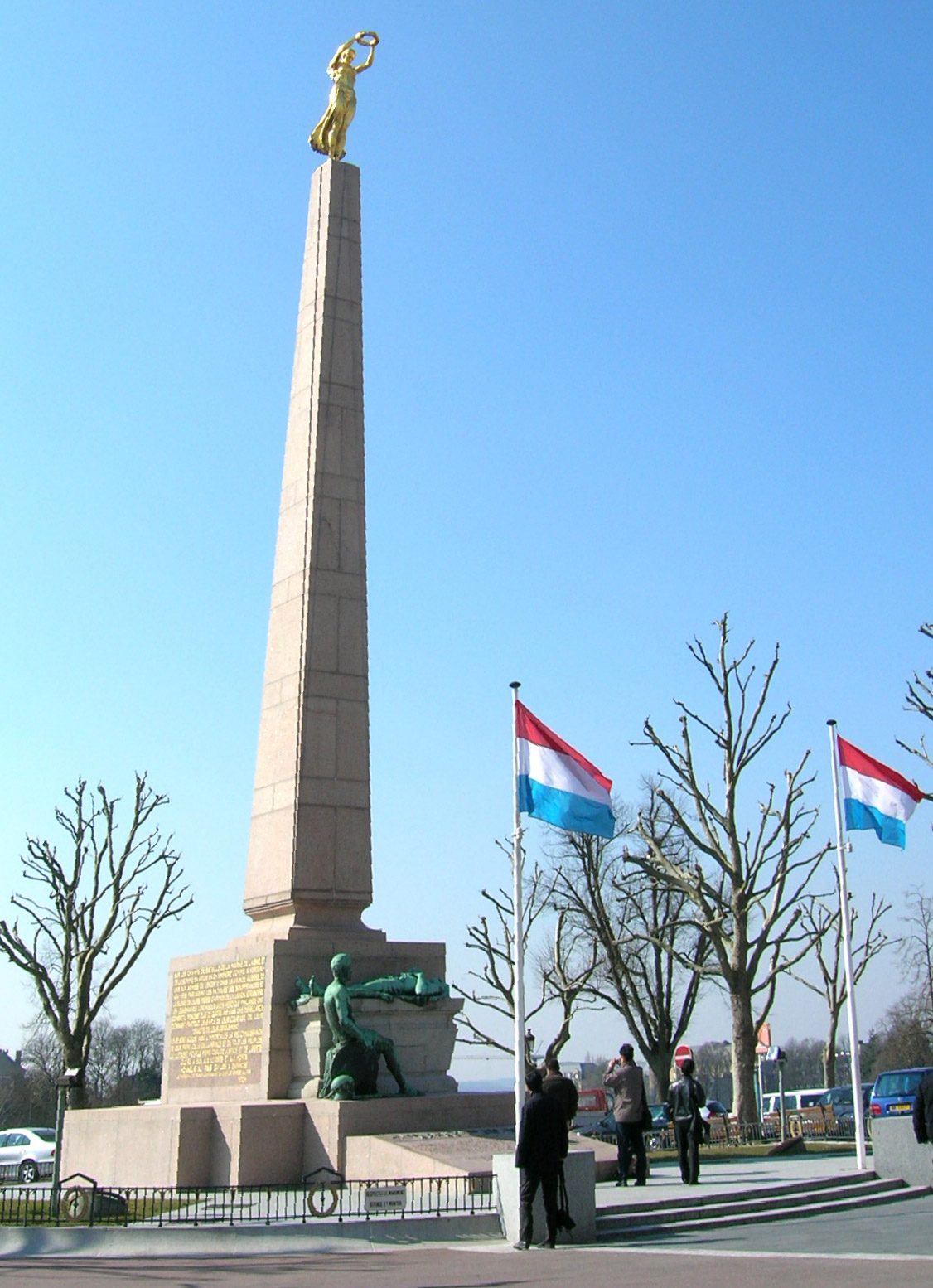
The Gëlle Fra, or 'Golden Lady,' is a war memorial located in the Place de la Constitution in Luxembourg City. It consists of a tall granite obelisk topped by a gilded bronze statue of a woman holding a laurel wreath, symbolizing victory and peace. The monument serves as a national symbol of resistance and remembrance for the thousands of Luxembourgers who volunteered for service in the Allied forces during both World Wars and the Korean War.
Originally unveiled in 1923 to commemorate those who died in World War I, the monument was dismantled by Nazi occupation forces in 1940. It remained lost for decades until its rediscovery in 1980, leading to its restoration and re-erection in 1985. Today, it stands as a central site for national commemorations and a poignant reminder of Luxembourg's contribution to global conflicts.
Key Facts
- Materials
- Granite, Gilded bronze
- Civilization
- Luxembourgish
- Accessibility
- Public square, fully accessible
- Date(s)
- 1923
- Condition
- Restored and well-maintained
- Original Function
- World War I memorial
- Key Figures
- Claus Cito
Inauguration
1923The monument was designed by the Luxembourgish sculptor Claus Cito and inaugurated in 1923 to honor the volunteers who served in the French army during the First World War.
Dismantling and Loss
1940Following the German invasion of Luxembourg in 1940, the Nazi occupation authorities ordered the destruction of the monument, viewing it as a symbol of anti-German sentiment. The statue was toppled and the obelisk dismantled.
Rediscovery and Restoration
1980-1985After decades of being considered lost, the statue was rediscovered in 1980 under the stands of the national football stadium. Following a public campaign, it was restored and returned to its original site in 1985.
Modern Commemoration
21st CenturyThe monument's scope was expanded to include those who served in the Second World War, the Korean War, and the Spanish Civil War, solidifying its role as the primary site for national remembrance in Luxembourg.
Cultural Significance
The Gëlle Fra is arguably the most recognizable national monument in Luxembourg. It represents the country's resilience and its historical alignment with the Allied powers. The statue's survival, disappearance, and eventual return have turned it into a powerful metaphor for the nation's own survival through the turbulent 20th century.
It serves as a focal point for official state ceremonies, particularly on National Day and Remembrance Day. The site is deeply embedded in the collective memory of the Luxembourgish people, representing both the tragedy of war and the hope for lasting peace.
Interpretive Notes
Scholarly debates and areas of uncertainty
There is limited scholarly debate regarding the monument itself, though historians have analyzed the shifting political narratives surrounding the memorial's dedication—from a specific WWI tribute to a broader, inclusive symbol of all Luxembourgish war volunteers.
Visiting Information
Entry Rules
The monument is located in a public square and is accessible 24 hours a day. No entry fees or tickets are required.
Best Times to Visit
Early morning or late evening provides the best lighting for photography. The site is particularly significant during national commemorative events in late June.
Photography
None; the monument is in a public space and photography is unrestricted.
Preservation Notes
The monument is protected as a national heritage site. Visitors are asked to respect the solemn nature of the memorial.
Nearby POIs
10 shown- Notre-Dame Cathedral of Luxembourg0.2 km
- Grand Ducal Palace0.3 km
- Luxembourg City History Museum0.3 km
- National Museum of Archaeology, History, and Art0.4 km
- The Bock0.5 km
- MUDAM1.2 km
- Beaufort Castle27.4 km
- Luxembourg National Museum of Military History29.2 km
- Bourscheid Castle33.2 km
- Chateau de Vianden36.6 km
Sources & Further Reading
- [1]The Gëlle Fra: A Symbol of Luxembourg — National Museum of History and Art. Luxembourg Government Publications (2015)View
- [2]Claus Cito and the Golden Lady — Jean-Marie Kreins. History of Luxembourg (2010)
Key Facts
- Materials
- Granite, Gilded bronze
- Civilization
- Luxembourgish
- Accessibility
- Public square, fully accessible
- Date(s)
- 1923
- Condition
- Restored and well-maintained
- Original Function
- World War I memorial
- Key Figures
- Claus Cito
Nearby POIs
10 shown- Notre-Dame Cathedral of Luxembourg0.2 km
- Grand Ducal Palace0.3 km
- Luxembourg City History Museum0.3 km
- National Museum of Archaeology, History, and Art0.4 km
- The Bock0.5 km
- MUDAM1.2 km
- Beaufort Castle27.4 km
- Luxembourg National Museum of Military History29.2 km
- Bourscheid Castle33.2 km
- Chateau de Vianden36.6 km