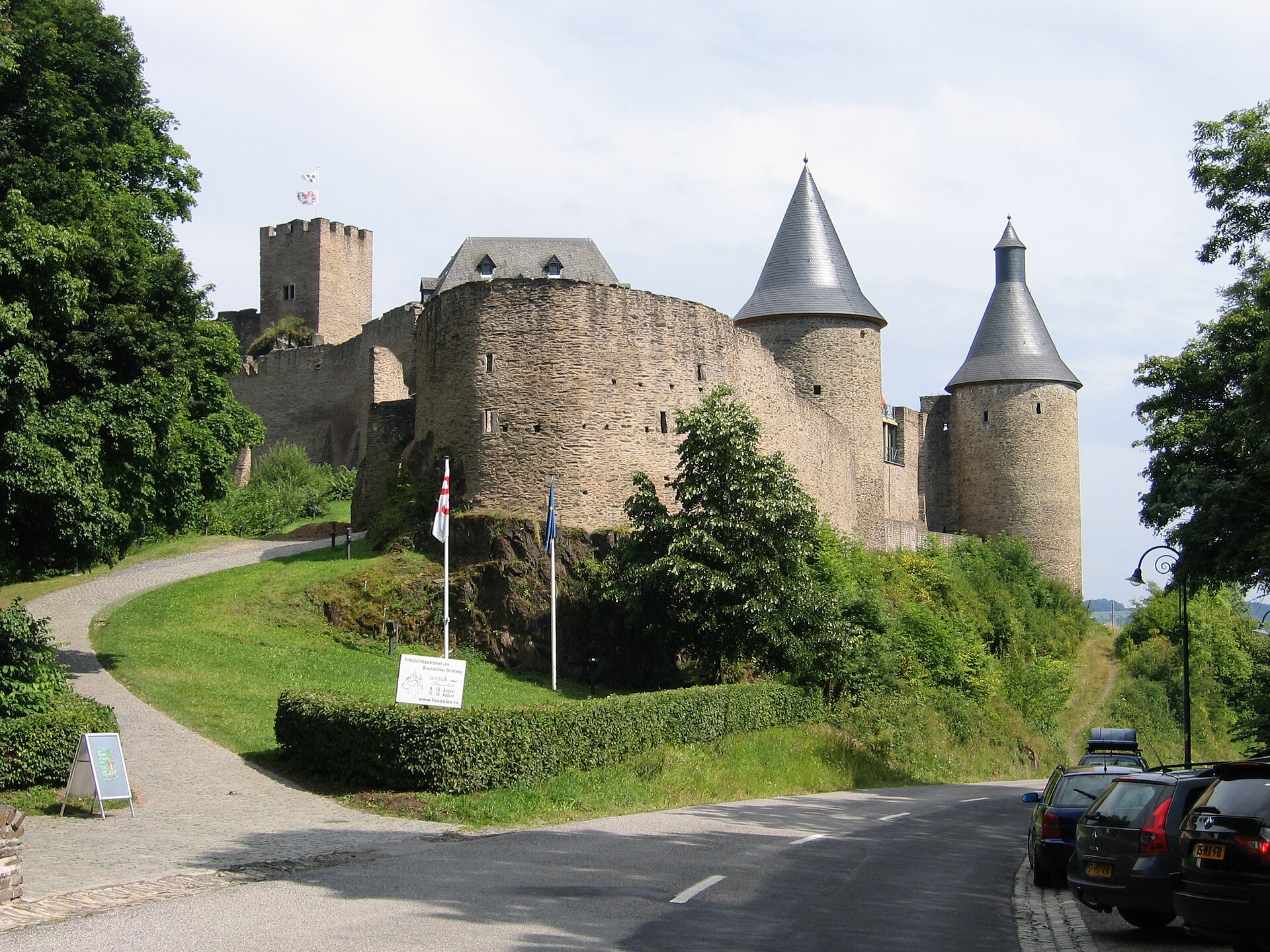
Bourscheid Castle is a medieval fortress situated on a prominent rocky spur 150 meters above the Sûre River in Luxembourg. The site covers approximately four hectares and is characterized by its triangular layout, which was strategically designed to command the surrounding valley and control regional trade routes.
The castle complex features eleven watchtowers and a substantial curtain wall, reflecting centuries of defensive architectural evolution. While the oldest parts of the structure date back to the 10th century, the site underwent significant expansions during the 14th and 15th centuries, including the addition of the lower bailey and advanced fortification systems.
Key Facts
- Materials
- Schist, Sandstone, Mortar
- Civilization
- Luxembourgish / Holy Roman Empire
- Accessibility
- Accessible via walking paths; steep terrain
- Date(s)
- 10th - 15th century
- Condition
- Partially restored, open to the public
- Original Function
- Defensive fortress and residence of the Lords of Bourscheid
- Key Figures
- Lords of Bourscheid
Early Foundations
10th centuryThe earliest structure was a wooden fortification built on the rocky promontory. By the 11th century, this was replaced by a stone keep, establishing the site as a strategic stronghold for the local nobility.
Expansion and Prosperity
14th - 15th centuryThe castle reached its greatest extent during this period. The Lords of Bourscheid expanded the fortifications significantly, adding the lower bailey, a gatehouse, and several defensive towers to accommodate a growing garrison and administrative needs.
Decline and Ruin
17th - 19th centuryFollowing the death of the last Lord of Bourscheid in the 17th century, the castle fell into disrepair. By the 19th century, the site was largely abandoned and had become a picturesque ruin, suffering from neglect and the elements.
Restoration
20th century - presentIn 1972, the Luxembourg state acquired the castle ruins. Extensive restoration work was undertaken to stabilize the masonry and reconstruct key sections, allowing the site to be opened as a cultural heritage destination.
Cultural Significance
Bourscheid Castle serves as a primary symbol of Luxembourg's feudal history and the strategic importance of the Ardennes region. It represents the transition from early medieval defensive structures to the more complex fortified residences of the late Middle Ages.
Today, the site is a focal point for regional tourism and historical education, hosting events that celebrate medieval culture and local heritage. It remains one of the most significant examples of military architecture in the Grand Duchy.
Interpretive Notes
Scholarly debates and areas of uncertainty
There is ongoing academic discussion regarding the exact sequence of the castle's expansion phases, particularly the transition between the 12th-century Romanesque elements and the 14th-century Gothic fortifications, as archaeological evidence is sometimes obscured by later restoration efforts.
Visiting Information
Entry Rules
Open daily from April to October. Tickets are required for entry. Visitors are advised to wear sturdy footwear due to the uneven terrain and steep paths within the castle grounds.
Best Times to Visit
Spring and autumn offer the best conditions for exploring the outdoor ruins. Early morning visits are recommended to avoid peak tourist traffic during summer weekends.
Photography
Personal photography is permitted throughout the site. Commercial photography requires prior authorization from the castle administration.
Preservation Notes
Visitors are requested to stay on marked paths and refrain from climbing on unrestored masonry. The site is subject to ongoing maintenance; some areas may be temporarily closed for structural repairs.
Nearby POIs
10 shownSources & Further Reading
- [1]Les châteaux forts de Luxembourg — Jean-Pierre Koltz. Editions Saint-Paul (1975)
- [2]Bourscheid: Geschichte einer Burg — Friedrich van der Heijden. Luxembourg Archaeological Society (1998)
Key Facts
- Materials
- Schist, Sandstone, Mortar
- Civilization
- Luxembourgish / Holy Roman Empire
- Accessibility
- Accessible via walking paths; steep terrain
- Date(s)
- 10th - 15th century
- Condition
- Partially restored, open to the public
- Original Function
- Defensive fortress and residence of the Lords of Bourscheid
- Key Figures
- Lords of Bourscheid