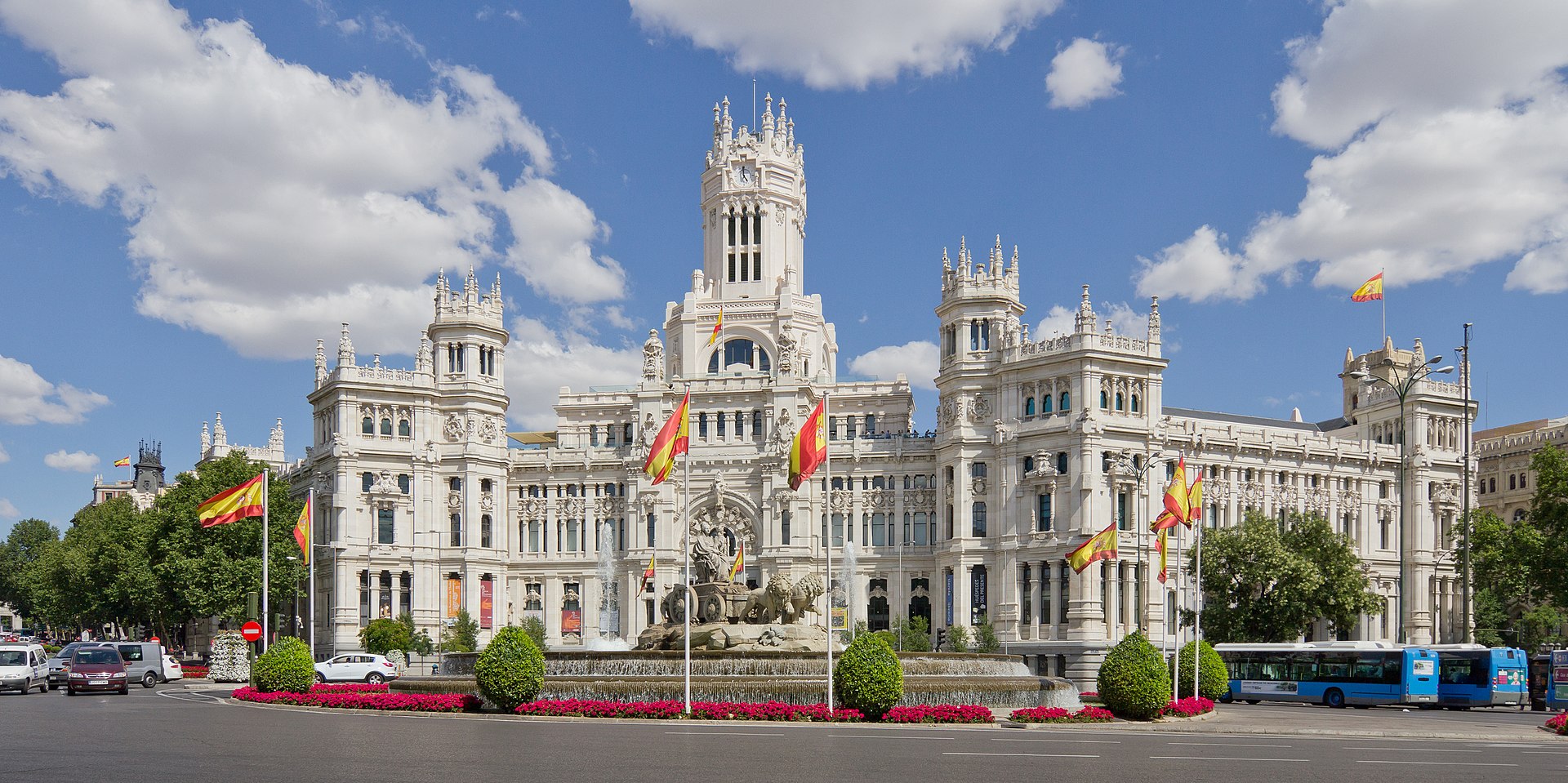
The Cybele Palace, originally known as the Palace of Communication, was designed by architects Antonio Palacios and Joaquín Otamendi. Completed in 1919, the building served as the headquarters for the Spanish postal and telegraph service for nearly a century. Its distinctive architecture blends Neo-Gothic and Neo-Plateresque elements, characterized by its white limestone facade and intricate decorative towers that dominate the Plaza de Cibeles.
Since 2007, the structure has functioned as the Madrid City Hall and a cultural center known as CentroCentro. The interior features a large glass-covered courtyard, while the upper levels offer public observation decks providing panoramic views of the city center. It remains a landmark of early 20th-century Spanish urban architecture.
Key Facts
- Materials
- Limestone, Steel, Glass, Concrete
- Civilization
- Spanish
- Accessibility
- Fully accessible with elevators to observation decks
- Date(s)
- 1907-1919
- Condition
- Well-preserved, active municipal government building
- Original Function
- Postal and Telegraph Headquarters
- Key Figures
- Antonio Palacios, Joaquín Otamendi
Design and Construction
1907-1919The building was commissioned to address the growing needs of the Spanish postal service. The design by Palacios and Otamendi won a national competition, emphasizing a monumental aesthetic that reflected the modernization of Madrid during the early 20th century.
Postal Headquarters Era
1919-2007For decades, the palace served as the central hub for national communications. Its grand interior hall was a bustling center for public services, and the building became an iconic symbol of the city's administrative growth.
Transformation to City Hall
2007-PresentFollowing a major renovation, the building was repurposed as the seat of the Madrid City Council. The project included the creation of the CentroCentro cultural space, integrating public exhibitions and observation areas into the historic structure.
Cultural Significance
The Cybele Palace is a central icon of Madrid, situated at the intersection of the city's most important thoroughfares. It represents the transition of Spanish architecture into the modern era, moving away from traditional styles toward a monumental, eclectic approach that defined the capital's urban identity in the early 1900s.
Interpretive Notes
Scholarly debates and areas of uncertainty
Debates have historically centered on the building's eclectic style, with some early 20th-century critics viewing its heavy ornamentation as anachronistic compared to emerging European modernist movements, while contemporary scholars praise it as a unique synthesis of Spanish historical motifs and modern engineering.
Visiting Information
Entry Rules
Open to the public for cultural exhibitions and access to the observation deck. Security screening is required at the entrance. Some administrative areas are restricted to government personnel.
Best Times to Visit
Late afternoon for sunset views from the observation deck. Weekdays are generally less crowded than weekends.
Photography
Personal photography is permitted in public areas and the observation deck. Commercial photography requires prior authorization from the City Council.
Preservation Notes
The building is protected as a site of cultural interest. Visitors are requested to respect the quiet zones within the cultural center and refrain from touching historical architectural details.
Nearby POIs
11 shown- Naval Museum of Madrid0.2 km
- Puerta de Alcala0.3 km
- Thyssen-Bornemisza Museum0.4 km
- Museo Arqueologico Nacional0.6 km
- Museo del Prado0.6 km
- Museo del Romanticismo1 km
- Palacio de Cristal del Retiro1 km
- Museo Nacional Centro de Arte Reina Sofia1.2 km
- Monument to Miguel de Cervantes1.8 km
- Sorolla Museum1.8 km
- Royal Palace of Madrid1.8 km
Sources & Further Reading
- [1]Antonio Palacios: Constructor de Madrid — José Luis Varela. Ediciones La Librería (2005)
- [2]The Architecture of the Palace of Communication — CentroCentro Research Department. Madrid City Council Archives (2018)
Key Facts
- Materials
- Limestone, Steel, Glass, Concrete
- Civilization
- Spanish
- Accessibility
- Fully accessible with elevators to observation decks
- Date(s)
- 1907-1919
- Condition
- Well-preserved, active municipal government building
- Original Function
- Postal and Telegraph Headquarters
- Key Figures
- Antonio Palacios, Joaquín Otamendi
Nearby POIs
11 shown- Naval Museum of Madrid0.2 km
- Puerta de Alcala0.3 km
- Thyssen-Bornemisza Museum0.4 km
- Museo Arqueologico Nacional0.6 km
- Museo del Prado0.6 km
- Museo del Romanticismo1 km
- Palacio de Cristal del Retiro1 km
- Museo Nacional Centro de Arte Reina Sofia1.2 km
- Monument to Miguel de Cervantes1.8 km
- Sorolla Museum1.8 km
- Royal Palace of Madrid1.8 km