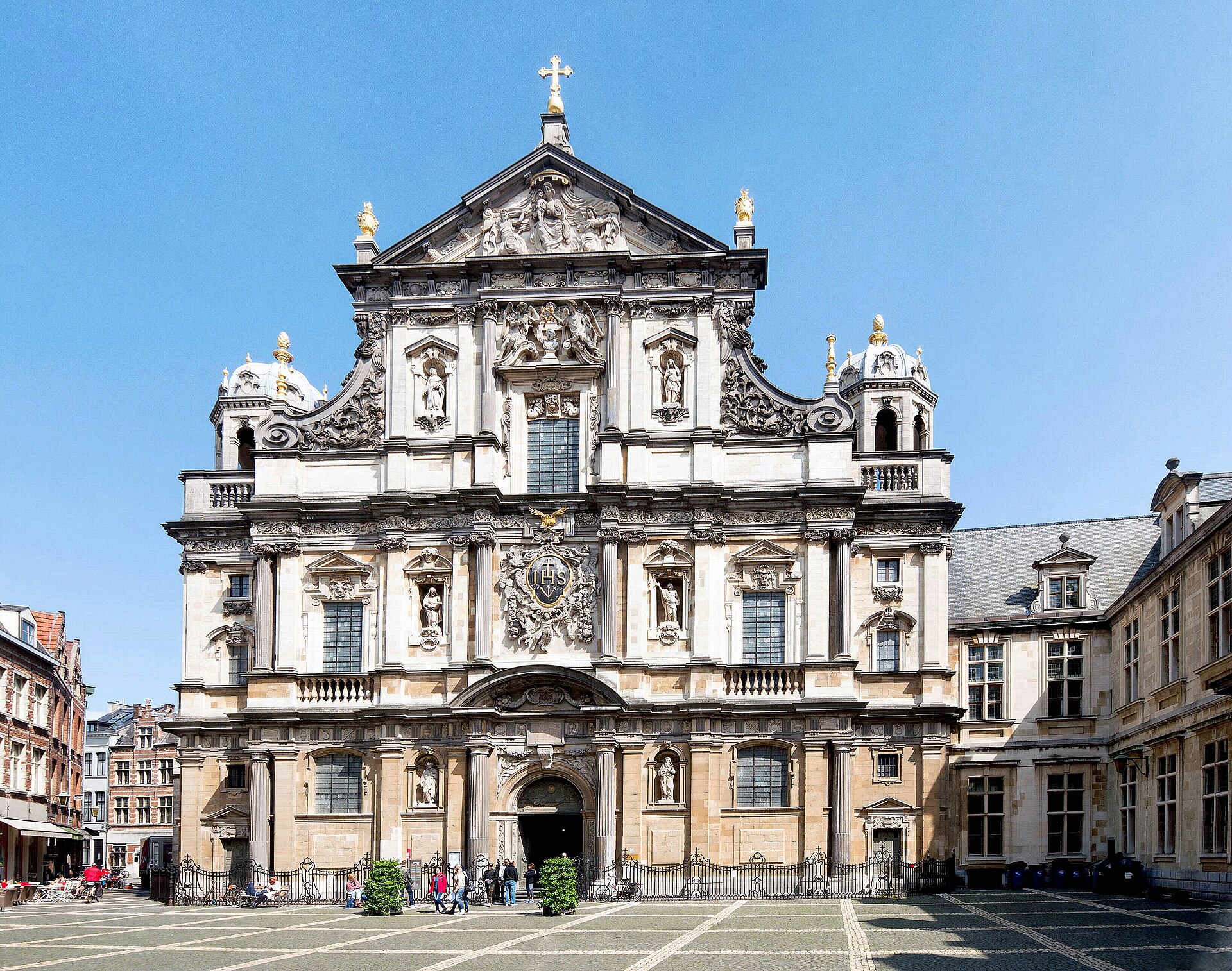
St. Charles Borromeo Church is a prominent example of Jesuit Baroque architecture in Antwerp, constructed between 1615 and 1621. The building was designed by the Jesuit order to serve as a center for the Counter-Reformation, featuring a facade heavily influenced by the Church of the Gesù in Rome and the works of Sebastiano Serlio.
The interior is renowned for its elaborate ornamentation and its historical connection to the artist Peter Paul Rubens, who contributed significantly to the decorative program. Although a fire in 1718 destroyed the original ceiling paintings, the church remains a significant site for the study of 17th-century religious art and architectural history in the Low Countries.
Key Facts
- Materials
- Sandstone, Marble, Oak
- Civilization
- Flemish
- Accessibility
- Ground level access available
- Date(s)
- 1615-1621
- Condition
- Well-preserved and active
- Original Function
- Jesuit parish church
- Key Figures
- Peter Paul Rubens, François Aguilon, Pieter Huyssens
Foundation and Construction
1615-1621The church was built by the Jesuit order following the success of their mission in Antwerp. Architects François Aguilon and Pieter Huyssens designed the structure, incorporating a facade that served as a manifesto of the Counter-Reformation, blending Italian Baroque principles with local Flemish traditions.
The Rubens Era
17th centuryPeter Paul Rubens was deeply involved in the artistic decoration of the church. He designed the high altar and was commissioned to paint 39 ceiling canvases, which were installed in the galleries to illustrate the lives of saints and biblical scenes.
Fire and Restoration
1718A lightning strike in 1718 caused a catastrophic fire that destroyed the roof and the original ceiling paintings by Rubens. The interior was subsequently restored in a more restrained style, though the structural integrity of the building was maintained.
Modern Preservation
20th century - presentThe church underwent extensive restoration in the 1980s to address structural issues and preserve the remaining Baroque features. Today, it functions as a parish church and a cultural site, housing a unique 18th-century mechanism that allows for the rotation of altarpieces.
Cultural Significance
St. Charles Borromeo Church stands as a testament to the influence of the Jesuit order in the Southern Netherlands during the 17th century. It represents the intersection of religious fervor and the artistic output of the Flemish Baroque period, serving as a physical manifestation of the Counter-Reformation's visual rhetoric.
Beyond its religious role, the church is a critical site for art historical research, particularly regarding the collaborative relationship between the Jesuit architects and Peter Paul Rubens. It remains a focal point for Antwerp's cultural heritage, drawing visitors interested in the evolution of Baroque architecture and ecclesiastical art.
Interpretive Notes
Scholarly debates and areas of uncertainty
There is ongoing academic discussion regarding the extent of Rubens' personal involvement in the architectural design of the facade versus his role as a consultant for the decorative program. Additionally, scholars continue to analyze the impact of the 1718 fire on the original iconographic program of the church and how the subsequent restoration altered the intended theological narrative of the interior space.
Visiting Information
Entry Rules
Open to the public daily. Entry is free, though donations are encouraged for maintenance. Visitors are requested to maintain silence and respect ongoing religious services.
Best Times to Visit
Weekday mornings are generally quieter for those wishing to view the architecture and altarpiece mechanism without large crowds.
Photography
Personal photography is permitted without flash or tripods. Professional photography requires prior authorization from the parish office.
Preservation Notes
The interior contains fragile 18th-century mechanisms and historic wood carvings; please refrain from touching any surfaces. Stay within designated visitor areas.
Nearby POIs
11 shownSources & Further Reading
- [1]
- [2]Baroque Architecture in the Low Countries — Konrad Ottenheym. Brepols Publishers (2010)
Key Facts
- Materials
- Sandstone, Marble, Oak
- Civilization
- Flemish
- Accessibility
- Ground level access available
- Date(s)
- 1615-1621
- Condition
- Well-preserved and active
- Original Function
- Jesuit parish church
- Key Figures
- Peter Paul Rubens, François Aguilon, Pieter Huyssens