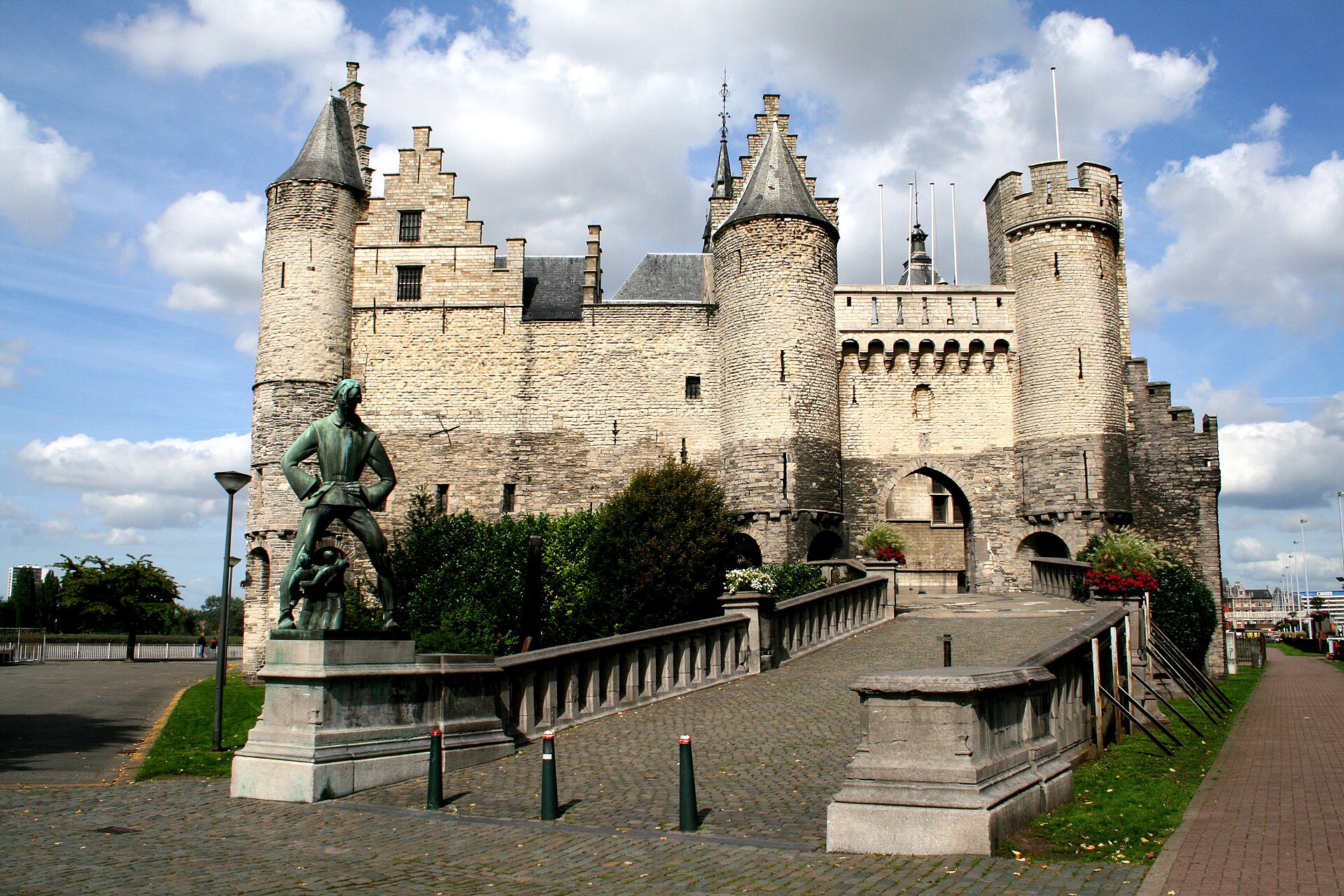
Het Steen is a medieval fortress located on the banks of the Scheldt river in Antwerp, Belgium. It serves as the oldest remaining building in the city, with its earliest stone foundations dating back to the 11th century. The structure was originally part of a larger defensive complex known as the Antwerp Burg, which protected the city from Viking raids and later served as the seat of the local margrave.
Over the centuries, the fortress underwent significant transformations, including a major reconstruction under Holy Roman Emperor Charles V in the 16th century. It functioned as a state prison for nearly five centuries before being repurposed in the 19th century to house a maritime museum. Today, it serves as a visitor center and gateway to the city, showcasing a blend of medieval military architecture and later decorative additions.
Key Facts
- Materials
- Sandstone, Brick
- Civilization
- Flemish
- Accessibility
- Partially accessible; some historic levels involve stairs
- Date(s)
- 11th century - 16th century
- Condition
- Restored and repurposed as a visitor center
- Original Function
- Defensive fortress and residence
- Key Figures
- Charles V, Holy Roman Emperor, Rubens
Origins and the Burg
11th centuryThe site originated as a stone fortification built to replace earlier wooden structures. It formed the core of the 'Burg', a fortified enclosure that served as the administrative and military center of Antwerp during the Middle Ages.
Imperial Reconstruction
1520-1523Under the orders of Emperor Charles V, the fortress was extensively rebuilt. Much of the current appearance, including the characteristic sandstone facade and the gatehouse, dates from this period of renovation.
Prison and Decline
16th-19th centuryFor nearly 500 years, Het Steen functioned as a prison. During this time, the surrounding fortifications were gradually demolished to allow for the expansion of the city's quays, leaving the fortress as a solitary landmark.
Museum and Modern Era
1862-presentThe building was converted into the National Maritime Museum in 1862. Following the relocation of the museum collection in 2008, the site underwent further restoration to serve as a modern visitor center and cruise terminal gateway.
Cultural Significance
Het Steen is a symbol of Antwerp's historical resilience and its long-standing relationship with the Scheldt river. It represents the transition of the city from a medieval defensive outpost to a major European trading hub. The site is also deeply embedded in local folklore, most notably the legend of the giant Lange Wapper, whose statue stands outside the entrance.
Interpretive Notes
Scholarly debates and areas of uncertainty
There is ongoing academic discussion regarding the extent of the original 11th-century foundations versus the 16th-century additions. The heavy restoration work conducted in the late 19th century has also led to debates about the authenticity of certain architectural features currently visible on the facade.
Visiting Information
Entry Rules
The visitor center is open daily. Entry to the public areas and the rooftop terrace is free, though specific exhibitions or guided tours may require a ticket.
Best Times to Visit
Weekdays during the morning to avoid weekend crowds. The rooftop terrace offers the best views of the Scheldt river during sunset.
Photography
Personal photography is permitted throughout the site. Commercial photography requires prior authorization from the city administration.
Preservation Notes
The structure is a protected heritage site. Visitors are requested to respect the historic masonry and refrain from climbing on non-designated areas of the exterior walls.
Nearby POIs
11 shownSources & Further Reading
- [1]Antwerp: A History of the City — Herman Van Goethem. Antwerp University Press (2017)
- [2]The Architectural History of the Antwerp Burg — Jan Lampo. Flemish Heritage Institute (2012)
Key Facts
- Materials
- Sandstone, Brick
- Civilization
- Flemish
- Accessibility
- Partially accessible; some historic levels involve stairs
- Date(s)
- 11th century - 16th century
- Condition
- Restored and repurposed as a visitor center
- Original Function
- Defensive fortress and residence
- Key Figures
- Charles V, Holy Roman Emperor, Rubens