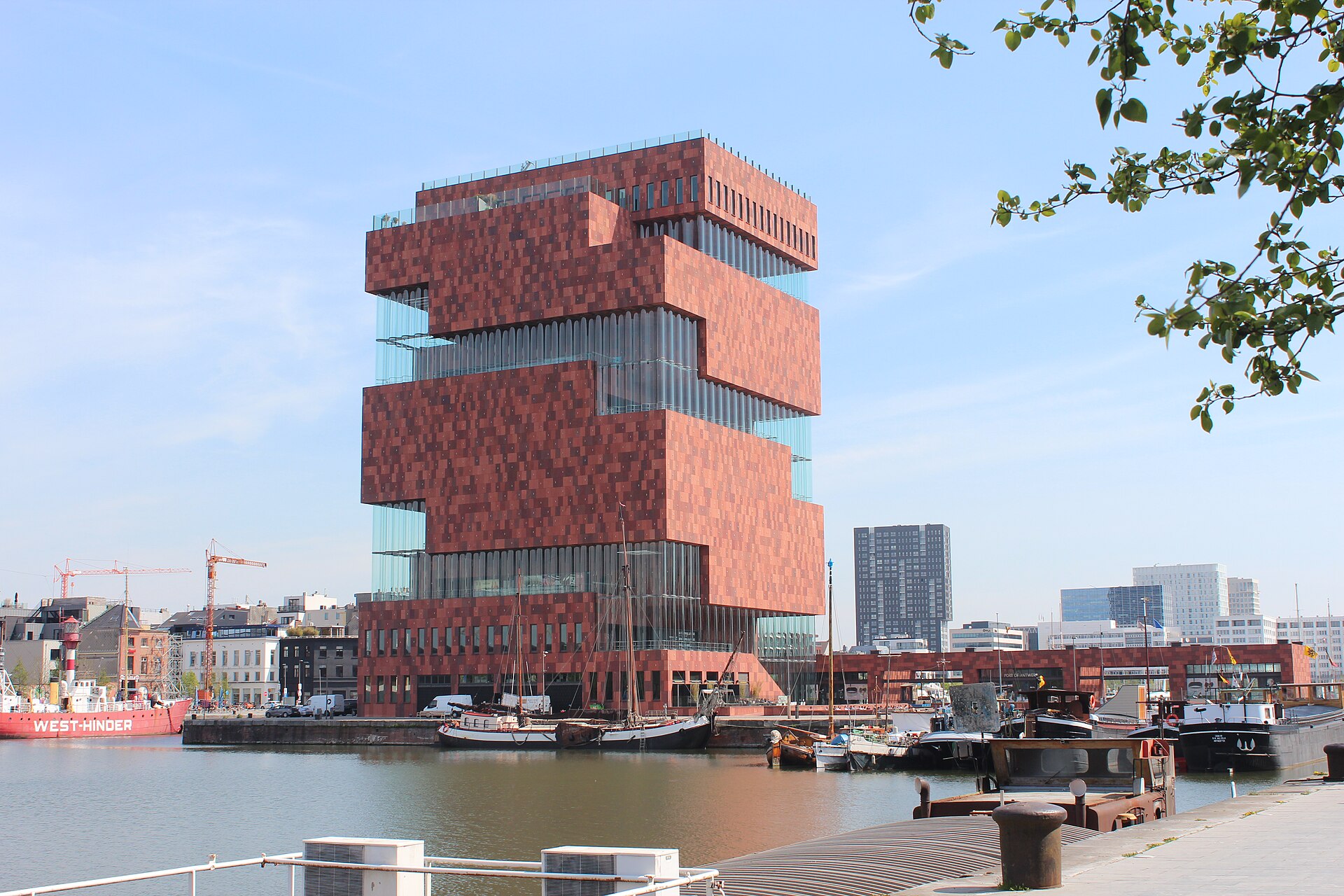
The Museum aan de Stroom (MAS) is a prominent cultural institution located in the Eilandje district of Antwerp, Belgium. Opened in 2011, the building was designed by the architectural firm Neutelings Riedijk Architects. Its distinctive structure features a stack of red sandstone volumes, rotated to create a spiral staircase that offers panoramic views of the city and the Scheldt river.
The museum houses a vast collection of over 500,000 artifacts, integrating the former collections of the National Maritime Museum, the Ethnographic Museum, and the Folklore Museum. The exhibits focus on the history of Antwerp as a global port city, exploring themes of international trade, shipping, and the cultural exchange that has defined the region from the 16th century to the present day.
Key Facts
- Materials
- Indian red sandstone, Glass, Concrete
- Civilization
- Belgian
- Accessibility
- Fully wheelchair accessible with elevators to all floors
- Date(s)
- 2006-2010
- Condition
- Active
- Original Function
- Museum
- Key Figures
- Neutelings Riedijk Architects, Jan De Nul Group
Conception and Design
2000-2006The city of Antwerp initiated the project to consolidate several disparate municipal collections into a single, modern facility. An international architectural competition was held, resulting in the selection of the 'stacked warehouse' design by Neutelings Riedijk.
Construction
2006-2010Construction took place on the site of the former Hanzehuis. The building's unique design utilizes red sandstone panels sourced from India, which were chosen to contrast with the surrounding industrial harbor environment.
Inauguration and Operation
2011-PresentThe museum officially opened to the public in May 2011. Since then, it has served as a central hub for maritime history and ethnographic studies, hosting both permanent collections and rotating international exhibitions.
Cultural Significance
The MAS serves as a bridge between Antwerp's historical identity as a global trading hub and its contemporary status as a multicultural metropolis. By housing ethnographic and maritime collections together, the museum emphasizes the interconnectedness of global cultures through the lens of the port.
Architecturally, the building has become a landmark of the Eilandje district, symbolizing the urban renewal of Antwerp's old harbor area. The public accessibility of the rooftop terrace and the spiral walkway reflects the museum's mission to be an open, inclusive space for both residents and international visitors.
Interpretive Notes
Scholarly debates and areas of uncertainty
There is ongoing academic discussion regarding the 'decolonization' of ethnographic collections within the museum. Scholars and curators debate the ethical presentation of artifacts acquired during the colonial era, focusing on provenance research and the potential repatriation of objects to their countries of origin.
Visiting Information
Entry Rules
Open Tuesday through Sunday. Tickets are required for the permanent and temporary exhibitions, while the rooftop terrace and the central boulevard are accessible to the public free of charge.
Best Times to Visit
Weekdays during the morning hours to avoid weekend crowds. The rooftop is particularly popular during sunset for panoramic views of the city.
Photography
Personal photography is permitted in most areas without flash. Professional or commercial photography requires prior authorization from the museum administration.
Preservation Notes
The museum employs strict climate control systems to preserve sensitive ethnographic materials. Visitors are requested not to touch artifacts and to refrain from bringing food or drink into the exhibition galleries.
Nearby POIs
11 shownKey Facts
- Materials
- Indian red sandstone, Glass, Concrete
- Civilization
- Belgian
- Accessibility
- Fully wheelchair accessible with elevators to all floors
- Date(s)
- 2006-2010
- Condition
- Active
- Original Function
- Museum
- Key Figures
- Neutelings Riedijk Architects, Jan De Nul Group