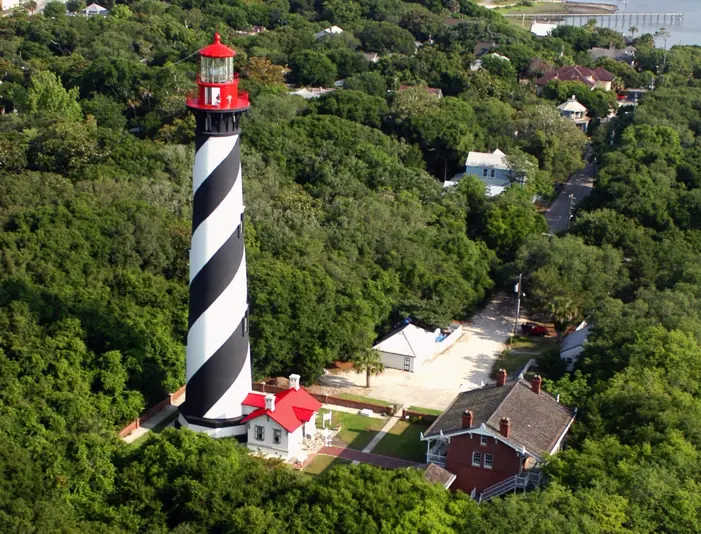
The St. Augustine Lighthouse is a historic maritime beacon located on the northern end of Anastasia Island in St. Augustine, Florida. The current tower, completed in 1874, stands 165 feet tall and replaced an earlier 1824 structure that had been compromised by coastal erosion. It remains an active aid to navigation, utilizing a first-order Fresnel lens that was restored to operational status in the early 1990s.
The site now functions as a maritime museum and educational facility, preserving the history of the lighthouse keepers and the maritime heritage of the region. The complex includes the keeper's house, which has been restored to its 19th-century appearance, and various outbuildings that provide context on the technological and social history of American lighthouse operations.
Key Facts
- Materials
- Brick, Cast iron, Glass
- Civilization
- United States
- Accessibility
- Grounds are accessible; tower climb requires physical exertion
- Date(s)
- 1871-1874
- Condition
- Active, restored, and maintained as a museum
- Original Function
- Navigational aid
- Key Figures
- Peter Williams, William Russell
The First Lighthouse
1824-1870The original lighthouse was built by the Spanish and later taken over by the United States. It served the port of St. Augustine for nearly 50 years until severe beach erosion threatened its foundation, leading to its eventual collapse into the Atlantic Ocean.
Construction of the Current Tower
1871-1874Construction of the new tower began in 1871 under the supervision of the U.S. Lighthouse Board. It was built using brick and iron, designed to withstand the harsh coastal environment. The light was officially lit on October 15, 1874.
Modern Preservation
1980-PresentIn 1980, the Junior Service League of St. Augustine began a massive restoration project to save the deteriorating structure. The site was subsequently established as a non-profit museum, focusing on the preservation of the tower and the surrounding maritime history.
Cultural Significance
The lighthouse serves as a symbol of St. Augustine's maritime identity, representing the city's long history as a port and its strategic importance in coastal defense. It is a focal point for local heritage tourism and historical education regarding the life of 19th-century lighthouse keepers.
Interpretive Notes
Scholarly debates and areas of uncertainty
There is ongoing discussion regarding the long-term impact of climate change and rising sea levels on the structural integrity of coastal heritage sites like the St. Augustine Lighthouse, specifically regarding the efficacy of current erosion mitigation strategies.
Visiting Information
Entry Rules
Open daily to the public. Tickets are required for entry to the museum and for climbing the lighthouse tower. Visitors must be at least 44 inches tall to climb the tower.
Best Times to Visit
Early morning or late afternoon to avoid peak heat and crowds. The site is particularly significant during the annual lighthouse anniversary events in October.
Photography
Personal photography is permitted throughout the grounds and tower. Commercial photography and drone usage require prior authorization from the museum administration.
Preservation Notes
The tower is a historic structure; visitors are requested to follow all safety guidelines while climbing. Do not touch the Fresnel lens or historical artifacts on display.
Nearby POIs
9 shownSources & Further Reading
- [1]St. Augustine Lighthouse & Maritime Museum History — St. Augustine Lighthouse & Maritime Museum. Official Museum Archives (2023)View
- [2]Lighthouses of the Florida Coast — Kevin McCarthy. Pineapple Press (2001)
Key Facts
- Materials
- Brick, Cast iron, Glass
- Civilization
- United States
- Accessibility
- Grounds are accessible; tower climb requires physical exertion
- Date(s)
- 1871-1874
- Condition
- Active, restored, and maintained as a museum
- Original Function
- Navigational aid
- Key Figures
- Peter Williams, William Russell