Saint Augustine,United States of America
Castillo de San Marcos
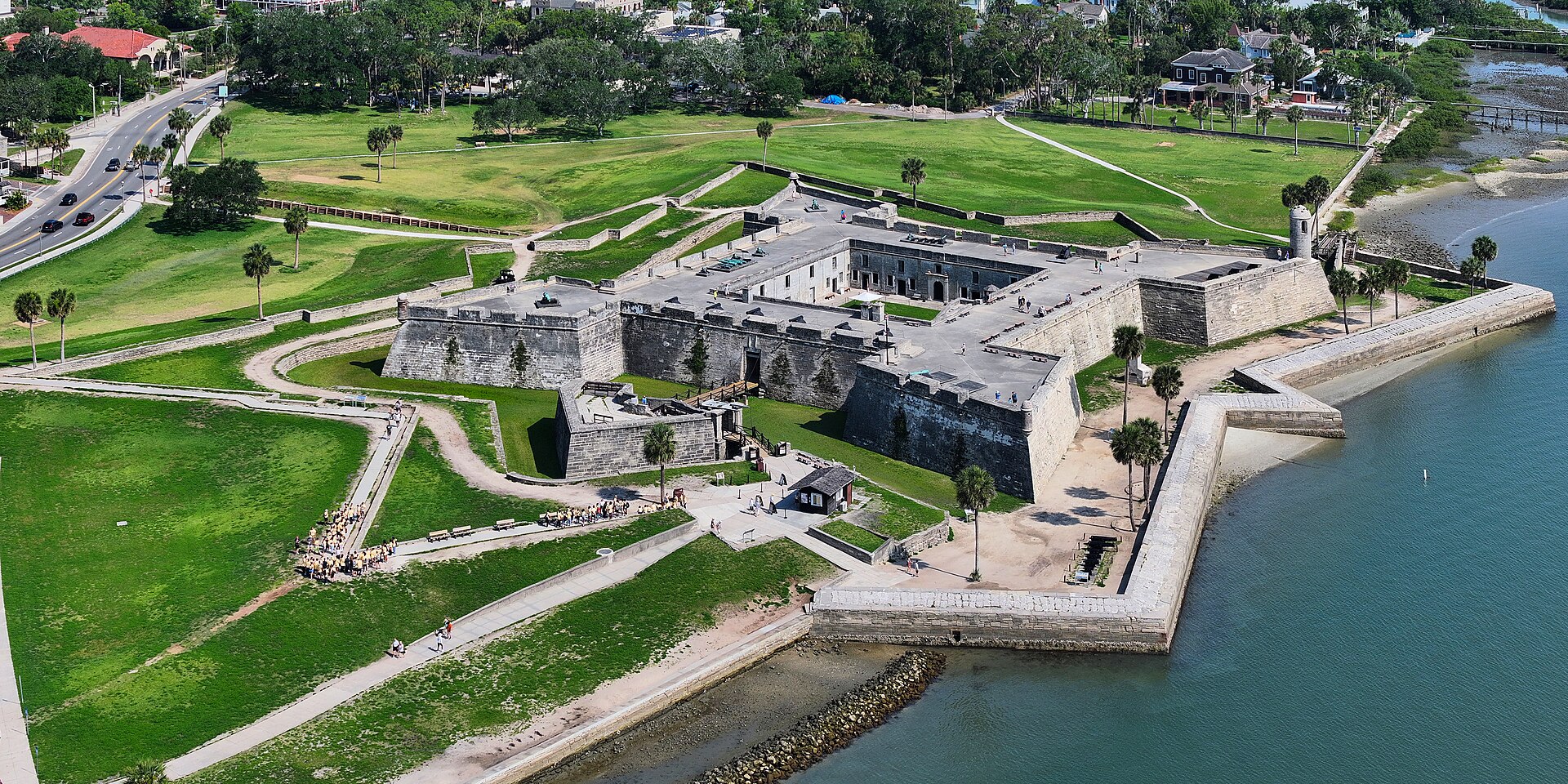
The Castillo de San Marcos is a 17th-century masonry fortress located in St. Augustine, Florida. Constructed by the Spanish between 1672 and 1695, it was built to defend Spain’s colonial holdings and protect the strategic Atlantic shipping route along the southeastern coast of North America. Designed as a star fort with bastions and a surrounding moat, the structure was built of coquina, a locally quarried shellstone that proved resilient under artillery fire. It is the oldest surviving masonry fort in the continental United States and reflects the military engineering principles of early modern Europe adapted to colonial conditions.
Key Facts
- Materials
- Coquina stone, Timber
- Dimensions
- Approximately 100m per side; four bastions with surrounding moat
- Civilization
- Spanish Empire
- Date(s)
- 1672-1695
- Condition
- Preserved fort operated as a National Monument
- Original Function
- Defensive coastal fortress
- Key Figures
- Queen Mariana of Spain, Governor Francisco de la Guerra y de la Vega
- Architectural Style
- Star fort (bastion system)
Spanish Construction
1672-1695Following repeated attacks by English forces and privateers, Spain authorized the construction of a permanent stone fortification in St. Augustine. Labor was drawn from soldiers, local residents, and Indigenous communities under Spanish control. The use of coquina allowed the walls to absorb cannon impact rather than fracture.
British Occupation
1763-1783After the Treaty of Paris in 1763, Florida was ceded to Britain. The fort was renamed Fort St. Mark and served as a British military installation until Spain regained control following the American Revolutionary War.
Second Spanish Period
1783-1821Spain reoccupied the fort and maintained it as a defensive post until Florida was transferred to the United States under the Adams-Onís Treaty in 1821.
U.S. Military Use
19th centuryUnder U.S. control, the structure was renamed Fort Marion. It served variously as a coastal defense installation and military prison, including during conflicts involving Indigenous resistance in the Southeast.
Preservation and National Monument Status
20th century - presentThe fort was designated a National Monument in 1924 and restored to its original Spanish name in 1942. It is administered by the U.S. National Park Service and functions as a preserved example of colonial military architecture.
Cultural Significance
The Castillo de San Marcos reflects the geopolitical contest between European empires in North America. Its construction illustrates the extension of Spanish military engineering traditions into the Atlantic world and the strategic importance of St. Augustine as a colonial settlement. The site also bears significance in Indigenous and African American histories, including its role in the broader system of Spanish colonial governance and its later use as a U.S. military prison during 19th-century conflicts.
Interpretive Notes
Scholarly debates and areas of uncertainty
Scholars examine the degree to which the fort’s defensive success derived from European engineering principles versus the specific properties of coquina stone. The adaptability of Old World military design to New World conditions remains a subject of comparative study. Historians also reassess the fort’s role in colonial and postcolonial power structures, particularly regarding Indigenous imprisonment and the dynamics of empire in the southeastern United States.
Visiting Information
Entry Rules
Paid admission required. Annual National Park passes accepted. Grounds open daily except certain federal holidays. Ranger-led programs available at scheduled times.
Best Times to Visit
Morning hours offer reduced crowd levels, especially during peak tourist seasons. Summer afternoons are hot and humid; shaded interior casemates provide limited relief.
Photography
Personal photography permitted. Tripods and commercial filming require National Park Service permit. Drone use prohibited.
Preservation Notes
Climb only designated stairways and platforms. The coquina masonry is porous and subject to erosion; do not touch or remove material. Surfaces may be uneven.
Nearby POIs
9 shownSources & Further Reading
- [1]The Oldest Fortress in the United States: Castillo de San Marcos — Albert C. Manucy. U.S. National Park Service (1994)
- [2]Spanish St. Augustine: The Archaeology of a Colonial Creole Community — Kathleen A. Deagan. Academic Press (1983)
- [3]Florida's Colonial Architectural Heritage — John W. Griffin. University Press of Florida
Key Facts
- Materials
- Coquina stone, Timber
- Dimensions
- Approximately 100m per side; four bastions with surrounding moat
- Civilization
- Spanish Empire
- Date(s)
- 1672-1695
- Condition
- Preserved fort operated as a National Monument
- Original Function
- Defensive coastal fortress
- Key Figures
- Queen Mariana of Spain, Governor Francisco de la Guerra y de la Vega
- Architectural Style
- Star fort (bastion system)