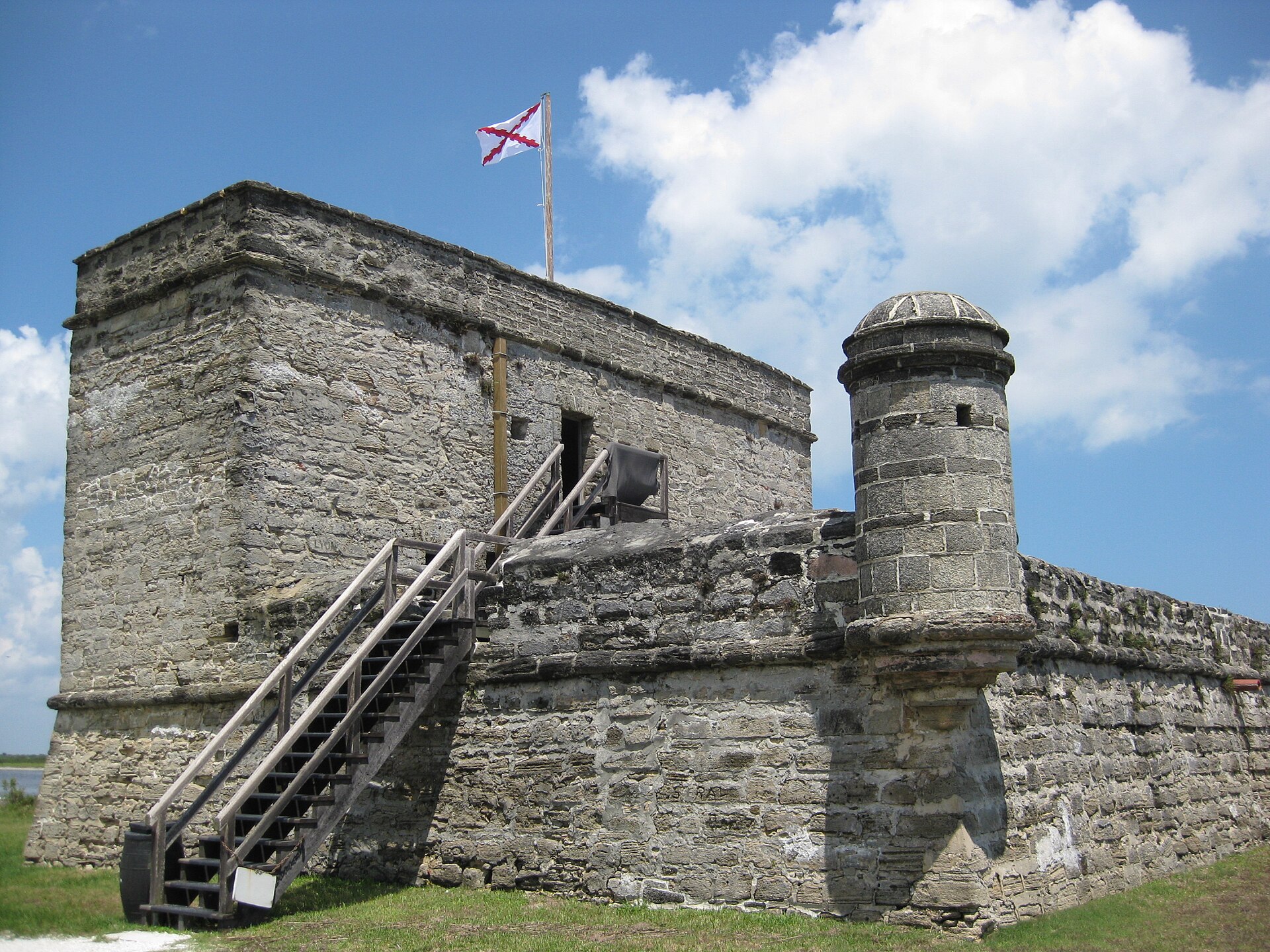
Fort Matanzas is a small masonry fortification located on Rattlesnake Island, constructed by the Spanish in 1740-1742 to guard the Matanzas Inlet, the southern approach to St. Augustine. The fort was strategically positioned to prevent British forces from bypassing the main defenses of the Castillo de San Marcos via the inland waterways.
The structure is built of coquina, a sedimentary rock composed of shell fragments, which was locally sourced and provided a resilient defense against cannon fire. Although it saw limited military action, the fort remains a significant example of 18th-century Spanish colonial military engineering and serves as a monument to the imperial competition between Spain and Great Britain in North America.
Key Facts
- Materials
- Coquina, Lime mortar
- Civilization
- Spanish
- Accessibility
- Accessible via park-operated ferry; limited mobility access within the fort
- Date(s)
- 1740-1742
- Condition
- Well-preserved, managed by the National Park Service
- Original Function
- Coastal defense fortification
- Key Figures
- Manuel de Montiano, Antonio de Arredondo
Strategic Necessity
1740Following the British invasion of Florida during the War of Jenkins' Ear, Spanish authorities recognized the vulnerability of the Matanzas Inlet. Governor Manuel de Montiano ordered the construction of a permanent stone fort to replace earlier wooden watchtowers.
Construction
1740-1742Designed by engineer Antonio de Arredondo, the fort was built using coquina blocks. The design featured a central tower and a gun deck, providing a clear line of sight over the inlet to deter British naval incursions.
Colonial Transition
1763-1821Following the Treaty of Paris in 1763, Florida was ceded to Britain. The fort was briefly occupied by British troops before returning to Spanish control in 1783, eventually becoming part of the United States in 1821.
National Monument
1924-PresentRecognizing its historical importance, President Calvin Coolidge designated Fort Matanzas a National Monument in 1924. It is currently maintained by the National Park Service, which provides public access via ferry.
Cultural Significance
Fort Matanzas represents the defensive efforts of the Spanish Empire to maintain its hold on Florida against British expansionism. It is a symbol of the geopolitical tensions that defined the colonial era in the American Southeast.
Today, the site is significant for its preservation of 18th-century military architecture and its role in educating the public about the diverse colonial history of Florida, including the interactions between Spanish, British, and indigenous populations.
Interpretive Notes
Scholarly debates and areas of uncertainty
The effectiveness of the fort's design in actual combat scenarios remains a subject of minor historical discussion, as the inlet's shifting sandbars often proved as much of a deterrent to large naval vessels as the fort's own artillery.
Visiting Information
Entry Rules
Access is via a free National Park Service ferry. Visitors must obtain a boarding pass at the visitor center. The fort interior is small and can be crowded; pets are not permitted on the ferry or inside the fort.
Best Times to Visit
Weekday mornings are recommended to avoid ferry wait times. Winter and spring offer milder temperatures for the outdoor ferry transit and exploration of the surrounding nature trails.
Photography
Personal photography is permitted. Commercial photography requires a special use permit from the National Park Service.
Preservation Notes
The coquina walls are fragile; visitors are prohibited from climbing on the exterior masonry. Stay on designated paths to protect the sensitive coastal dune ecosystem.
Nearby POIs
9 shownSources & Further Reading
- [1]Fort Matanzas National Monument: Administrative History — National Park Service. U.S. Department of the Interior (1999)View
- [2]The Spanish Frontier in North America — David J. Weber. Yale University Press (1992)
Key Facts
- Materials
- Coquina, Lime mortar
- Civilization
- Spanish
- Accessibility
- Accessible via park-operated ferry; limited mobility access within the fort
- Date(s)
- 1740-1742
- Condition
- Well-preserved, managed by the National Park Service
- Original Function
- Coastal defense fortification
- Key Figures
- Manuel de Montiano, Antonio de Arredondo