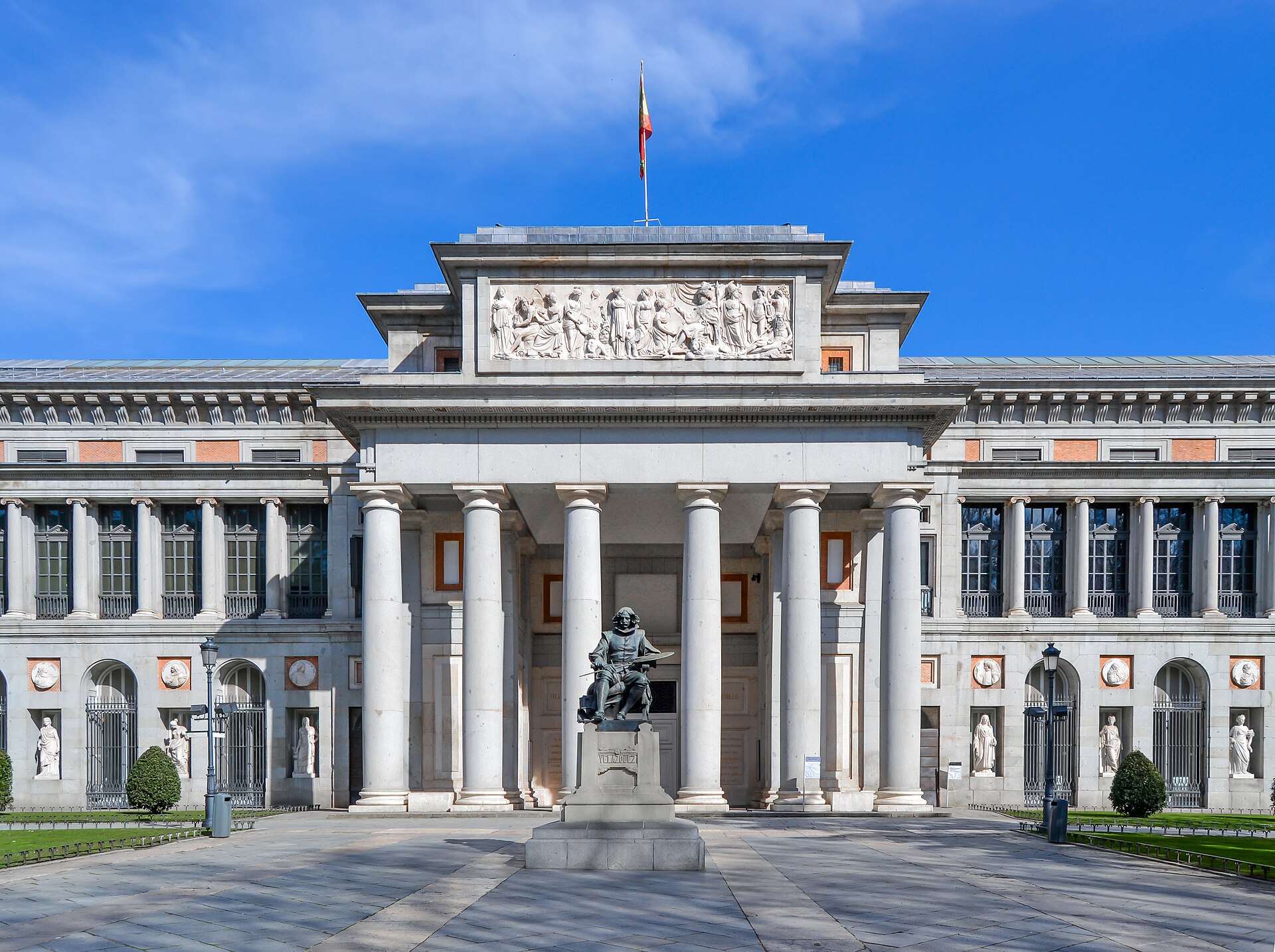
The Museo Nacional del Prado is Spain's primary national art museum, located in central Madrid. It houses one of the world's finest collections of European art, spanning from the 12th century to the early 20th century, and is widely considered to possess the most comprehensive collection of Spanish painting globally.
The museum's core collection originated from the former Spanish Royal Collection, reflecting the refined tastes of the Spanish monarchy over several centuries. The building itself is a masterpiece of Neoclassical architecture, designed by Juan de Villanueva in 1785, and has served as a public museum since 1819.
Key Facts
- Materials
- Brick, Stone, Granite
- Civilization
- Spanish
- Accessibility
- Fully wheelchair accessible
- Date(s)
- 1785-1819
- Condition
- Well-preserved, active museum
- Original Function
- Natural Science Museum
- Key Figures
- King Charles III, Juan de Villanueva, Francisco Goya, Diego Velázquez
Royal Origins
16th-18th centuryThe collection began as the private holdings of the Spanish Habsburg and Bourbon monarchs. Kings like Philip IV were avid patrons of artists such as Velázquez, accumulating vast quantities of masterpieces that would eventually form the museum's foundation.
Architectural Foundation
1785-1819King Charles III commissioned architect Juan de Villanueva to design a building for the Natural Science Cabinet. Following the Napoleonic Wars, King Ferdinand VII repurposed the structure to house the royal art collection, opening it to the public in 1819.
Expansion and Modernization
20th century - presentThroughout the 20th century, the museum underwent several expansions to accommodate its growing collection and increasing visitor numbers. The 2007 expansion by Rafael Moneo integrated the nearby cloister of the Jerónimos church, significantly increasing exhibition space.
Cultural Significance
The Prado is a cornerstone of Spanish cultural identity, serving as the primary repository for the nation's artistic heritage. Its collection of works by Velázquez, Goya, and El Greco is central to the study of Western art history and continues to influence contemporary artistic discourse in Europe.
Interpretive Notes
Scholarly debates and areas of uncertainty
Debates often center on the attribution of works within the vast royal collection, particularly regarding the school of Hieronymus Bosch. Additionally, there is ongoing academic discussion regarding the ethics of the museum's historical acquisition methods during the colonial era.
Visiting Information
Entry Rules
Open daily. Tickets can be purchased online or at the box office. Free entry is available during the final two hours of operation each day. Large bags and backpacks are not permitted in the galleries.
Best Times to Visit
Weekday mornings (10:00-12:00) are generally less crowded. The museum is significantly busier on weekends and public holidays.
Photography
Photography is permitted for personal, non-commercial use in most permanent collection galleries. Flash, tripods, and selfie sticks are strictly prohibited.
Preservation Notes
Maintain a respectful distance from all artworks. Do not touch frames or canvases. Climate control is strictly maintained; please follow staff instructions regarding movement through the galleries.
Nearby POIs
11 shown- Thyssen-Bornemisza Museum0.4 km
- Naval Museum of Madrid0.4 km
- Cybele Palace0.6 km
- Museo Nacional Centro de Arte Reina Sofia0.7 km
- Puerta de Alcala0.7 km
- Palacio de Cristal del Retiro0.8 km
- Museo Arqueologico Nacional1.1 km
- Museo del Romanticismo1.5 km
- Royal Palace of Madrid1.9 km
- Catedral de la Almudena1.9 km
- Real Basilica de San Francisco el Grande1.9 km
Sources & Further Reading
- [1]The Prado: Masterpieces — Alfonso E. Pérez Sánchez. Harry N. Abrams (1996)
- [2]Museo del Prado: Official Guide — Museo Nacional del Prado. Museo Nacional del Prado Ediciones (2020)View
Key Facts
- Materials
- Brick, Stone, Granite
- Civilization
- Spanish
- Accessibility
- Fully wheelchair accessible
- Date(s)
- 1785-1819
- Condition
- Well-preserved, active museum
- Original Function
- Natural Science Museum
- Key Figures
- King Charles III, Juan de Villanueva, Francisco Goya, Diego Velázquez
Nearby POIs
11 shown- Thyssen-Bornemisza Museum0.4 km
- Naval Museum of Madrid0.4 km
- Cybele Palace0.6 km
- Museo Nacional Centro de Arte Reina Sofia0.7 km
- Puerta de Alcala0.7 km
- Palacio de Cristal del Retiro0.8 km
- Museo Arqueologico Nacional1.1 km
- Museo del Romanticismo1.5 km
- Royal Palace of Madrid1.9 km
- Catedral de la Almudena1.9 km
- Real Basilica de San Francisco el Grande1.9 km