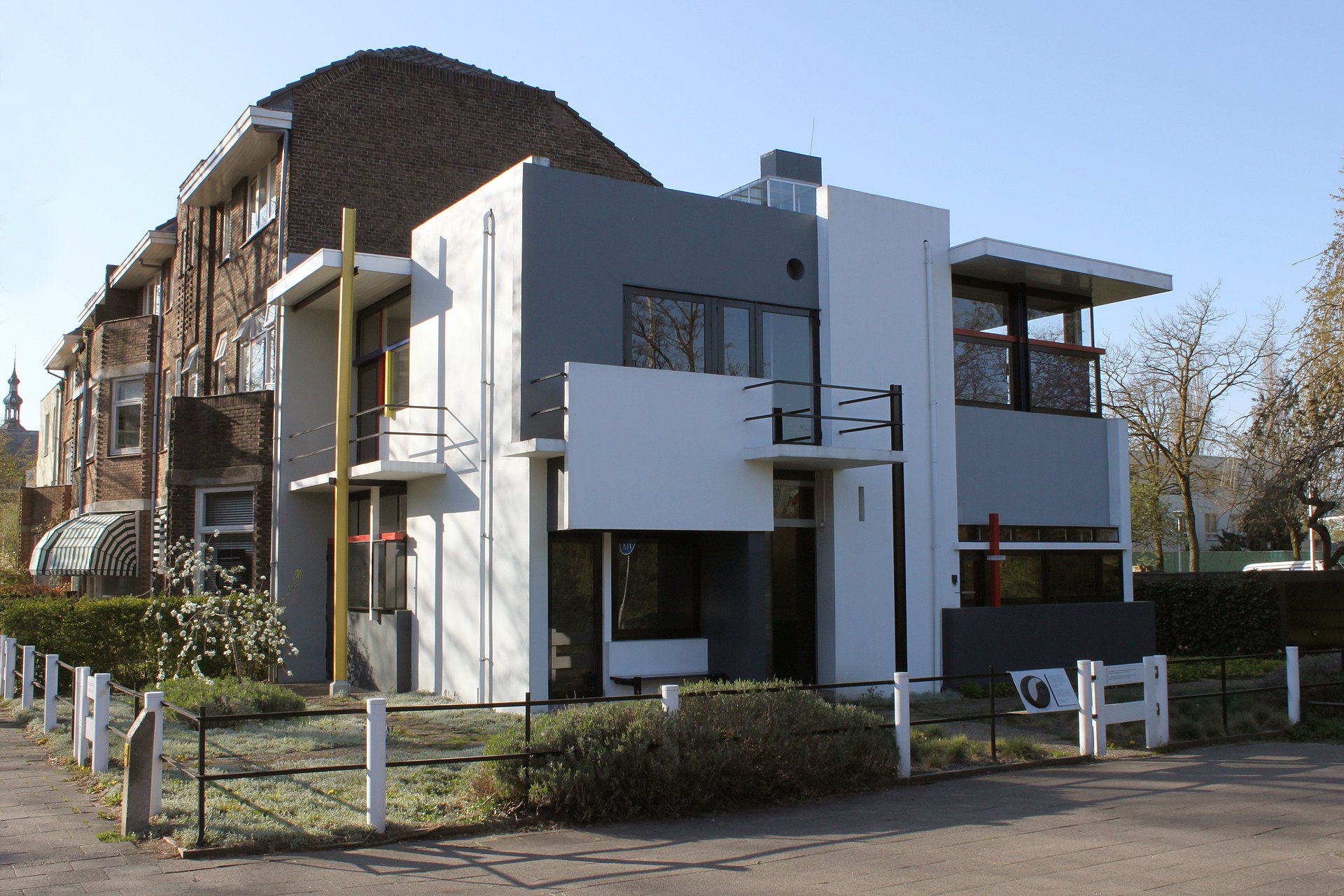
The Rietveld Schröder House, located in Utrecht, was commissioned by Truus Schröder-Schräder and designed by architect Gerrit Rietveld in 1924. It stands as a seminal work of the De Stijl movement, characterized by its radical approach to design, which emphasizes primary colors, geometric purity, and the integration of interior and exterior spaces.
The house is renowned for its flexible floor plan, featuring sliding partitions that allow the upper level to be reconfigured from an open-plan space into distinct rooms. This innovative spatial organization reflects the movement's desire to break away from traditional architectural constraints and create a dynamic, functional living environment.
Key Facts
- Materials
- Brick, Concrete, Steel, Glass, Wood
- Civilization
- Dutch
- Accessibility
- Limited due to historic structure; stairs required for upper level
- Date(s)
- 1924
- Condition
- Restored and preserved as a museum
- Original Function
- Private residence
- Key Figures
- Gerrit Rietveld, Truus Schröder-Schräder
Commission and Design
1924Truus Schröder-Schräder commissioned Gerrit Rietveld to design a house that would embody the principles of the De Stijl movement. The design process was highly collaborative, resulting in a structure that challenged contemporary domestic norms.
Architectural Significance
1920sUpon completion, the house became an icon of the Modern Movement. Its use of steel beams, glass panels, and a palette of white, grey, and primary colors served as a three-dimensional manifestation of Piet Mondrian's paintings.
Preservation and UNESCO Status
1975-2000Following the death of Truus Schröder in 1985, the house was restored to its original 1924 state. It was inscribed as a UNESCO World Heritage Site in 2000, recognized for its exceptional contribution to modern architectural history.
Cultural Significance
The Rietveld Schröder House is a cornerstone of 20th-century architecture, representing the transition from traditional residential design to the open-plan concepts that define modern living. It remains a primary reference point for the De Stijl movement's influence on global design and spatial theory.
Beyond its architectural merit, the house symbolizes a progressive lifestyle and the close creative partnership between Rietveld and Schröder. It continues to serve as a site for scholarly research into the evolution of domestic space and the application of abstract art principles to functional structures.
Interpretive Notes
Scholarly debates and areas of uncertainty
Debates persist regarding the extent to which the house was intended as a permanent residence versus an experimental architectural manifesto. Some scholars argue that the functional limitations of the sliding walls suggest the house was primarily a conceptual exercise, while others emphasize the successful long-term habitation by Schröder as evidence of its practical viability.
Visiting Information
Entry Rules
Visits are by appointment only via the Centraal Museum Utrecht. Guided tours are mandatory to preserve the interior. Visitors must wear provided shoe covers.
Best Times to Visit
Spring and autumn offer the best conditions for viewing the exterior. Tours are available year-round, but booking several weeks in advance is essential.
Photography
Personal photography is permitted for non-commercial use. Tripods and flash are strictly prohibited inside the house.
Preservation Notes
The house is extremely fragile. Visitors must follow the guide's instructions at all times, avoid touching surfaces, and refrain from carrying large bags inside.
Nearby POIs
11 shownKey Facts
- Materials
- Brick, Concrete, Steel, Glass, Wood
- Civilization
- Dutch
- Accessibility
- Limited due to historic structure; stairs required for upper level
- Date(s)
- 1924
- Condition
- Restored and preserved as a museum
- Original Function
- Private residence
- Key Figures
- Gerrit Rietveld, Truus Schröder-Schräder