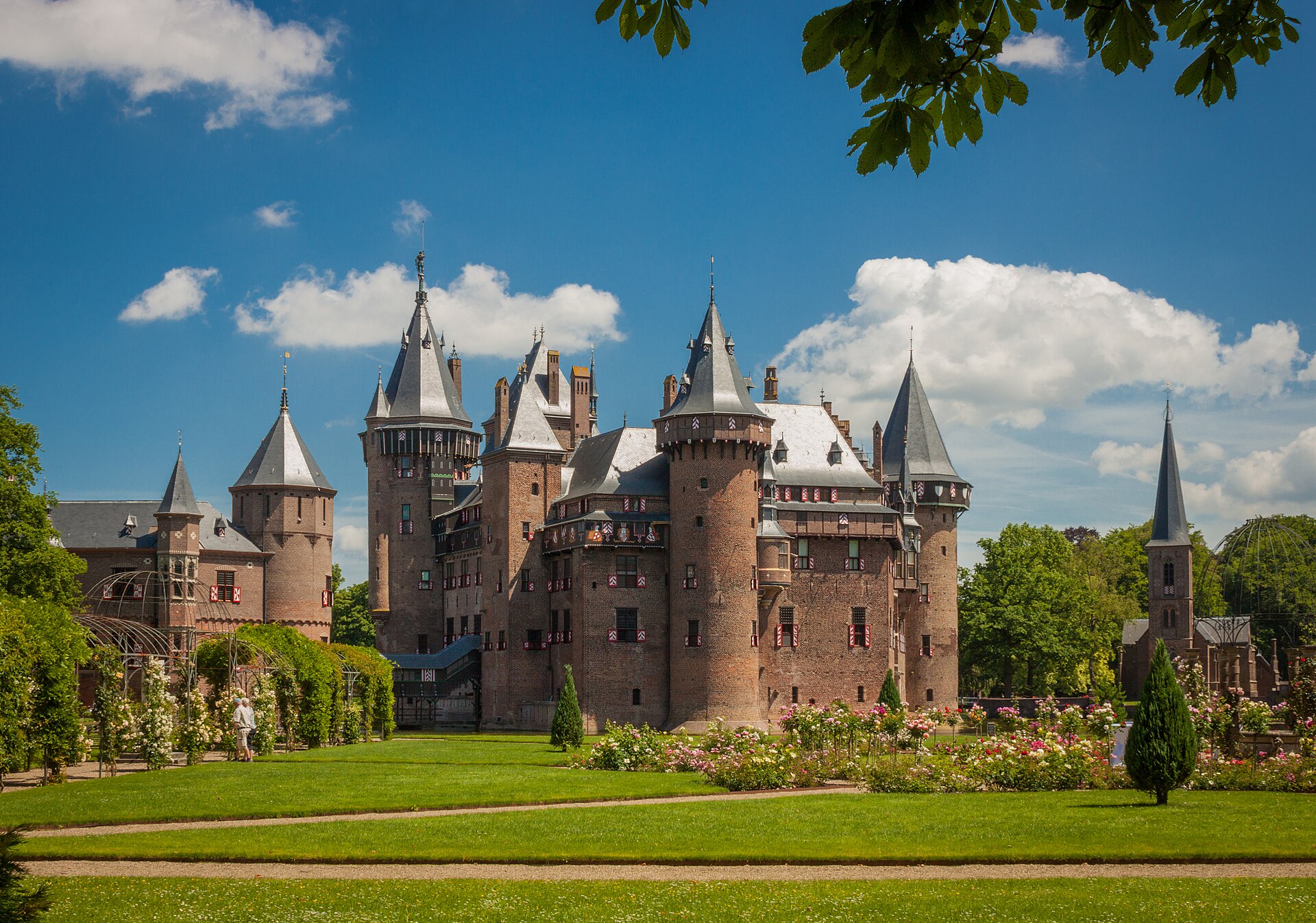
Kasteel de Haar is the largest castle in the Netherlands, situated near Utrecht. While the site dates back to the 14th century, the current structure is largely the result of an extensive reconstruction project led by architect Pierre Cuypers between 1892 and 1912. Commissioned by Baron Étienne van Zuylen van Nijevelt, the project aimed to restore the ruined medieval fortress into a grand residence for the family's social gatherings.
The castle is a prime example of Neo-Gothic architecture, characterized by its elaborate towers, turrets, and moats. The interior is equally opulent, housing a vast collection of decorative arts, tapestries, and paintings. The surrounding 135-acre parkland, designed by landscape architect Hendrik Copijn, features formal gardens and a complex water management system, reflecting the romanticized vision of aristocratic life at the turn of the 20th century.
Key Facts
- Materials
- Brick, Natural stone, Iron, Wood
- Civilization
- Dutch
- Accessibility
- Ground floor accessible, upper floors limited
- Date(s)
- 1892-1912 (reconstruction)
- Condition
- Well-preserved, museum and private estate
- Original Function
- Fortified residence
- Key Figures
- Baron Étienne van Zuylen van Nijevelt, Hélène de Rothschild, Pierre Cuypers
Medieval Origins
14th centuryThe first mention of the castle dates to 1391, when the Van de Haar family held the property as a fiefdom from the Bishop of Utrecht. The original structure was a fortified house built on a strategic location near a branch of the Rhine.
Decline and Ruin
15th-19th centuryThe castle suffered significant damage during the 15th century and remained in a state of decay for centuries. By the late 19th century, the estate was a crumbling ruin inherited by Baron Étienne van Zuylen van Nijevelt.
The Cuypers Reconstruction
1892-1912Baron Étienne and his wife, Hélène de Rothschild, commissioned architect Pierre Cuypers to rebuild the castle. The project was massive, involving the movement of an entire village to accommodate the expanded park and the installation of modern amenities like central heating and electricity.
Modern Era
20th century-presentThe castle served as a prestigious venue for the Van Zuylen family to host international guests. In 2000, the castle and the surrounding park were transferred to a foundation to ensure their preservation, and it now operates as a public museum.
Cultural Significance
Kasteel de Haar serves as a symbol of the Dutch aristocratic revival in the late 19th century. It represents the intersection of medieval heritage and the immense wealth of the European elite during the Belle Époque. The castle is deeply embedded in local culture as a landmark of the Utrecht province and a testament to the influence of the Van Zuylen family.
Interpretive Notes
Scholarly debates and areas of uncertainty
The extent to which the reconstruction by Pierre Cuypers 'invented' a medieval past rather than restoring it is a subject of architectural discussion. Critics often debate the balance between authentic historical preservation and the creation of a romanticized, theatrical environment designed for social display.
Visiting Information
Entry Rules
Open daily for museum visits. Tickets can be purchased online or at the entrance. The park and the castle interior have different access requirements; check the official website for seasonal opening hours and guided tour availability.
Best Times to Visit
Spring and summer are ideal for exploring the extensive parklands and rose gardens. Weekdays are generally quieter than weekends.
Photography
Personal photography is permitted in the park and the castle interior without flash or tripods. Professional or commercial photography requires prior written permission.
Preservation Notes
The castle is a protected national monument. Visitors are requested to follow marked paths, refrain from touching historical artifacts, and respect the ongoing maintenance of the gardens and structural masonry.
Nearby POIs
11 shownSources & Further Reading
- [1]Kasteel de Haar: The History of a Reconstruction — B. Olde Meierink. Matrijs Publishers (2012)
- [2]Pierre Cuypers and the Neo-Gothic Movement — A.J.C. van Leeuwen. Waanders Uitgevers (2007)
Key Facts
- Materials
- Brick, Natural stone, Iron, Wood
- Civilization
- Dutch
- Accessibility
- Ground floor accessible, upper floors limited
- Date(s)
- 1892-1912 (reconstruction)
- Condition
- Well-preserved, museum and private estate
- Original Function
- Fortified residence
- Key Figures
- Baron Étienne van Zuylen van Nijevelt, Hélène de Rothschild, Pierre Cuypers