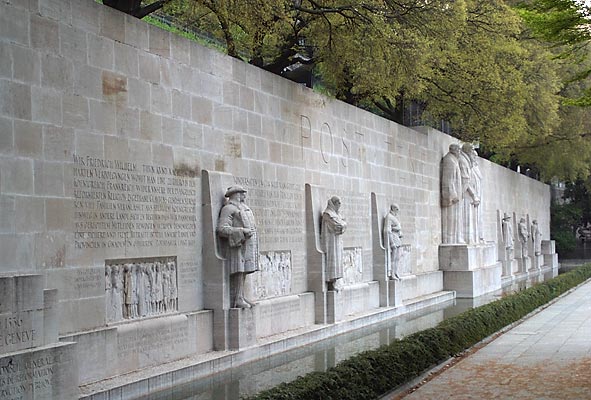
The Reformation Wall, or International Monument to the Reformation, is a monumental wall located within the Parc des Bastions in Geneva, Switzerland. Constructed between 1909 and 1917, it commemorates the primary figures and historical milestones of the Protestant Reformation. The central section features four five-meter-tall statues of key reformers: John Calvin, Guillaume Farel, Theodore Beza, and John Knox.
Flanking the central figures are smaller statues and relief carvings depicting other significant individuals and events, such as Oliver Cromwell and the Mayflower Pilgrims. The wall serves as a physical manifestation of Geneva's historical identity as the 'Protestant Rome' and was built to celebrate the 400th anniversary of John Calvin's birth and the 350th anniversary of the founding of the University of Geneva.
Key Facts
- Materials
- Savonnières limestone
- Civilization
- Swiss
- Accessibility
- Wheelchair accessible via park paths
- Date(s)
- 1909-1917
- Condition
- Well-preserved
- Original Function
- Commemorative monument
- Key Figures
- John Calvin, Guillaume Farel, Theodore Beza, John Knox
Conception and Competition
1908A competition was launched in 1908 to design a monument celebrating the Reformation. The project attracted 71 entries from around the world, with the winning design submitted by four Swiss architects: Henri-Paul Nénot, Julien Flegenheimer, Alphonse Laverrière, and Jean Taillens.
Construction
1909-1917Construction began in 1909 to coincide with the 400th anniversary of John Calvin's birth. The wall was built into the old 16th-century city fortifications, utilizing the existing ramparts to provide a dramatic backdrop for the limestone sculptures.
Modern Significance
20th Century - PresentThe monument has become a landmark of Geneva, representing the city's intellectual and religious history. It remains a site of public interest and historical education, maintained by the city as part of the University of Geneva's park grounds.
Cultural Significance
The Reformation Wall is a central symbol of Geneva's role in the Protestant Reformation, highlighting the city's historical status as a refuge for reformers and a center of theological education. It reflects the international scope of the movement, honoring figures from various countries including France, Scotland, and England.
Beyond its religious context, the monument is a significant example of early 20th-century monumental sculpture and urban planning. It integrates historical architecture with public space, serving as a focal point for both local residents and international visitors interested in European history.
Interpretive Notes
Scholarly debates and areas of uncertainty
There is occasional scholarly discussion regarding the selection of figures included on the wall. Some historians argue that the monument reflects a specific, curated narrative of the Reformation that emphasizes certain theological traditions while omitting others, such as the Anabaptist movement or specific female reformers who played critical roles in the era.
Visiting Information
Entry Rules
The monument is located in a public park and is accessible at all times. There is no entry fee.
Best Times to Visit
Spring and summer months offer the best conditions for viewing the monument within the park. Early morning or late afternoon provides the best lighting for photography of the relief carvings.
Photography
Personal photography is permitted. Commercial photography may require authorization from the City of Geneva.
Preservation Notes
The limestone is susceptible to weathering. Visitors are requested not to climb on the monument or touch the delicate relief carvings.
Nearby POIs
10 shownSources & Further Reading
- [1]The Reformation Wall: A Guide to the Monument — Geneva Tourism Office. Geneva Official Portal (2021)View
- [2]Protestantism and the City: The Reformation in Geneva — William G. Naphy. Cambridge University Press (2003)
Key Facts
- Materials
- Savonnières limestone
- Civilization
- Swiss
- Accessibility
- Wheelchair accessible via park paths
- Date(s)
- 1909-1917
- Condition
- Well-preserved
- Original Function
- Commemorative monument
- Key Figures
- John Calvin, Guillaume Farel, Theodore Beza, John Knox