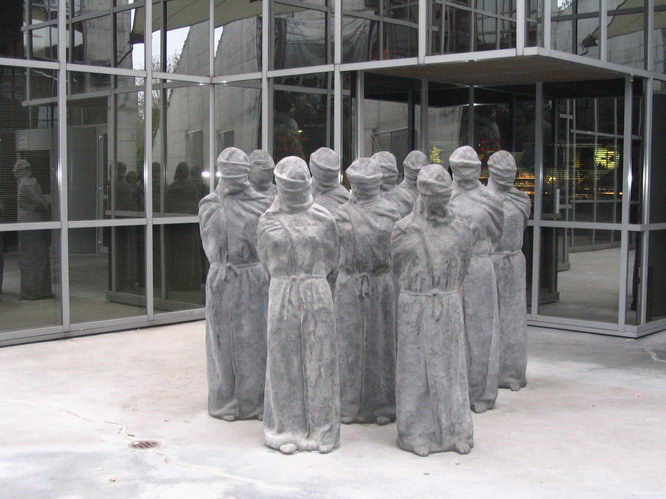
The International Red Cross and Red Crescent Museum, located in Geneva, Switzerland, serves as the primary institution dedicated to documenting the history and humanitarian impact of the Red Cross and Red Crescent Movement. The museum is situated near the headquarters of the International Committee of the Red Cross (ICRC) and provides a comprehensive overview of humanitarian action from the 19th century to the present day.
The permanent exhibition is organized into three distinct thematic areas, each designed by a different internationally renowned architect: 'Defending Human Dignity' by Gringo Cardia, 'Reducing Natural Risks' by Diébédo Francis Kéré, and 'Restoring Family Links' by Shigeru Ban. These spaces utilize immersive installations and archival materials to explore the challenges of humanitarian aid in conflict zones, natural disasters, and humanitarian crises.
Key Facts
- Materials
- Concrete, Glass, Steel
- Civilization
- Modern Swiss
- Accessibility
- Fully wheelchair accessible
- Date(s)
- 1988
- Condition
- Active
- Original Function
- Museum
- Key Figures
- Henry Dunant
Founding and Early Years
1988The museum was inaugurated in 1988 to provide a public space for understanding the origins of the Red Cross movement, which was sparked by Henry Dunant's experiences at the Battle of Solferino in 1859.
Major Renovation
2013The museum underwent a significant transformation in 2013, moving away from a purely chronological display to the current thematic approach designed by three international architects to better engage visitors with contemporary humanitarian issues.
Cultural Significance
The museum acts as a global center for humanitarian discourse, reflecting Switzerland's historical role as a neutral ground for international diplomacy and the birthplace of the Geneva Conventions. It serves as a vital educational resource for understanding the evolution of international humanitarian law.
Interpretive Notes
Scholarly debates and areas of uncertainty
Discussions often center on the challenge of maintaining institutional neutrality while presenting the complex political realities of the conflicts in which the Red Cross operates. Scholars debate the effectiveness of immersive museum design in conveying the gravity of humanitarian suffering without resorting to sensationalism.
Visiting Information
Entry Rules
Open Tuesday through Sunday. Tickets can be purchased online or at the entrance. Group visits and guided tours should be booked in advance.
Best Times to Visit
Weekday mornings are generally quieter. The museum is closed on Mondays.
Photography
Personal photography is permitted in most areas without flash. Professional photography requires prior authorization.
Preservation Notes
Visitors are requested to respect the sensitive nature of the exhibits, which include archival documents and personal testimonies related to human suffering.
Nearby POIs
10 shownSources & Further Reading
- [1]The International Red Cross and Red Crescent Museum: A New Approach to Humanitarian History — Roger Mayou. ICRC Review (2013)View
- [2]Humanitarianism and the Museum Space — Peter G. H. M. van der Auwera. Journal of Museum Studies (2015)
Key Facts
- Materials
- Concrete, Glass, Steel
- Civilization
- Modern Swiss
- Accessibility
- Fully wheelchair accessible
- Date(s)
- 1988
- Condition
- Active
- Original Function
- Museum
- Key Figures
- Henry Dunant