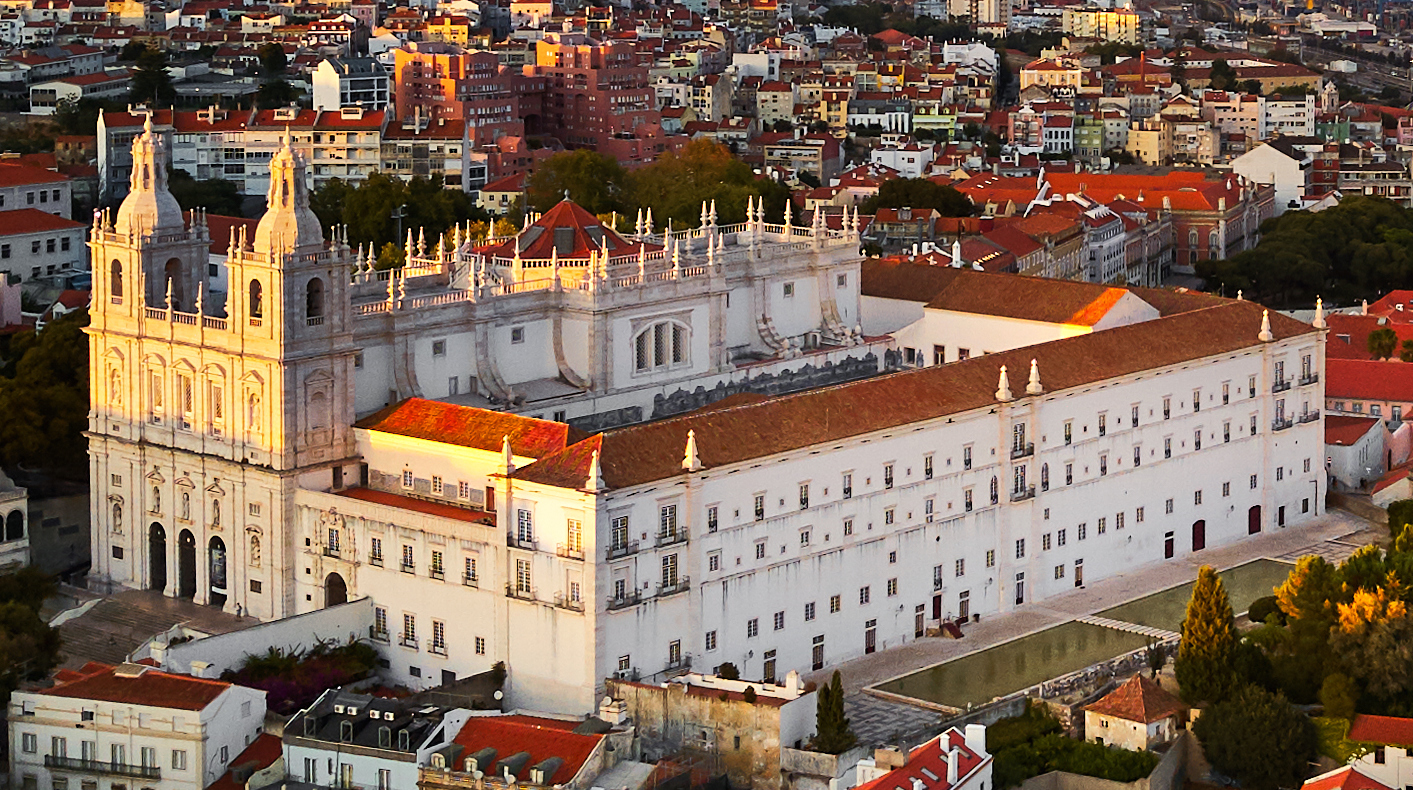
The Monastery of São Vicente de Fora is a significant 17th-century religious complex located in the Alfama district of Lisbon. Founded originally in 1147 by King Afonso Henriques for the Augustinian Order, the current structure was largely rebuilt between 1582 and 1629 following the designs of Italian architect Filippo Terzi. It stands as one of the most prominent examples of Mannerist architecture in Portugal, characterized by its austere facade and balanced proportions.
Beyond its architectural importance, the monastery serves as the final resting place for the Braganza dynasty. The royal pantheon, located within the refectory and adjacent chambers, houses the tombs of numerous Portuguese monarchs and their families. The site is also renowned for its extensive collection of 18th-century azulejos (ceramic tiles), which depict scenes from the fables of Jean de La Fontaine and the history of the monastery itself.
Key Facts
- Materials
- Limestone, Marble, Glazed ceramic tiles
- Civilization
- Portuguese
- Accessibility
- Partial accessibility; some areas involve stairs
- Date(s)
- 1582-1629
- Condition
- Well-preserved, active religious site and museum
- Original Function
- Augustinian Monastery
- Key Figures
- King Afonso Henriques, Filippo Terzi, King John IV
Founding and Early History
1147The monastery was established by King Afonso Henriques outside the city walls (hence 'de Fora') to honor Saint Vincent, the patron saint of Lisbon, following the Christian reconquest of the city from the Moors.
Mannerist Reconstruction
1582-1629Under the patronage of Philip II of Spain (Philip I of Portugal), the original medieval structure was demolished and replaced with the current Mannerist complex designed by Filippo Terzi and later overseen by Baltazar Álvares.
Royal Pantheon and Baroque Additions
17th-18th centuryFollowing the Restoration of Independence in 1640, the monastery became the official burial site for the House of Braganza. During the 18th century, the cloister walls were decorated with elaborate blue and white azulejos.
Modern Era
19th century - presentFollowing the dissolution of religious orders in Portugal in 1834, the monastery underwent various administrative changes. Today, it functions as a museum and a site of historical pilgrimage, maintaining its role as a royal pantheon.
Cultural Significance
The monastery is a cornerstone of Portuguese cultural heritage, representing the transition from the austere Mannerist style to the decorative Baroque period. Its status as the Royal Pantheon of the Braganza dynasty links it directly to the political history of the Portuguese monarchy, while its tile collection is considered one of the most important in the world for its narrative and artistic quality.
Interpretive Notes
Scholarly debates and areas of uncertainty
There is ongoing academic discussion regarding the extent of Filippo Terzi's original design versus the modifications implemented by Baltazar Álvares during the lengthy construction process. Additionally, the conservation of the 18th-century tile panels remains a subject of technical debate due to the fragility of the ceramic glazes in the humid Lisbon climate.
Visiting Information
Entry Rules
Open Tuesday to Sunday. Tickets are required for entry to the museum and the royal pantheon. Visitors are expected to maintain a respectful demeanor as the site remains a place of religious significance.
Best Times to Visit
Weekday mornings are recommended to avoid weekend crowds. The site is particularly pleasant in late spring when the light enhances the detail of the azulejo panels in the cloisters.
Photography
Personal photography is permitted in most areas without flash. Tripods and professional equipment require prior authorization.
Preservation Notes
The azulejo panels are extremely fragile; visitors must refrain from touching the walls. Some areas of the monastery are subject to ongoing conservation efforts to stabilize the stone masonry.
Nearby POIs
11 shownSources & Further Reading
- [1]The Architecture of the Monastery of São Vicente de Fora — José Augusto França. Editorial Presença (1990)
- [2]Azulejos in Portugal: A History of Ceramic Art — Santos, Maria Helena. Museu Nacional do Azulejo (2015)
Key Facts
- Materials
- Limestone, Marble, Glazed ceramic tiles
- Civilization
- Portuguese
- Accessibility
- Partial accessibility; some areas involve stairs
- Date(s)
- 1582-1629
- Condition
- Well-preserved, active religious site and museum
- Original Function
- Augustinian Monastery
- Key Figures
- King Afonso Henriques, Filippo Terzi, King John IV