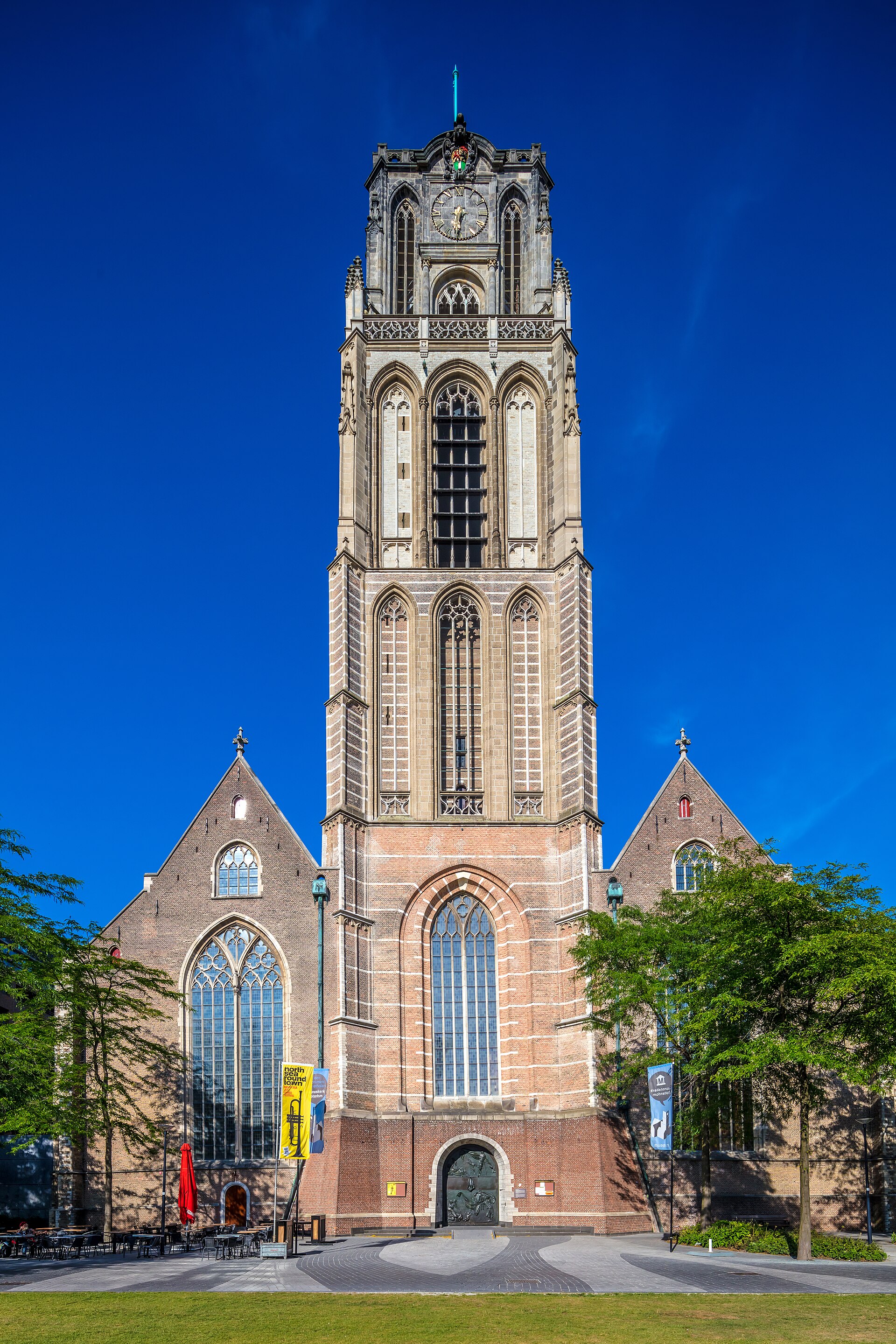
The Grote of Sint-Laurenskerk is the only remaining medieval building in Rotterdam, serving as a significant architectural survivor of the city's destruction during the Second World War. Constructed between 1449 and 1525, the church stands as a prominent example of late Gothic architecture in the Netherlands, characterized by its imposing brick structure and limestone detailing.
Following the devastating bombardment of Rotterdam in May 1940, the church suffered severe damage, losing much of its roof and interior furnishings. Its subsequent restoration, completed in 1968, was championed by Queen Juliana and became a symbol of the city's resilience and post-war recovery. Today, the church functions as a cultural venue, hosting concerts, exhibitions, and civic ceremonies while maintaining its historical identity.
Key Facts
- Materials
- Brick, Limestone
- Civilization
- Dutch
- Accessibility
- Wheelchair accessible
- Date(s)
- 1449-1525
- Condition
- Restored, active cultural and religious venue
- Original Function
- Catholic Church
- Key Figures
- Queen Juliana, Desiderius Erasmus
Construction and Early Years
1449-1525The church was built to replace the smaller St. Lawrence chapel. Construction began in 1449 and took nearly 80 years to complete, resulting in a grand cruciform basilica that dominated the Rotterdam skyline.
Reformation and Transition
1572-1940Following the Protestant Reformation in 1572, the church was converted from Catholic to Reformed use. Over the following centuries, it served as the primary religious center for the city, housing the tombs of several Dutch naval heroes.
The Rotterdam Blitz
1940During the German bombardment of Rotterdam on May 14, 1940, the church was severely damaged by fire and falling debris. It was one of the few structures in the city center to remain standing, albeit in a ruined state.
Post-War Restoration
1952-1968After years of debate regarding whether to demolish the ruins, a restoration project was initiated in 1952. The church was meticulously rebuilt and modernized, officially reopening in 1968 as a symbol of Rotterdam's rebirth.
Cultural Significance
The Sint-Laurenskerk is deeply embedded in the identity of Rotterdam. As the sole medieval survivor in a city defined by modern architecture, it acts as a physical bridge to the city's pre-1940 history. It is frequently used for major civic events, including the inauguration of the city's mayor and various memorial services.
Interpretive Notes
Scholarly debates and areas of uncertainty
There is ongoing academic discussion regarding the extent to which the post-war restoration altered the original medieval aesthetic versus preserving the 'ruined' historical narrative of the building.
Visiting Information
Entry Rules
Open to the public Tuesday through Saturday. Entry requires a ticket for tower climbs and general admission. Modest dress is requested as it remains a site of religious significance.
Best Times to Visit
Late morning for natural light through the stained glass. The tower climb is best during clear weather for panoramic views of the Rotterdam skyline.
Photography
Personal photography is permitted. Tripods and commercial photography require prior authorization from the church administration.
Preservation Notes
The building is a protected national monument. Visitors are asked to refrain from touching the historic stonework and to remain on designated paths.
Nearby POIs
11 shownSources & Further Reading
- [1]Rotterdam in the Second World War — Nico van der Meer. Rotterdam City Archives (2015)
- [2]The Architecture of the Grote Kerk — J.R. ter Molen. Waanders Publishers (1998)
Key Facts
- Materials
- Brick, Limestone
- Civilization
- Dutch
- Accessibility
- Wheelchair accessible
- Date(s)
- 1449-1525
- Condition
- Restored, active cultural and religious venue
- Original Function
- Catholic Church
- Key Figures
- Queen Juliana, Desiderius Erasmus