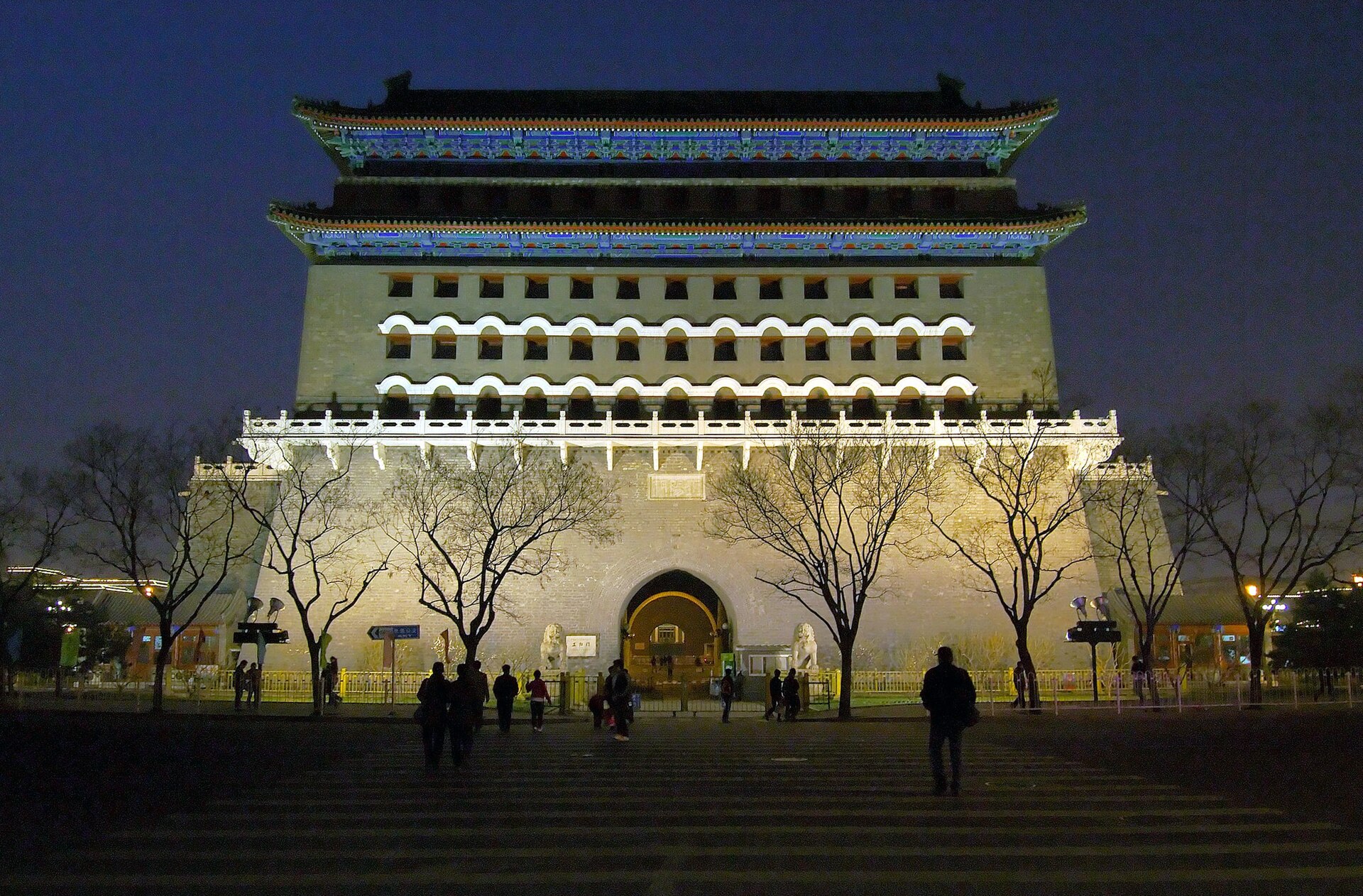
Zhengyangmen, historically known as Qianmen, served as the primary southern gate of the Inner City of Beijing during the Ming and Qing dynasties. Situated directly south of the Imperial City, it functioned as the ceremonial entrance for the Emperor when traveling to the Temple of Heaven or the Temple of Agriculture.
The complex consists of two primary structures: the gatehouse and the archery tower, separated by a semi-circular barbican. While the original wooden structures suffered damage during the Boxer Rebellion in 1900, the gate was reconstructed in the early 20th century. Today, it stands as a prominent landmark in central Beijing, housing a museum dedicated to the history of the city's old fortifications.
Key Facts
- Materials
- Brick, Wood, Stone
- Civilization
- Chinese (Ming Dynasty)
- Accessibility
- Ground level accessible, upper floors via stairs
- Date(s)
- 1419 CE
- Condition
- Restored, functions as a museum
- Original Function
- City gate and defensive fortification
- Key Figures
- Yongle Emperor
Construction and Imperial Use
1419-1439Built during the reign of the Yongle Emperor, Zhengyangmen was the largest of the nine gates of the Inner City. It was designed to control access to the imperial palace and served as a vital component of the capital's defensive perimeter.
Destruction and Reconstruction
1900During the Boxer Rebellion, the gatehouse was severely damaged by fire caused by the Eight-Nation Alliance. The structure was subsequently rebuilt in 1903, incorporating some Western architectural influences while maintaining its traditional Chinese form.
Modern Preservation
1949-PresentFollowing the establishment of the People's Republic of China, the city walls were largely demolished to accommodate urban expansion. Zhengyangmen was preserved as a historical monument and now serves as a museum documenting the history of Beijing's city gates.
Cultural Significance
Zhengyangmen is a symbol of Beijing's historical urban layout, marking the central axis of the city. It represents the transition between the bustling commercial districts of the Outer City and the restricted, sacred spaces of the Inner City and Imperial Palace.
Interpretive Notes
Scholarly debates and areas of uncertainty
There is ongoing academic discussion regarding the extent to which the 1903 reconstruction deviated from the original Ming-era architectural specifications, particularly concerning the structural integrity and aesthetic modifications introduced during the post-Boxer Rebellion period.
Visiting Information
Entry Rules
Open Tuesday to Sunday. Tickets are required for entry into the museum located within the archery tower. Security screening is mandatory for all visitors.
Best Times to Visit
Morning hours are recommended to avoid peak tourist traffic in the Qianmen area. Weekdays offer a quieter experience for viewing the exhibits.
Photography
Photography is permitted in public areas. Flash photography is prohibited inside the museum galleries.
Preservation Notes
The structure is a protected cultural heritage site. Visitors are requested to refrain from touching the historical brickwork and to remain within designated viewing areas.
Nearby POIs
11 shown- Chairman Mao Memorial Hall0.2 km
- National Museum of China0.6 km
- Forbidden City2 km
- Temple of Heaven2.8 km
- National Art Museum of China2.9 km
- Prince Gong's Mansion4.1 km
- Drum Tower and Bell Tower of Beijing4.6 km
- Capital Museum4.8 km
- Beijing Temple of Confucius5.3 km
- Yonghe Temple5.4 km
- Military Museum of the Chinese People's Revolution6.4 km
Sources & Further Reading
- [1]Beijing's City Walls and Gates — Osvald Sirén. Bodley Head (1924)
- [2]The Forbidden City: The Great Within — May Holdsworth. Oxford University Press (1998)
Key Facts
- Materials
- Brick, Wood, Stone
- Civilization
- Chinese (Ming Dynasty)
- Accessibility
- Ground level accessible, upper floors via stairs
- Date(s)
- 1419 CE
- Condition
- Restored, functions as a museum
- Original Function
- City gate and defensive fortification
- Key Figures
- Yongle Emperor
Nearby POIs
11 shown- Chairman Mao Memorial Hall0.2 km
- National Museum of China0.6 km
- Forbidden City2 km
- Temple of Heaven2.8 km
- National Art Museum of China2.9 km
- Prince Gong's Mansion4.1 km
- Drum Tower and Bell Tower of Beijing4.6 km
- Capital Museum4.8 km
- Beijing Temple of Confucius5.3 km
- Yonghe Temple5.4 km
- Military Museum of the Chinese People's Revolution6.4 km