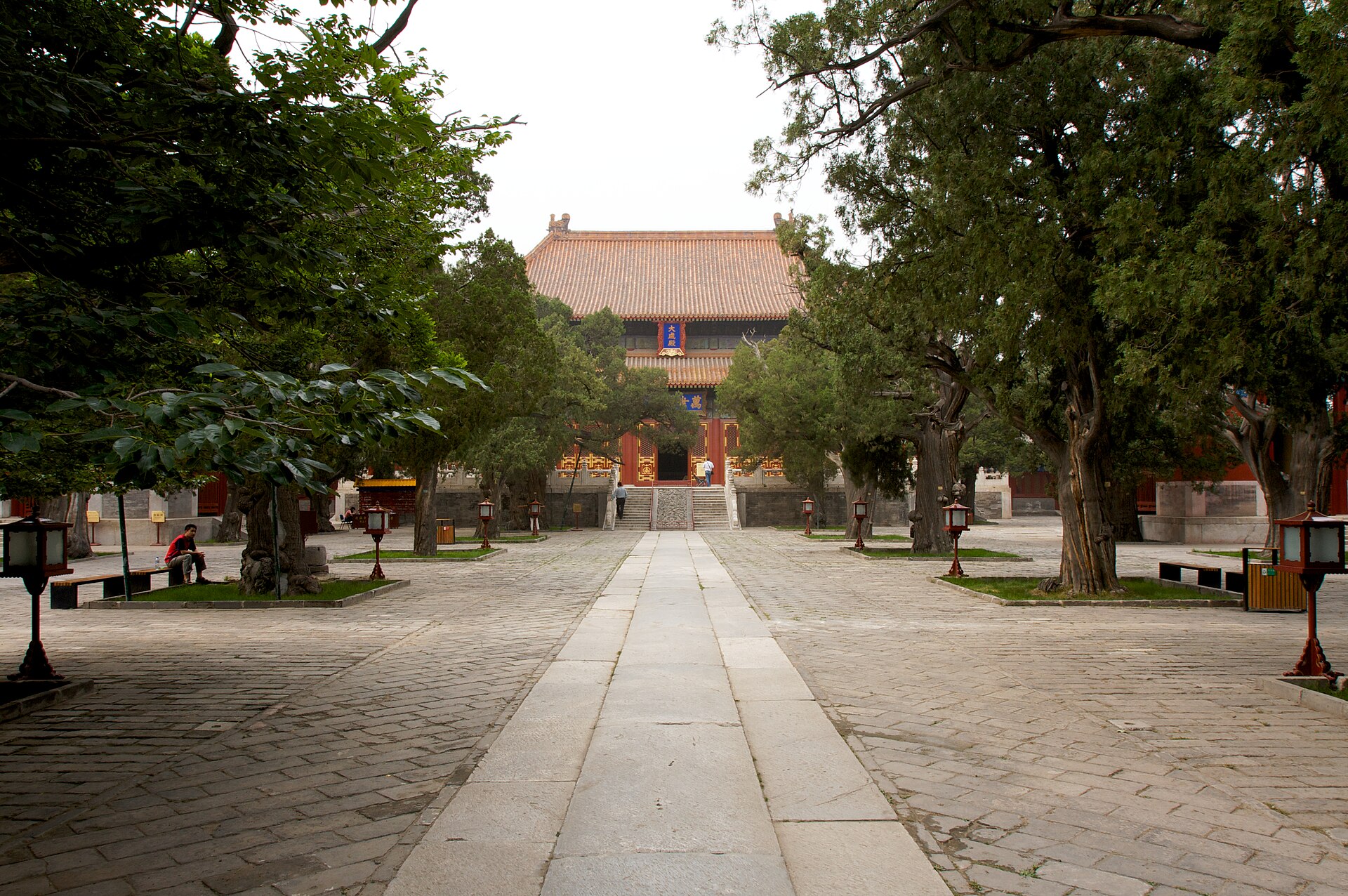
The Beijing Temple of Confucius is the second-largest Confucian temple in China, surpassed only by the temple in Qufu. Originally constructed in 1302 during the Yuan Dynasty, it served as a site for imperial ceremonies honoring Confucius and his disciples. The complex is situated near the Guozijian, or Imperial Academy, reflecting the historical integration of Confucian ritual and state-sponsored education.
The temple grounds feature a series of courtyards lined with ancient cypress trees and numerous stone stelae. These monuments include the Jinshi stelae, which record the names of successful candidates in the imperial examinations from the Yuan, Ming, and Qing dynasties, providing a significant historical record of China's civil service system.
Key Facts
- Materials
- Wood, Brick, Stone, Glazed tile
- Civilization
- Chinese
- Accessibility
- Ground level access with paved paths
- Date(s)
- 1302 CE
- Condition
- Well-preserved, functioning as a museum
- Original Function
- Confucian ritual and imperial worship
- Key Figures
- Confucius, Kublai Khan, Emperor Yongle
Foundation and Early Years
1302 CEThe temple was established in 1302 during the reign of Temür Khan (Emperor Chengzong of Yuan). It was designed to serve as the primary site for Confucian rites in the capital city of Dadu.
Ming and Qing Expansions
1368-1911 CEThroughout the Ming and Qing dynasties, the temple underwent multiple expansions and renovations. It became closely linked to the adjacent Imperial Academy, serving as the spiritual heart of the imperial examination system.
Modern Preservation
20th century - presentFollowing the end of the imperial era, the site was repurposed as a museum. It has undergone extensive restoration to preserve its architectural integrity and the thousands of stone inscriptions housed within the courtyards.
Cultural Significance
The temple represents the historical nexus of Chinese intellectual and political life. By housing the records of imperial examination graduates, it serves as a testament to the meritocratic ideals that defined the Chinese bureaucracy for centuries. It remains a vital site for understanding the influence of Confucianism on East Asian social structures and governance.
Interpretive Notes
Scholarly debates and areas of uncertainty
Scholarly discussion often focuses on the architectural evolution of the site and the degree to which its layout reflects the specific ritual requirements of the Yuan versus the later Ming and Qing dynasties. There is also ongoing research into the preservation of the stone stelae, which are subject to environmental degradation.
Visiting Information
Entry Rules
Open daily. Tickets are required for entry. Visitors are expected to maintain a quiet demeanor as the site is a place of cultural heritage.
Best Times to Visit
Spring and autumn offer the most comfortable weather for walking through the outdoor courtyards. Weekday mornings are recommended to avoid weekend crowds.
Photography
Personal photography is permitted in the courtyards. Flash photography is prohibited inside the exhibition halls.
Preservation Notes
Do not touch the stone stelae or the wooden structures. Stay on designated paths to protect the historic grounds.
Nearby POIs
11 shown- Yonghe Temple0.2 km
- Drum Tower and Bell Tower of Beijing1.7 km
- National Art Museum of China2.4 km
- Prince Gong's Mansion2.6 km
- Forbidden City3.4 km
- National Museum of China4.7 km
- Chairman Mao Memorial Hall5.1 km
- Zhengyangmen5.3 km
- China Science and Technology Museum6.7 km
- Temple of Heaven7.6 km
- Capital Museum7.6 km
Sources & Further Reading
- [1]The Temple of Confucius in Beijing — Beijing Municipal Administration of Cultural Heritage. Beijing Publishing House (2015)View
- [2]Confucianism and the Imperial Examination System — Benjamin A. Elman. University of California Press (2000)
Key Facts
- Materials
- Wood, Brick, Stone, Glazed tile
- Civilization
- Chinese
- Accessibility
- Ground level access with paved paths
- Date(s)
- 1302 CE
- Condition
- Well-preserved, functioning as a museum
- Original Function
- Confucian ritual and imperial worship
- Key Figures
- Confucius, Kublai Khan, Emperor Yongle
Nearby POIs
11 shown- Yonghe Temple0.2 km
- Drum Tower and Bell Tower of Beijing1.7 km
- National Art Museum of China2.4 km
- Prince Gong's Mansion2.6 km
- Forbidden City3.4 km
- National Museum of China4.7 km
- Chairman Mao Memorial Hall5.1 km
- Zhengyangmen5.3 km
- China Science and Technology Museum6.7 km
- Temple of Heaven7.6 km
- Capital Museum7.6 km