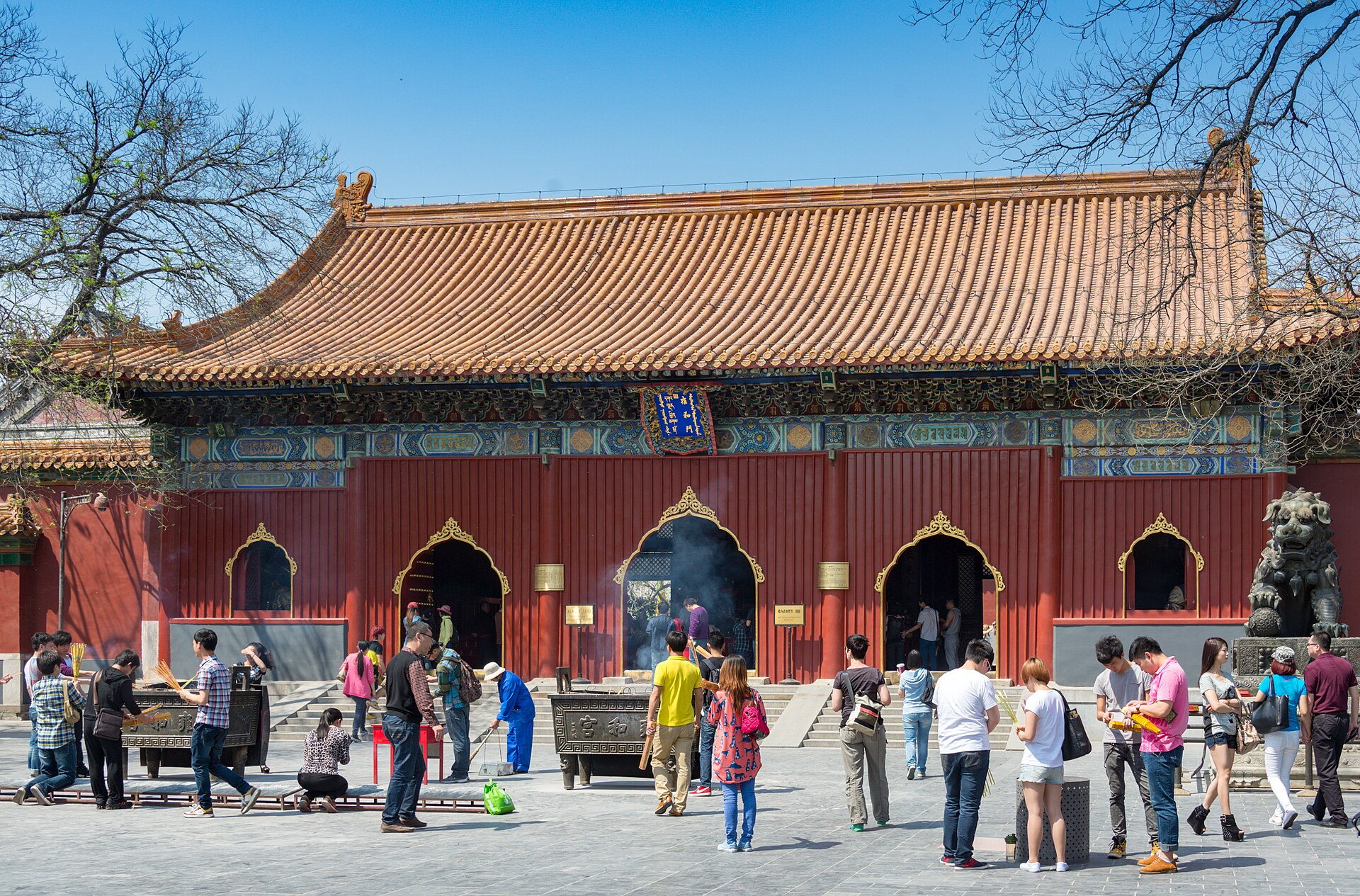
The Yonghe Temple, also known as the Palace of Peace and Harmony Lama Temple, is a monastery and temple of the Gelug school of Tibetan Buddhism located in the Dongcheng District of Beijing. Originally constructed in 1694 as the residence of Prince Yinzhen (the future Yongzheng Emperor), it was converted into a lamasery in 1744 after he ascended the throne.
The temple complex is renowned for its blend of Han Chinese and Tibetan architectural styles, featuring five main halls along a central axis. It houses a massive 18-meter-tall statue of Maitreya Buddha carved from a single piece of white sandalwood, which is recognized by the Guinness World Records as the largest of its kind in the world.
Key Facts
- Materials
- Wood, Brick, Glazed tile
- Civilization
- Qing Dynasty
- Accessibility
- Partially accessible; some uneven stone surfaces and steps
- Date(s)
- 1694
- Condition
- Active monastery and museum
- Original Function
- Imperial residence
- Key Figures
- Yongzheng Emperor, Qianlong Emperor
Imperial Residence
1694The site was originally built as the residence for Prince Yinzhen, the fourth son of the Kangxi Emperor. It served as his palace until he became the Yongzheng Emperor in 1722.
Conversion to Lamasery
1744Following the death of the Yongzheng Emperor, his successor, the Qianlong Emperor, converted the residence into a Tibetan Buddhist monastery. It became a center for the Gelug school and housed monks from Tibet and Mongolia.
Modern Preservation
1949-PresentAfter the founding of the People's Republic of China, the temple was declared a national heritage site. It underwent significant restoration in the 1980s and remains an active place of worship today.
Cultural Significance
The Yonghe Temple served as a vital political and religious tool for the Qing emperors to maintain control and influence over Tibet and Mongolia. By patronizing the Gelug school, the Qing court integrated the spiritual authority of the Dalai and Panchen Lamas into the imperial state structure.
Today, it remains one of the most important Buddhist sites in Beijing, attracting thousands of pilgrims and tourists daily. It serves as a living testament to the multi-ethnic nature of the Qing Empire and the enduring influence of Tibetan Buddhism in Chinese urban life.
Interpretive Notes
Scholarly debates and areas of uncertainty
There is ongoing academic discussion regarding the extent to which the temple's architecture was intentionally designed to reflect the political hierarchy of the Qing state versus purely religious requirements. Some scholars argue the layout was a deliberate attempt to project imperial power through the lens of Buddhist cosmology.
Visiting Information
Entry Rules
Open daily. Tickets are required for entry. Visitors are expected to dress modestly and maintain a respectful demeanor as it is an active place of worship. Incense is provided at the entrance for visitors to use at the designated burners.
Best Times to Visit
Early morning on weekdays to avoid large tour groups. The temple is particularly significant during the Lunar New Year celebrations when traditional rituals are performed.
Photography
Photography is permitted in the courtyards, but strictly prohibited inside the halls where the Buddha statues are housed.
Preservation Notes
Do not touch the statues or altars. Stay on the marked paths and respect the areas reserved for monks and prayer. The temple is a non-smoking site.
Nearby POIs
11 shown- Beijing Temple of Confucius0.2 km
- Drum Tower and Bell Tower of Beijing1.9 km
- National Art Museum of China2.5 km
- Prince Gong's Mansion2.9 km
- Forbidden City3.6 km
- National Museum of China4.8 km
- Chairman Mao Memorial Hall5.2 km
- Zhengyangmen5.4 km
- China Science and Technology Museum6.7 km
- Temple of Heaven7.7 km
- Capital Museum7.8 km
Sources & Further Reading
- [1]The Lama Temple of Beijing — Gao, Ming. Beijing Arts and Crafts Publishing House (2012)
- [2]Qing Imperial Patronage of Tibetan Buddhism — Berger, Patricia. University of Hawaii Press (2003)
Key Facts
- Materials
- Wood, Brick, Glazed tile
- Civilization
- Qing Dynasty
- Accessibility
- Partially accessible; some uneven stone surfaces and steps
- Date(s)
- 1694
- Condition
- Active monastery and museum
- Original Function
- Imperial residence
- Key Figures
- Yongzheng Emperor, Qianlong Emperor
Nearby POIs
11 shown- Beijing Temple of Confucius0.2 km
- Drum Tower and Bell Tower of Beijing1.9 km
- National Art Museum of China2.5 km
- Prince Gong's Mansion2.9 km
- Forbidden City3.6 km
- National Museum of China4.8 km
- Chairman Mao Memorial Hall5.2 km
- Zhengyangmen5.4 km
- China Science and Technology Museum6.7 km
- Temple of Heaven7.7 km
- Capital Museum7.8 km