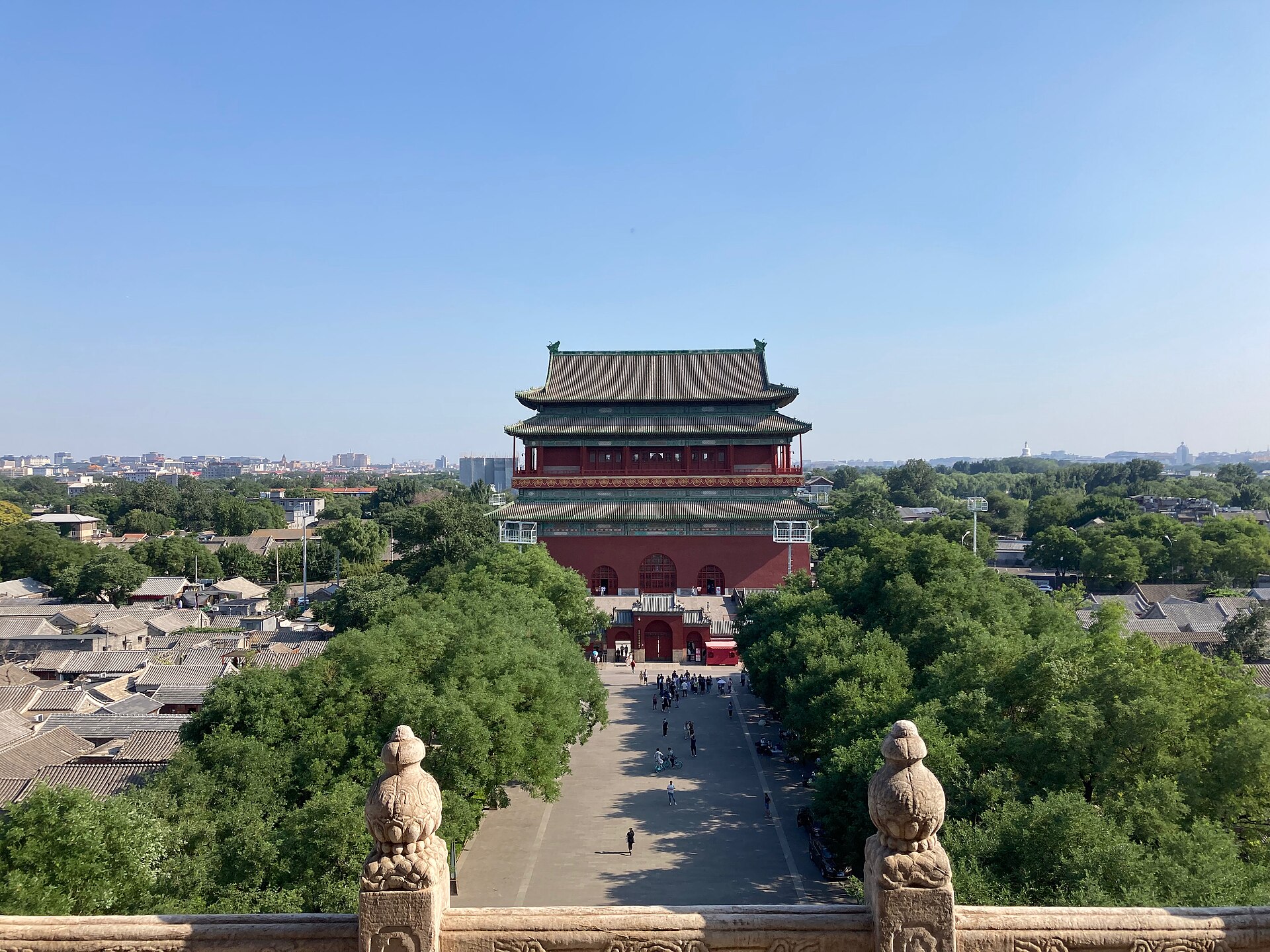
The Drum Tower (Gulou) and Bell Tower (Zhonglou) are located at the northern end of Beijing's central axis. Originally constructed in 1272 during the Yuan Dynasty under Kublai Khan, the structures served as the official timekeeping center for the capital city for over 650 years. The towers were rebuilt during the Ming Dynasty after fires destroyed the original wooden structures, with the current Bell Tower dating primarily to the 18th century.
The towers are characterized by their massive brick and stone platforms and traditional Chinese timber-frame architecture. The Drum Tower, standing 47 meters tall, once housed 24 drums used to mark the hours of the day, while the Bell Tower, standing 33 meters tall, contains a massive bronze bell weighing approximately 63 tons. Together, they remain significant landmarks that define the historical urban planning of Beijing.
Key Facts
- Materials
- Brick, Wood, Stone, Bronze
- Civilization
- Chinese
- Accessibility
- Steep stairs; limited accessibility for mobility-impaired visitors
- Date(s)
- 1272 (rebuilt 1420, 1745)
- Condition
- Restored and open to the public
- Original Function
- Timekeeping and signaling
- Key Figures
- Kublai Khan, Emperor Yongle, Emperor Qianlong
Yuan Dynasty Origins
1272The towers were established as the 'Tower of Orderly Administration' during the reign of Kublai Khan, serving as the heart of the Dadu city plan. They were positioned to anchor the northern end of the city's central axis.
Ming Dynasty Reconstruction
1420Following the transition to the Ming Dynasty and the relocation of the capital to Beijing, the towers were reconstructed by the Yongle Emperor as part of his massive urban expansion project.
Qing Dynasty Refinement
1745The Bell Tower was rebuilt in stone and brick by the Qianlong Emperor to ensure better fire resistance, replacing the earlier wooden structure that had been destroyed by fire.
Modern Preservation
20th century - presentThe towers were opened to the public as a museum in the 1980s. They have undergone several rounds of structural reinforcement and restoration to preserve their architectural integrity while maintaining their status as iconic city landmarks.
Cultural Significance
The towers are central to the concept of the 'Central Axis' of Beijing, a line of symmetry that has organized the city's layout for centuries. Historically, the rhythmic beating of drums and the tolling of the bell dictated the daily life, work, and curfew schedules of the city's residents, symbolizing the authority of the imperial government over time itself.
Today, the towers are symbols of Beijing's historical continuity. They are frequently visited by locals and tourists alike, serving as a cultural bridge between the ancient imperial past and the modern urban landscape of the surrounding hutongs.
Interpretive Notes
Scholarly debates and areas of uncertainty
There is ongoing academic discussion regarding the exact acoustic properties of the Bell Tower's design and how the architectural geometry was intended to amplify the sound of the 63-ton bell across the city. Additionally, scholars debate the extent to which the current site layout reflects the original Yuan Dynasty urban plan versus later Ming and Qing modifications.
Visiting Information
Entry Rules
Open daily. Tickets are required for entry and can be purchased at the gate. Visitors are advised to wear comfortable shoes due to the steep, narrow staircases leading to the upper levels.
Best Times to Visit
Early morning or late afternoon to avoid peak tourist crowds and to experience the best lighting for photography from the top of the Drum Tower.
Photography
Personal photography is permitted throughout the site. Professional or commercial photography requires prior authorization from the site management.
Preservation Notes
The structures are fragile due to their age and wooden components. Visitors are requested to stay within marked areas and refrain from touching the historical artifacts or the bell.
Nearby POIs
11 shown- Prince Gong's Mansion1 km
- Beijing Temple of Confucius1.7 km
- Yonghe Temple1.9 km
- National Art Museum of China2.2 km
- Forbidden City2.6 km
- National Museum of China4.2 km
- Chairman Mao Memorial Hall4.4 km
- Zhengyangmen4.6 km
- Capital Museum6.1 km
- China Science and Technology Museum7.1 km
- Military Museum of the Chinese People's Revolution7.1 km
Sources & Further Reading
- [1]Beijing's Central Axis: A Historical Perspective — Wang, Jun. Beijing Publishing House (2010)
- [2]The Imperial City of Beijing — Susan Naquin. Yale University Press (2000)
Key Facts
- Materials
- Brick, Wood, Stone, Bronze
- Civilization
- Chinese
- Accessibility
- Steep stairs; limited accessibility for mobility-impaired visitors
- Date(s)
- 1272 (rebuilt 1420, 1745)
- Condition
- Restored and open to the public
- Original Function
- Timekeeping and signaling
- Key Figures
- Kublai Khan, Emperor Yongle, Emperor Qianlong
Nearby POIs
11 shown- Prince Gong's Mansion1 km
- Beijing Temple of Confucius1.7 km
- Yonghe Temple1.9 km
- National Art Museum of China2.2 km
- Forbidden City2.6 km
- National Museum of China4.2 km
- Chairman Mao Memorial Hall4.4 km
- Zhengyangmen4.6 km
- Capital Museum6.1 km
- China Science and Technology Museum7.1 km
- Military Museum of the Chinese People's Revolution7.1 km