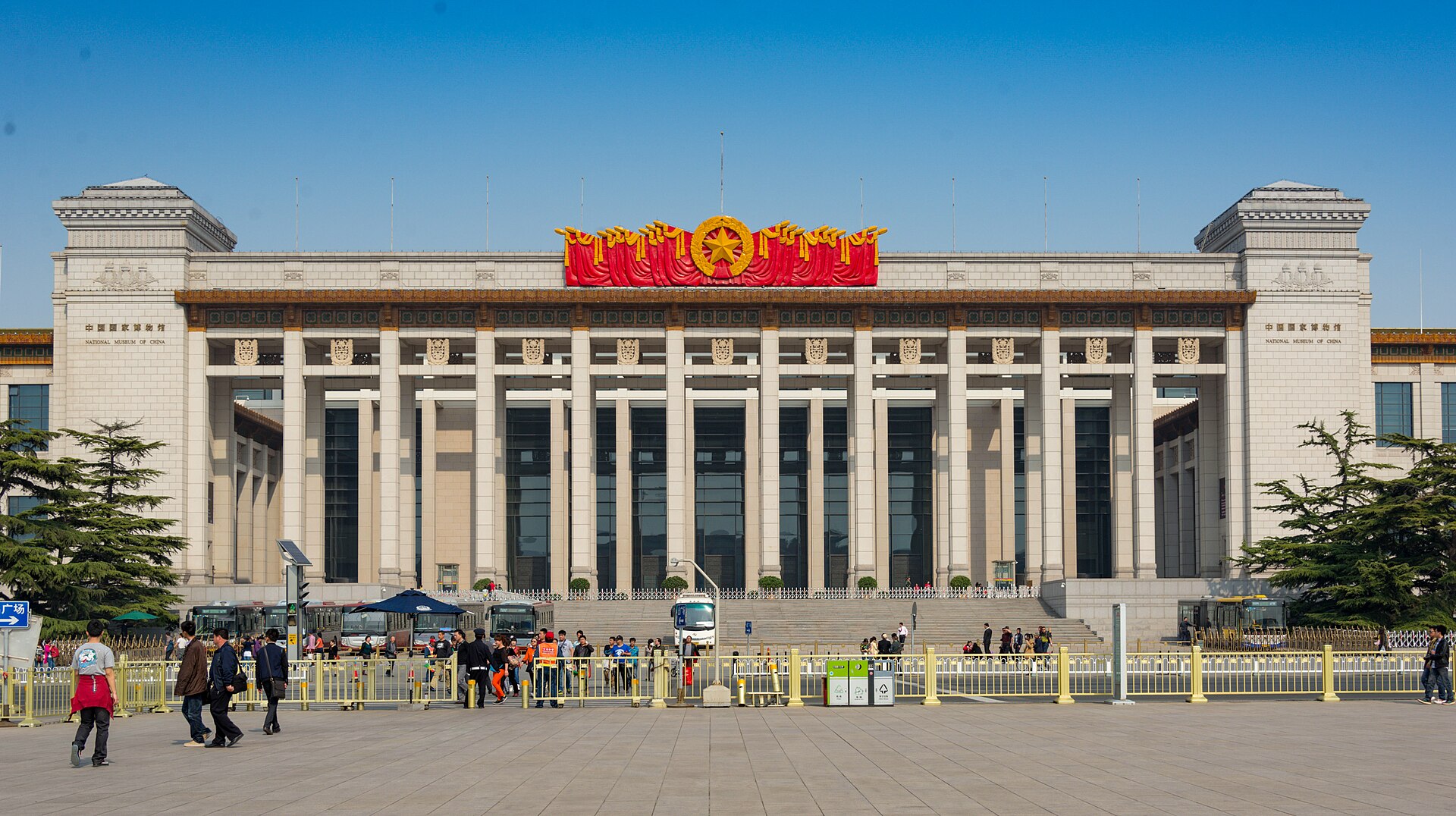
The National Museum of China, located on the eastern side of Tiananmen Square in Beijing, is one of the largest and most visited museums in the world. It was formed in 2003 through the merger of the Museum of the Chinese Revolution and the National Museum of Chinese History, creating a comprehensive institution dedicated to the preservation and exhibition of Chinese arts, history, and culture.
The museum's massive structure, which underwent a significant expansion completed in 2011, covers approximately 200,000 square meters. It houses a vast collection of over 1.4 million items, ranging from ancient artifacts dating back to the Yuanmou Man to contemporary artworks, providing a chronological narrative of Chinese civilization across 48 exhibition halls.
Key Facts
- Materials
- Reinforced concrete, Granite, Glass
- Civilization
- Chinese
- Accessibility
- Fully accessible with elevators and ramps
- Date(s)
- 1959 (original), 2011 (expansion)
- Condition
- Active, well-maintained
- Original Function
- Museum
- Key Figures
- Zhang Kaiji
Founding and Early Development
1959The museum was established as one of the 'Ten Great Buildings' constructed to celebrate the tenth anniversary of the People's Republic of China. It originally operated as two separate entities: the Museum of the Chinese Revolution and the National Museum of Chinese History.
Merger and Expansion
2003-2011In 2003, the two institutions were officially merged into the National Museum of China. Following this, a major architectural renovation and expansion project was launched, led by the German architectural firm Gerkan, Marg and Partners, which significantly increased the floor space and modernized the facilities.
Modern Status
2011-PresentSince its reopening in 2011, the museum has solidified its role as a primary center for national heritage. It hosts major international exhibitions and serves as a key venue for diplomatic cultural exchange, housing artifacts that span over 5,000 years of history.
Cultural Significance
The National Museum of China serves as the primary repository for the nation's historical identity. By housing artifacts that trace the evolution of Chinese society from prehistoric times to the modern era, it plays a critical role in state-sponsored historical education and the promotion of national pride.
Its location on Tiananmen Square underscores its political and symbolic importance. The museum is frequently used to host exhibitions that highlight China's historical continuity and its contributions to global civilization, making it a central pillar of the country's cultural diplomacy.
Interpretive Notes
Scholarly debates and areas of uncertainty
There is ongoing academic discussion regarding the museum's curatorial approach, particularly concerning the balance between archaeological objectivity and the narrative of national identity. Some international scholars have debated the framing of certain historical periods within the museum's permanent exhibitions, noting the influence of contemporary political perspectives on historical interpretation.
Visiting Information
Entry Rules
Admission is free, but visitors must book tickets in advance through the official website or mobile platform using a valid ID or passport. Security screening is mandatory for all visitors upon entry.
Best Times to Visit
Weekday mornings are recommended to avoid the high volume of domestic tour groups. The museum is closed on Mondays.
Photography
Personal photography is permitted in most exhibition halls without the use of flash or tripods. Professional photography requires prior authorization.
Preservation Notes
Maintain a respectful distance from all artifacts. Flash photography is strictly prohibited to prevent light damage to sensitive materials. Large bags must be stored in the provided lockers.
Nearby POIs
11 shown- Chairman Mao Memorial Hall0.4 km
- Zhengyangmen0.6 km
- Forbidden City1.6 km
- National Art Museum of China2.3 km
- Temple of Heaven3.1 km
- Prince Gong's Mansion3.7 km
- Drum Tower and Bell Tower of Beijing4.2 km
- Beijing Temple of Confucius4.7 km
- Yonghe Temple4.8 km
- Capital Museum5.1 km
- Military Museum of the Chinese People's Revolution6.6 km
Sources & Further Reading
- [1]The National Museum of China: A New Landmark — Gerkan, Marg and Partners. Architectural Press (2012)
- [2]Museums and the Construction of National Identity in China — Kirk A. Denton. University of British Columbia Press (2014)
Key Facts
- Materials
- Reinforced concrete, Granite, Glass
- Civilization
- Chinese
- Accessibility
- Fully accessible with elevators and ramps
- Date(s)
- 1959 (original), 2011 (expansion)
- Condition
- Active, well-maintained
- Original Function
- Museum
- Key Figures
- Zhang Kaiji
Nearby POIs
11 shown- Chairman Mao Memorial Hall0.4 km
- Zhengyangmen0.6 km
- Forbidden City1.6 km
- National Art Museum of China2.3 km
- Temple of Heaven3.1 km
- Prince Gong's Mansion3.7 km
- Drum Tower and Bell Tower of Beijing4.2 km
- Beijing Temple of Confucius4.7 km
- Yonghe Temple4.8 km
- Capital Museum5.1 km
- Military Museum of the Chinese People's Revolution6.6 km