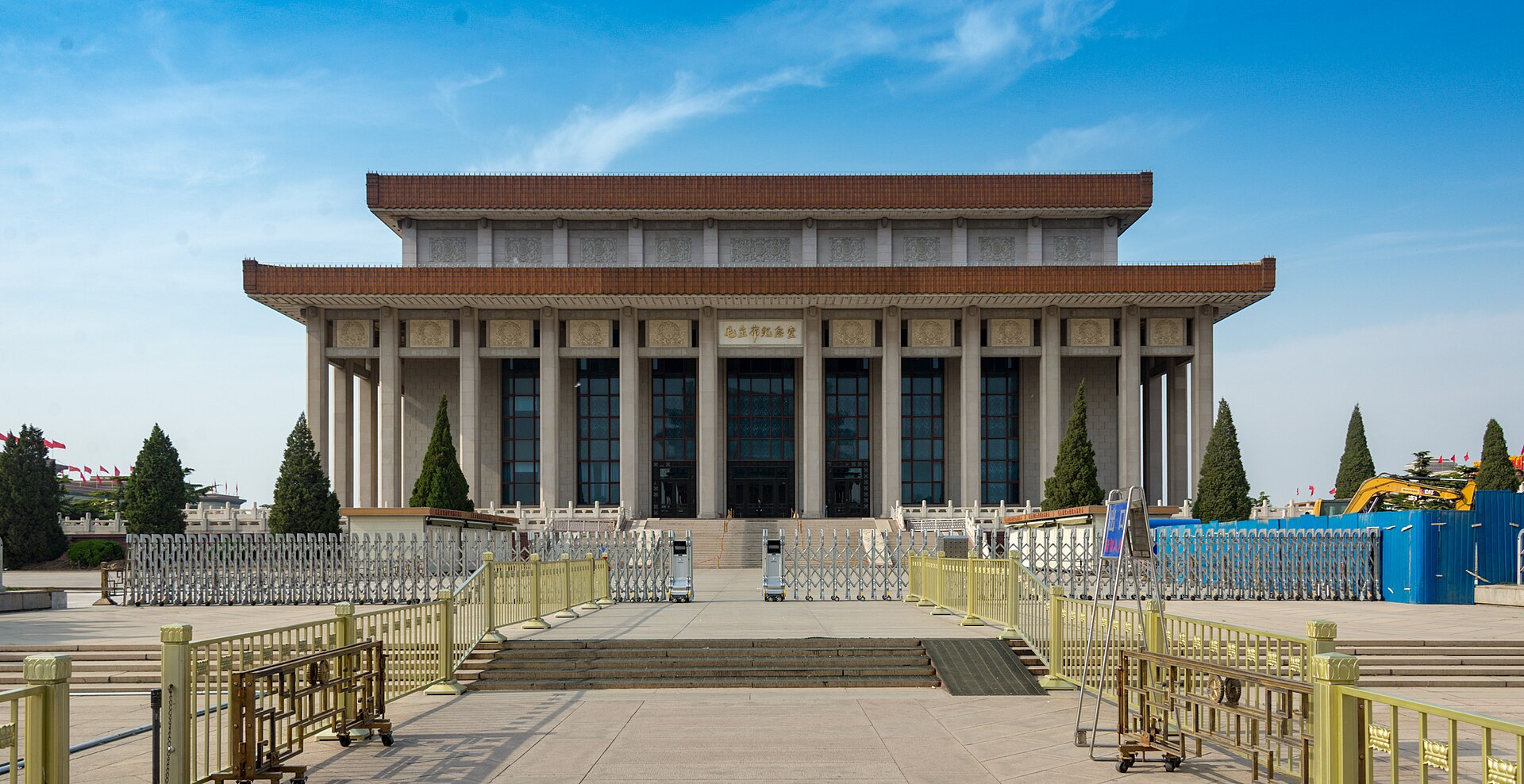
The Chairman Mao Memorial Hall, located at the southern end of Tiananmen Square in Beijing, serves as the final resting place of Mao Zedong, the founding father of the People's Republic of China. Completed in 1977, the structure was built shortly after his death to house his embalmed body, which remains on public display within a crystal sarcophagus.
The building is a prominent example of socialist realist architecture, characterized by its massive, symmetrical design and granite facade. It stands on the site of the former Gate of China, the southern entrance to the Imperial City, and is oriented along the central north-south axis of Beijing, reflecting the symbolic importance of the location in modern Chinese political history.
Key Facts
- Materials
- Granite, Steel, Reinforced concrete
- Civilization
- People's Republic of China
- Accessibility
- Wheelchair accessible; security screening required
- Date(s)
- 1976-1977
- Condition
- Well-maintained, active memorial site
- Original Function
- Mausoleum
- Key Figures
- Mao Zedong, Hua Guofeng
Construction and Inauguration
1976-1977Following the death of Mao Zedong in September 1976, the Central Committee of the Chinese Communist Party decided to construct a memorial hall. Construction began in November 1976 and was completed in May 1977, involving thousands of workers and volunteers from across China.
Political Significance
1977-PresentThe hall has served as a site for state ceremonies and public visitation for decades. It remains a focal point for political pilgrimage, reinforcing the legacy of Mao Zedong within the framework of the Chinese state.
Modern Preservation
21st CenturyThe site continues to undergo periodic maintenance and upgrades to its climate control and security systems to ensure the preservation of the remains and the structural integrity of the hall.
Cultural Significance
The Memorial Hall is a central symbol of modern Chinese political identity. It represents the continuity of the Chinese Communist Party and the enduring influence of Mao Zedong's ideology. For many visitors, it is a site of historical reflection and national reverence.
Interpretive Notes
Scholarly debates and areas of uncertainty
Debates exist regarding the architectural transition from the imperial past to the socialist present, specifically concerning the demolition of the historic Gate of China to make room for the mausoleum. Scholars also discuss the role of the site in the ongoing construction of Mao's historical legacy.
Visiting Information
Entry Rules
Entry is free but requires a valid government-issued ID or passport. Visitors must pass through strict security checks. Large bags, cameras, and mobile phones are prohibited inside the hall and must be stored in lockers nearby.
Best Times to Visit
Early morning on weekdays to avoid the longest queues. The site is closed on Mondays and certain public holidays.
Photography
Photography is strictly prohibited inside the memorial hall. No cameras or recording devices are allowed beyond the security checkpoint.
Preservation Notes
Visitors are expected to maintain a respectful, quiet demeanor. The flow of traffic is strictly managed by security personnel; stopping or lingering in the main hall is not permitted.
Nearby POIs
11 shown- Zhengyangmen0.2 km
- National Museum of China0.4 km
- Forbidden City1.8 km
- National Art Museum of China2.7 km
- Temple of Heaven2.9 km
- Prince Gong's Mansion3.9 km
- Drum Tower and Bell Tower of Beijing4.4 km
- Capital Museum4.8 km
- Beijing Temple of Confucius5.1 km
- Yonghe Temple5.2 km
- Military Museum of the Chinese People's Revolution6.4 km
Sources & Further Reading
- [1]Mao's Mausoleum: The Construction of a Revolutionary Icon — Daniel Leese. Journal of Contemporary China (2011)View
- [2]The Forbidden City and the Construction of Modern Beijing — Wu Hung. University of Chicago Press (2005)
Key Facts
- Materials
- Granite, Steel, Reinforced concrete
- Civilization
- People's Republic of China
- Accessibility
- Wheelchair accessible; security screening required
- Date(s)
- 1976-1977
- Condition
- Well-maintained, active memorial site
- Original Function
- Mausoleum
- Key Figures
- Mao Zedong, Hua Guofeng
Nearby POIs
11 shown- Zhengyangmen0.2 km
- National Museum of China0.4 km
- Forbidden City1.8 km
- National Art Museum of China2.7 km
- Temple of Heaven2.9 km
- Prince Gong's Mansion3.9 km
- Drum Tower and Bell Tower of Beijing4.4 km
- Capital Museum4.8 km
- Beijing Temple of Confucius5.1 km
- Yonghe Temple5.2 km
- Military Museum of the Chinese People's Revolution6.4 km