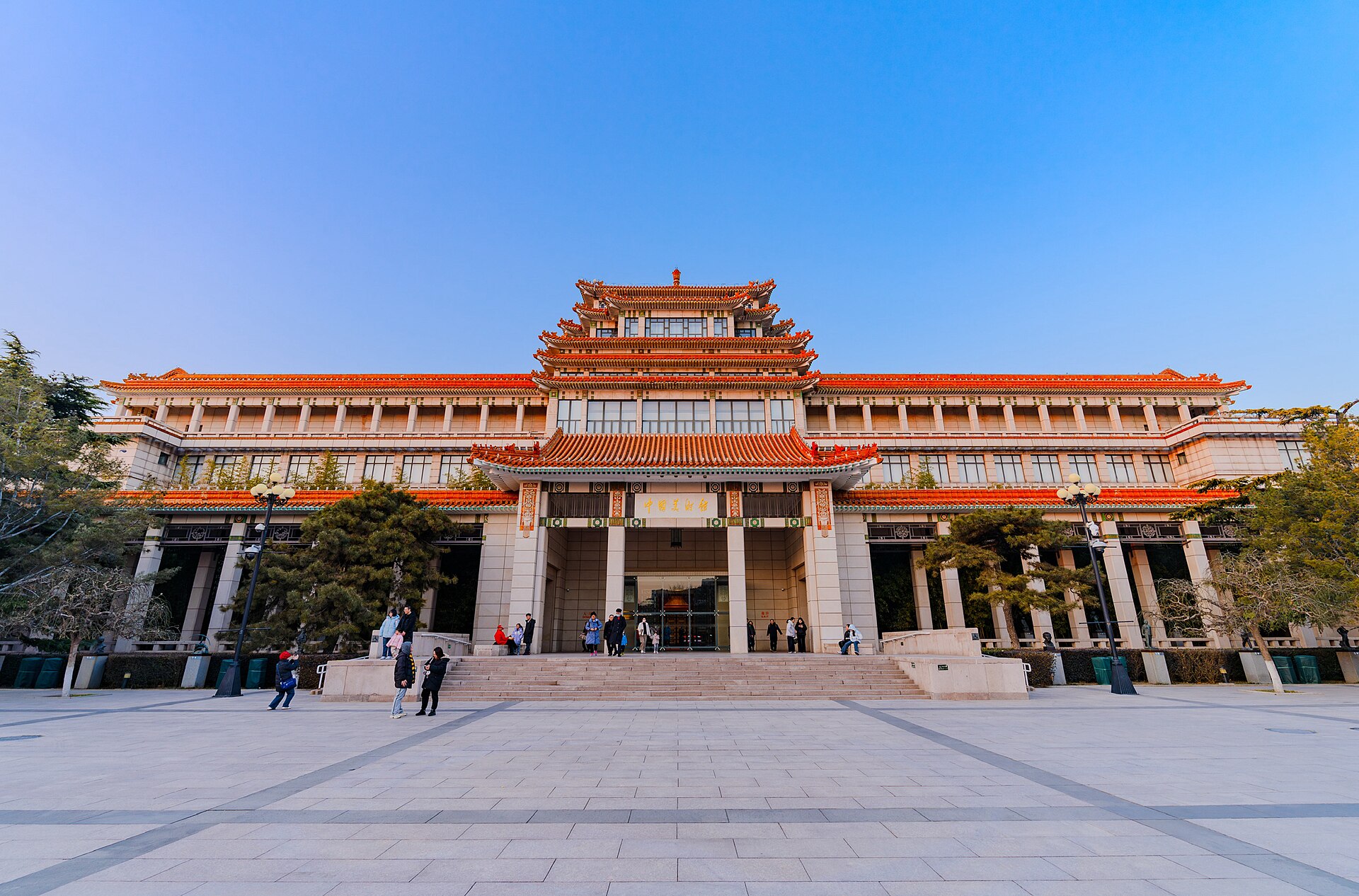
The National Art Museum of China (NAMOC) is the premier state-level art museum in Beijing, dedicated to the collection, research, and exhibition of modern and contemporary Chinese art. Opened in 1963, the museum occupies a significant position in the nation's cultural infrastructure, housing a vast collection that spans traditional Chinese painting, calligraphy, sculpture, and oil painting, alongside significant international works.
The museum's architecture is a notable example of Chinese socialist-style design, featuring a traditional-style roof structure atop a modern concrete frame. It serves as a primary venue for major national art exhibitions and international cultural exchanges, playing a central role in the state's promotion of artistic development and historical preservation.
Key Facts
- Materials
- Reinforced concrete, Glazed tile
- Civilization
- People's Republic of China
- Accessibility
- Wheelchair accessible
- Date(s)
- 1958-1963
- Condition
- Active, well-maintained
- Original Function
- National art gallery and exhibition space
- Key Figures
- Dai Nianci
Establishment
1958-1963The museum was one of the 'Ten Great Buildings' commissioned to celebrate the tenth anniversary of the People's Republic of China. Designed by architect Dai Nianci, the building was completed in 1962 and officially opened to the public in 1963.
Expansion and Renovation
2003-2004The museum underwent a major renovation in 2003 to modernize its facilities and expand its exhibition capacity, ensuring it could accommodate larger international touring exhibitions and better preserve its growing permanent collection.
Contemporary Role
21st CenturyToday, the museum continues to serve as the primary institution for the study of 20th-century Chinese art, while also hosting high-profile international exhibitions that facilitate cultural dialogue between China and the global art community.
Cultural Significance
NAMOC is central to the Chinese state's cultural identity, serving as the primary repository for the nation's modern artistic heritage. It acts as a bridge between traditional aesthetic values and the evolving contemporary art scene, influencing national standards for art education and historical curation.
Interpretive Notes
Scholarly debates and areas of uncertainty
There is ongoing academic discussion regarding the museum's curatorial focus, specifically the balance between state-sanctioned 'mainstream' art and the inclusion of more experimental or avant-garde contemporary works. Scholars often debate how the museum's collection policies reflect shifting political priorities in the interpretation of Chinese art history.
Visiting Information
Entry Rules
Admission is free, but visitors must reserve tickets in advance via the official website or WeChat mini-program. A valid government-issued ID or passport is required for entry. Security screening is mandatory for all visitors.
Best Times to Visit
Weekday mornings are recommended to avoid large crowds. The museum is closed on Mondays.
Photography
Non-commercial photography is generally permitted in permanent collection galleries without flash or tripods. Specific temporary exhibitions may prohibit photography entirely.
Preservation Notes
Maintain a respectful distance from all artworks. Do not touch displays or use flash photography, as light sensitivity is a concern for many of the traditional ink-on-paper works.
Nearby POIs
11 shown- Forbidden City1.2 km
- Drum Tower and Bell Tower of Beijing2.2 km
- National Museum of China2.3 km
- Prince Gong's Mansion2.3 km
- Beijing Temple of Confucius2.4 km
- Yonghe Temple2.5 km
- Chairman Mao Memorial Hall2.7 km
- Zhengyangmen2.9 km
- Temple of Heaven5.2 km
- Capital Museum6.1 km
- Military Museum of the Chinese People's Revolution7.5 km
Sources & Further Reading
- [1]The National Art Museum of China: A History — Fan Di'an. Beijing Fine Arts Publishing House (2013)
- [2]Modern Chinese Art and the State — Julia F. Andrews. University of California Press (1994)
Key Facts
- Materials
- Reinforced concrete, Glazed tile
- Civilization
- People's Republic of China
- Accessibility
- Wheelchair accessible
- Date(s)
- 1958-1963
- Condition
- Active, well-maintained
- Original Function
- National art gallery and exhibition space
- Key Figures
- Dai Nianci
Nearby POIs
11 shown- Forbidden City1.2 km
- Drum Tower and Bell Tower of Beijing2.2 km
- National Museum of China2.3 km
- Prince Gong's Mansion2.3 km
- Beijing Temple of Confucius2.4 km
- Yonghe Temple2.5 km
- Chairman Mao Memorial Hall2.7 km
- Zhengyangmen2.9 km
- Temple of Heaven5.2 km
- Capital Museum6.1 km
- Military Museum of the Chinese People's Revolution7.5 km