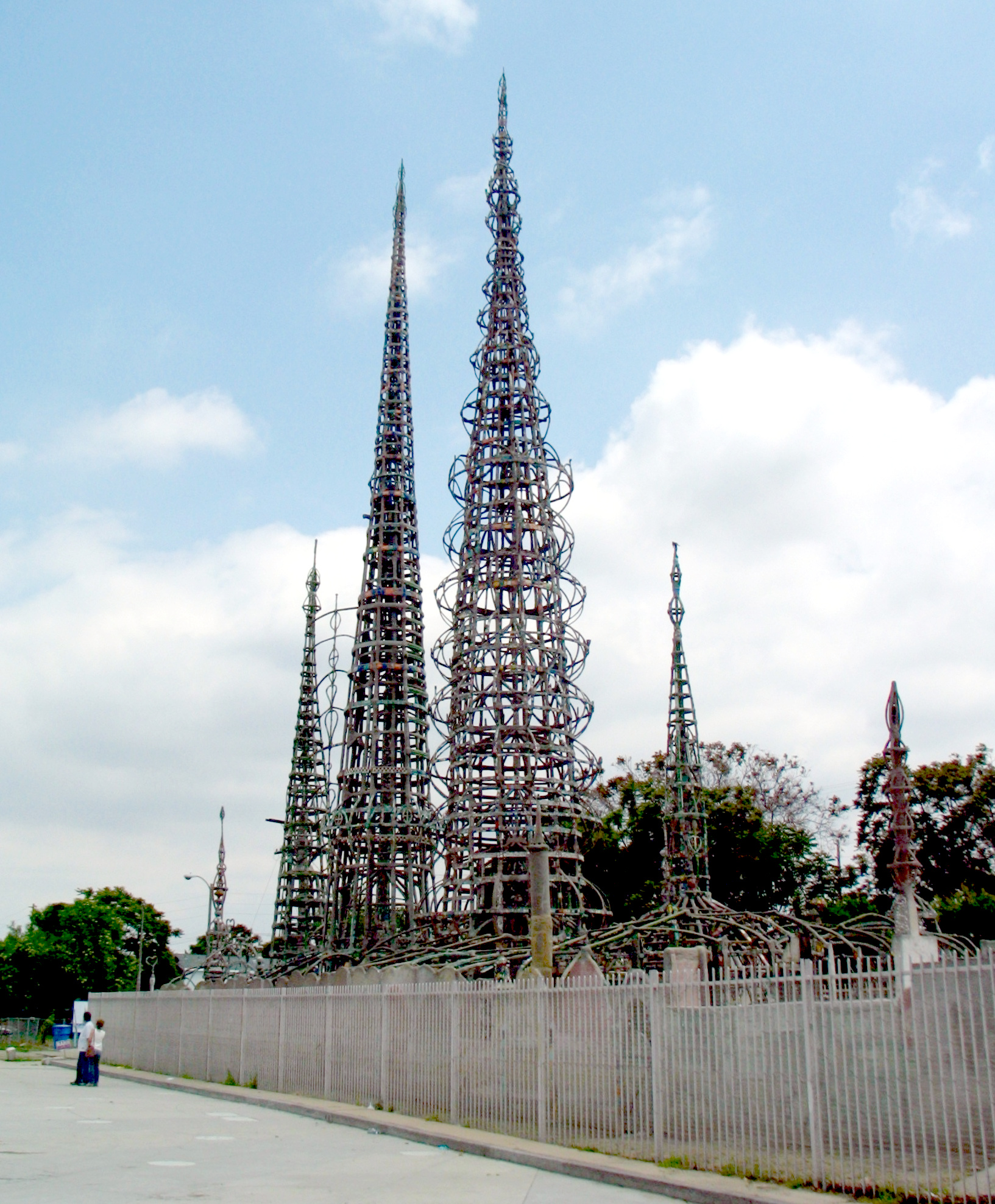
The Watts Towers, also known as 'Nuestro Pueblo,' are a collection of 17 interconnected sculptural towers, architectural structures, and mosaics located in the Watts district of Los Angeles. Constructed by Italian immigrant Sabato 'Simon' Rodia between 1921 and 1954, the structures reach heights of up to 99 feet and were built entirely by hand without the use of scaffolding, bolts, or rivets.
The towers are constructed from steel rebar and wire mesh, covered in mortar, and embedded with a diverse array of found materials including sea shells, pottery shards, glass bottles, and ceramic tiles. The site represents a significant example of outsider art and folk architecture, reflecting Rodia's singular vision and dedication over three decades of solitary labor.
Key Facts
- Materials
- Steel rebar, Wire mesh, Mortar, Sea shells, Ceramic tiles, Glass
- Civilization
- American
- Accessibility
- Guided tours required for interior access
- Date(s)
- 1921-1954
- Condition
- Preserved as a historic landmark
- Original Function
- Private residential art project
- Key Figures
- Sabato 'Simon' Rodia
Construction Period
1921-1954Simon Rodia spent 33 years building the structures on his residential property. He worked alone, using a window-washer's belt and simple hand tools to climb the structures as they grew in height.
Abandonment and Preservation
1954-1959Rodia deeded the property to a neighbor and moved away in 1954. The site faced potential demolition by the city in 1959, but a group of artists and community members formed the Committee for Simon Rodia's Towers in Watts to save the structures.
Landmark Status
1960s-PresentThe towers were designated a National Historic Landmark in 1977. Today, the site is managed by the City of Los Angeles Department of Cultural Affairs and serves as a focal point for community arts education.
Cultural Significance
The Watts Towers serve as a powerful symbol of resilience and individual creativity within the Los Angeles landscape. They are widely recognized as a masterpiece of folk art, demonstrating how discarded materials can be transformed into monumental public art. The site has become deeply embedded in the identity of the Watts community, representing both the history of immigrant labor and the potential for art to foster social cohesion.
Beyond their artistic value, the towers are a focal point for discussions regarding the preservation of non-traditional architecture. Their survival against urban development pressures has made them a touchstone for historic preservationists advocating for the protection of cultural sites that fall outside the canon of institutional architecture.
Interpretive Notes
Scholarly debates and areas of uncertainty
Debates often center on the classification of the site, specifically whether it should be categorized as 'outsider art,' 'folk art,' or 'visionary architecture.' Scholars also discuss the ethics of conservation, particularly how to maintain the structural integrity of the towers without compromising the original, idiosyncratic aesthetic created by Rodia.
Visiting Information
Entry Rules
The site is accessible via guided tours only. Visitors must check in at the Watts Towers Arts Center campus. Tours are subject to weather conditions and staff availability.
Best Times to Visit
Weekend mornings are recommended for guided tours. The site is best viewed during daylight hours to appreciate the intricate mosaic details.
Photography
Personal photography is permitted from outside the perimeter fence. Professional or commercial photography requires a permit from the City of Los Angeles.
Preservation Notes
The structures are fragile; visitors must remain on designated paths and are strictly prohibited from touching the towers or the mosaic surfaces.
Nearby POIs
11 shown- California Science Center9.4 km
- Natural History Museum of Los Angeles County9.6 km
- Grammy Museum11.9 km
- Japanese American National Museum12.2 km
- The Broad12.8 km
- George C. Page Museum17.3 km
- La Brea Tar Pits17.3 km
- Petersen Automotive Museum17.5 km
- Los Angeles County Museum of Art17.6 km
- Academy Museum of Motion Pictures17.6 km
- Hollywood Museum20 km
Sources & Further Reading
- [1]
- [2]The Watts Towers of Los Angeles — Jeanne Morgan. Journal of Popular Culture (1972)
Key Facts
- Materials
- Steel rebar, Wire mesh, Mortar, Sea shells, Ceramic tiles, Glass
- Civilization
- American
- Accessibility
- Guided tours required for interior access
- Date(s)
- 1921-1954
- Condition
- Preserved as a historic landmark
- Original Function
- Private residential art project
- Key Figures
- Sabato 'Simon' Rodia
Nearby POIs
11 shown- California Science Center9.4 km
- Natural History Museum of Los Angeles County9.6 km
- Grammy Museum11.9 km
- Japanese American National Museum12.2 km
- The Broad12.8 km
- George C. Page Museum17.3 km
- La Brea Tar Pits17.3 km
- Petersen Automotive Museum17.5 km
- Los Angeles County Museum of Art17.6 km
- Academy Museum of Motion Pictures17.6 km
- Hollywood Museum20 km