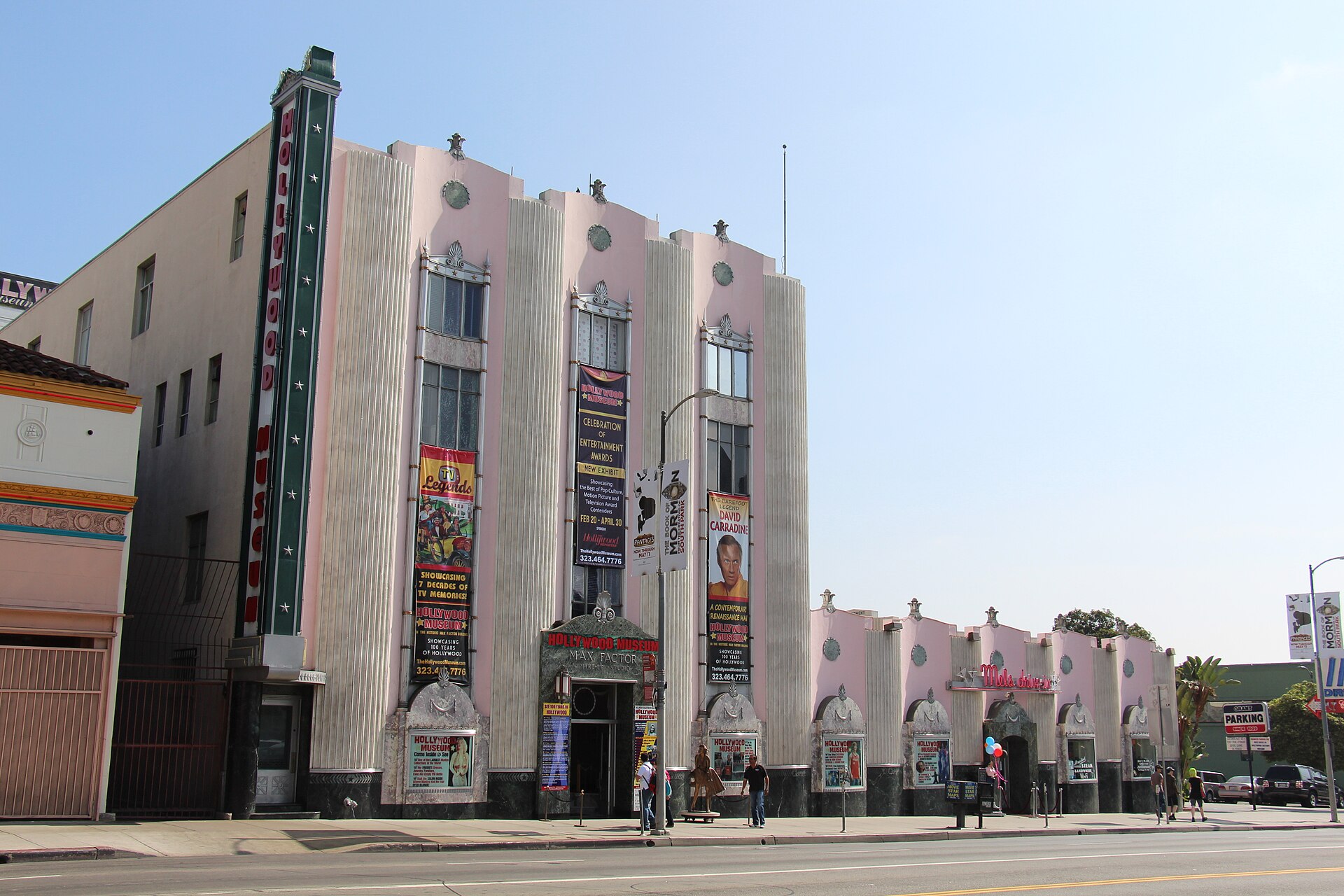
The Hollywood Museum is located in the historic Max Factor Building in Los Angeles, California. It houses an extensive collection of memorabilia spanning the history of American motion pictures and television, featuring over 10,000 items including costumes, props, photographs, scripts, and vintage film equipment.
The museum occupies the former headquarters of Max Factor, where the famous makeup artist created the 'looks' for Hollywood icons such as Marilyn Monroe, Judy Garland, and Lucille Ball. The building itself is a registered historic landmark, preserving the original makeup rooms and studio offices where much of Hollywood's aesthetic history was defined.
Key Facts
- Materials
- Reinforced concrete, Stucco, Glass
- Civilization
- American
- Accessibility
- Wheelchair accessible
- Date(s)
- 1928
- Condition
- Well-preserved and active museum
- Original Function
- Max Factor Cosmetics Headquarters and Studio
- Key Figures
- Max Factor, Marilyn Monroe, Lucille Ball
The Max Factor Era
1928-1970sThe building was commissioned by Max Factor to serve as his primary studio and laboratory. It became the epicenter of Hollywood makeup artistry, featuring specialized rooms designed for different hair colors and skin tones of the era's biggest stars.
Preservation and Conversion
1990s-2000sFollowing the decline of the original cosmetics company's operations in the building, the structure underwent significant restoration to preserve its Art Deco architecture. It was eventually repurposed to house the extensive private collection of Donelle Dadigan.
Establishment as a Museum
2003-PresentThe Hollywood Museum officially opened to the public in 2003. It has since expanded its collection to include modern television artifacts and rotating exhibits dedicated to specific genres, such as horror and classic cinema.
Cultural Significance
The museum serves as a repository for the material culture of the entertainment industry, bridging the gap between the technical craft of makeup artistry and the broader history of film production. It acts as a site of memory for the 'Golden Age' of Hollywood, allowing visitors to engage with the physical artifacts that defined the visual identity of 20th-century American media.
Interpretive Notes
Scholarly debates and areas of uncertainty
There is ongoing discussion among film historians regarding the balance between the museum's role as a commercial tourist attraction and its function as an archival institution. Debates often center on the preservation of ephemeral props versus the need for public display and the impact of private ownership on the accessibility of film history.
Visiting Information
Entry Rules
Open Wednesday through Sunday. Tickets can be purchased at the door or online. Visitors are encouraged to check the official website for holiday closures and special event schedules.
Best Times to Visit
Weekday mornings are generally less crowded, allowing for a more thorough viewing of the multi-floor exhibits. The museum is climate-controlled, making it a comfortable destination year-round.
Photography
Personal photography is permitted in most areas of the museum. Flash photography and the use of tripods are prohibited to protect the integrity of the artifacts.
Preservation Notes
Many of the costumes and paper artifacts are sensitive to light and humidity. Visitors are asked to refrain from touching displays and to maintain a respectful distance from the exhibits.
Nearby POIs
11 shown- Hollywood Wax Museum0.1 km
- Hollywood Walk of Fame0.2 km
- Griffith Observatory4 km
- George C. Page Museum4.5 km
- La Brea Tar Pits4.5 km
- Los Angeles County Museum of Art4.6 km
- Academy Museum of Motion Pictures4.6 km
- Petersen Automotive Museum4.8 km
- Grammy Museum9.3 km
- The Broad9.6 km
- Natural History Museum of Los Angeles County10.4 km
Sources & Further Reading
- [1]The Max Factor Building: A History of Hollywood Glamour — Los Angeles Conservancy. LA Conservancy Archives (2015)View
- [2]Hollywood's Museum of History — Museum Association of California. California History Journal (2019)
Key Facts
- Materials
- Reinforced concrete, Stucco, Glass
- Civilization
- American
- Accessibility
- Wheelchair accessible
- Date(s)
- 1928
- Condition
- Well-preserved and active museum
- Original Function
- Max Factor Cosmetics Headquarters and Studio
- Key Figures
- Max Factor, Marilyn Monroe, Lucille Ball
Nearby POIs
11 shown- Hollywood Wax Museum0.1 km
- Hollywood Walk of Fame0.2 km
- Griffith Observatory4 km
- George C. Page Museum4.5 km
- La Brea Tar Pits4.5 km
- Los Angeles County Museum of Art4.6 km
- Academy Museum of Motion Pictures4.6 km
- Petersen Automotive Museum4.8 km
- Grammy Museum9.3 km
- The Broad9.6 km
- Natural History Museum of Los Angeles County10.4 km